Publication of Paper on Photon-Based Chips
Topic Also Being Researched in the US, UK, and Other Countries
As the Biden administration tightens AI semiconductor regulations targeting China, a claim has emerged from a Chinese university about developing a chip that is 3,000 times superior to Nvidia's AI chips, drawing significant attention.
According to the Hong Kong South China Morning Post (SCMP) on the 2nd, researchers at Tsinghua University in China published a paper in the international academic journal Nature at the end of last month stating that they developed the ACCEL chip, which has a computing speed 3,000 times faster and energy consumption 4 million times lower than Nvidia's AI semiconductor A100.
The ACCEL chip developed by the research team recorded a computing speed of 4.6 petaflops (PFlops) in laboratory conditions. One petaflop (PF) is a speed capable of performing one quadrillion operations per second. The computing speed of the ACCEL chip is about 3,000 times faster than Nvidia's A100 graphics processing unit (GPU).
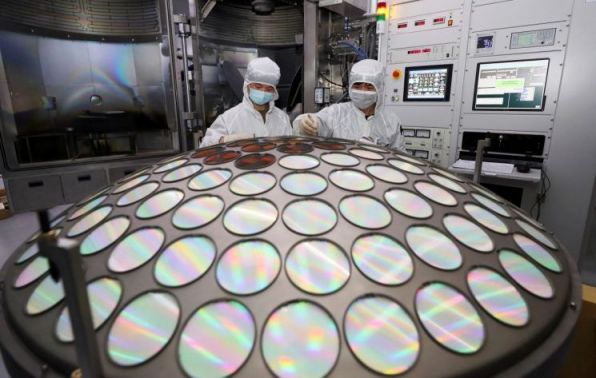 Chinese Semiconductor Industry. Photo is not related to any specific expression in the article. [Image source=Reuters Yonhap News]
Moreover, the researchers emphasized that the power efficiency of the ACCEL chip improved 400 times compared to the A100. Currently, ACCEL can only be used in limited areas such as high-resolution image recognition and traffic identification, but the researchers claim that "it will soon be used in wearable devices, electric vehicles, and smart factories."
The chip is reported to have been manufactured by China's semiconductor foundry SMIC using traditional transistor manufacturing processes.
So how were the Tsinghua University researchers able to design a chip superior to the best existing AI GPUs? According to the paper, ACCEL is a photon-based chip rather than a conventional electron-based computer chip.
Typically, computer chips operate by electrons moving through fine circuits inside silicon to activate transistors. However, using photons instead of electrons can achieve much higher computing speeds with significantly less energy.
Unlike electrons, photons have no mass, so unnecessary energy and information loss caused by friction while passing through circuits is virtually zero.
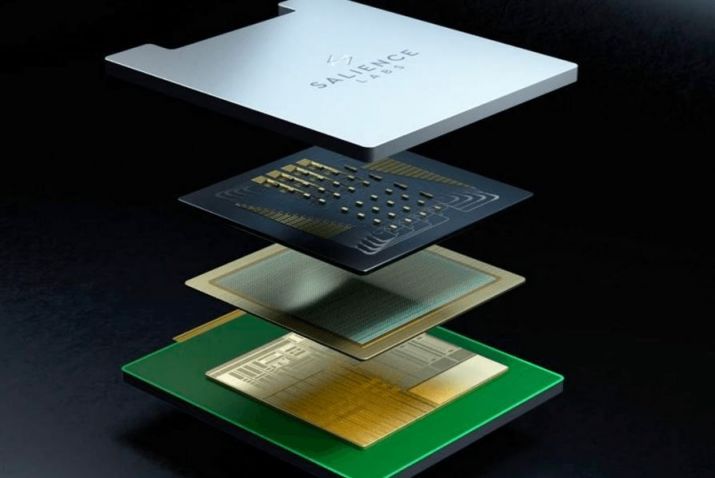 Photon AI chip developed by the Oxford University alumnus startup 'Salience Labs'. There are several startups creating photonic-based semiconductors, mainly in advanced semiconductor design countries such as the United States and the United Kingdom.
 [Image source=Salience Labs]
In fact, the idea of a 'photon-based AI chip' is not original. Many companies, mainly startups in the US and UK, have already begun developing photon-based AI chips, and some have developed prototype chips and are conducting tests, showing considerable progress.
However, it is still known that the era when photon semiconductors will replace electron semiconductors is far off. There are no cases of mass production of photon chips yet, and the technology to stably implement photon circuits remains incomplete.
© The Asia Business Daily(www.asiae.co.kr). All rights reserved.
![Clutching a Stolen Dior Bag, Saying "I Hate Being Poor but Real"... The Grotesque Con of a "Human Knockoff" [Slate]](https://cwcontent.asiae.co.kr/asiaresize/183/2026021902243444107_1771435474.jpg)

















