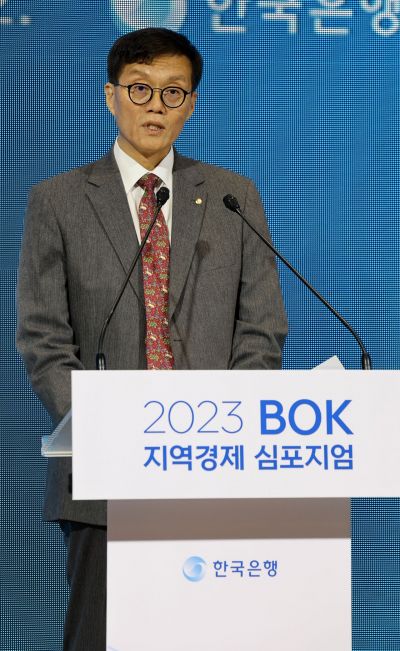
 On the 2nd, at the newly constructed integrated annex of the Bank of Korea, Lee Chang-yong, Governor of the Bank of Korea, delivered a greeting at the '2023 BOK Regional Economy Symposium' hosted by the Bank of Korea. Photo by Heo Young-han younghan@
Lee Chang-yong, Governor of the Bank of Korea, emphasized on the 2nd that alleviating the excessive concentration of population and economy in Seoul and the metropolitan area greatly contributes to the central bank's roles of price stability and financial stability.
Governor Lee made these remarks during his welcoming speech at the 'BOK Regional Economy Symposium' held at the Bank of Korea headquarters in Seoul, explaining the purpose of hosting the symposium to jointly consider regional economic issues and policy alternatives.
He said, "One of the things I have felt while serving as the Governor of the Bank of Korea is that mitigating regional imbalances and promoting stable growth of regional economies greatly helps in fulfilling the central bank's duties of price stability and financial stability."
He added, "It may be natural for economic conditions to differ by region, but if the degree is excessive, economic agents may experience significantly differentiated conditions in terms of economy, prices, and finance across regions due to the effects of monetary credit policy and fiscal policy. In such an environment, the central bank will face difficulties in forming national consensus and consistently implementing monetary credit policy."
Governor Lee stated, "In a situation where regional communities face pressing challenges such as balanced regional development, regional extinction, and deterioration of local finances, it is more urgent than ever to promptly grasp regional conditions through expanded regional statistics and prepare appropriate countermeasures."
He continued, "The Bank of Korea will continue to cooperate with Statistics Korea, which has contributed greatly to regional development through the development of various regional statistics such as Gross Regional Domestic Product (GRDP), striving to enhance consistency between Gross Domestic Product (GDP) and GRDP to create mutual synergy effects. Along with this, we will also make continuous efforts in regional economic analysis based on regional statistics and big data," he emphasized.
Governor Lee also mentioned the need to respond to structural issues such as low birth rates and regional population crises.
He said, "Our country’s low birth rate problem is becoming increasingly serious. It would be beneficial to examine how the population crisis caused by low birth rates, aging, and concentration of population in the metropolitan area is impacting regional economies, and based on this, consider appropriate policy responses."
Meanwhile, Jeong Min-su, Deputy Director of the Regional Economy Research Team at the Bank of Korea’s Research Department, presented a report at the forum emphasizing the need for 'selection and concentration' support centered on key cities in each region to curb the concentration of the domestic population in the metropolitan area.
This drew attention as it somewhat conflicts with the ruling party’s recent 'Mega Seoul' plan. The People Power Party decided on the 30th of last month to pursue incorporating Gimpo City into Seoul as a party policy.
© The Asia Business Daily(www.asiae.co.kr). All rights reserved.

















