Startup Alliance and Open Survey Announce 'Startup Trend Report 2023'
Startup founders rated this year's startup ecosystem at less than 50 points out of 100. This is lower than last year's approximately 54 points, when the atmosphere was dampened by investment contraction and economic recession.
Startup Alliance and Open Survey announced the 'Startup Trend Report 2023' containing these details on the 2nd. The Startup Trend Report is a survey jointly conducted by Startup Alliance and Open Survey since 2014 to understand trends in the startup industry, including founders and employees.
This survey was conducted over nine days from September 5 to 13 through Open Survey and Remember to grasp the perceptions and realities of participants in the domestic startup ecosystem. A total of 200 founders, 250 employees from large corporations, 250 startup employees, and 200 job seekers participated in the survey.
Founders Rate This Year’s Startup Ecosystem at 46.51 Points
According to this report, founders evaluated the startup ecosystem atmosphere this year at '46.5 points.' This is a decrease of 7.2 points compared to last year. 76.5% of founders felt that the startup ecosystem atmosphere had 'negatively changed' compared to last year. Only 9% of founders responded that the startup ecosystem had positively changed compared to one year ago. This atmosphere does not seem likely to change easily. Due to heightened perceptions of economic recession and interest rate hikes, 45.0% of founders predicted that the startup ecosystem atmosphere would 'hardly change' in 2024.
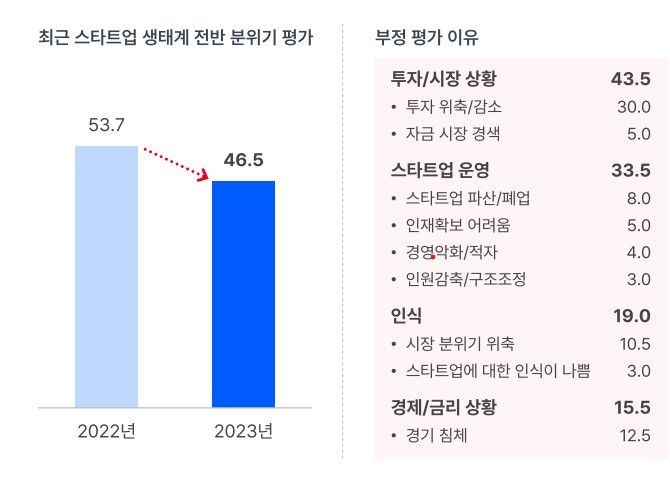
The biggest reason founders felt the startup ecosystem had negatively changed was 'lukewarm investment and support from venture capital (58.8%).' Eight out of ten founders felt that the startup investment market had contracted this year compared to last year. Among founders, 63.0% answered that it had actually become more difficult to attract investment compared to last year.
To address this, founders answered that they would focus on 'establishing diversified sales strategies (54.0%).' This was followed by 'focusing on profitable businesses (51.0%),' 'reducing company expenses (46.5%),' and 'pursuing government support projects (43.0%).' In the same question last year, 'reducing company expenses' was most frequently chosen as a countermeasure against the investment winter, but this year it seems that founders are focusing on setting business strategies to strengthen their companies internally.
Preferred Investors and Institutions Are ‘Naver, Google Campus, Primer, Altos Ventures'
When asked which companies are most active in supporting startups, founders most frequently chose Naver at 25.5%. This was followed by Kakao at 20.5% and Samsung at 10.5%. Compared to last year, preferences for POSCO and GS slightly increased, and NCSoft newly entered the list.
The startup support center most desired for residency and utilization was Google Startup Campus, with 21.5% of first-choice responses. Next were Seoul Startup Hub (9.5%) and Asan Nanum Foundation Maru180 (7.5%), ranking within the top three.
The most preferred accelerator was Primer (9.5%), continuing from last year. FuturePlay (8.5%) and SparkLabs (8.5%) tied for second place. The Ventures (5.5%), Sopung Ventures, and Mashup Angels (5.0%) were also mentioned.
When asked about the most preferred venture capital (VC), Altos Ventures ranked first with 16.0%. This was followed by KB Investment (8.0%), SoftBank Ventures (7.5%), Mirae Asset Venture Investment (4.5%), and Korea Investment Partners and Bon Angels Venture Partners (4.0%). The most preferred corporate venture capitals (CVC) were Kakao Ventures (15.5%) and Naver D2SF (10.0%).
The government’s role was rated at 52.5 points, down 9.6 points from 62.1 points last year. Especially, founders with more than six years of experience rated the government’s role relatively lower. The most helpful government policy was 'business expense support such as TIPS (50.0%).' Founders identified the urgent government improvement task as 'securing ecosystem-based funds and revitalizing investment (29.5%).'
Startup Alliance stated, "Although the startup ecosystem evaluation is quite rigid due to economic recession and interest rate hikes, startups themselves are overcoming this situation by focusing on sales diversification and profitable businesses." They added, "As founders seek solutions in overseas markets, we hope that the government, investors, and support organizations will work together to find new opportunities and create new possibilities through this."
© The Asia Business Daily(www.asiae.co.kr). All rights reserved.
![Clutching a Stolen Dior Bag, Saying "I Hate Being Poor but Real"... The Grotesque Con of a "Human Knockoff" [Slate]](https://cwcontent.asiae.co.kr/asiaresize/183/2026021902243444107_1771435474.jpg)
















