Supplementary Budget of 13 Trillion Yen Including Price Measures, Investment Promotion, and Tax Cuts
Low Public Support for Policies
Rebound of Plummeting Approval Ratings Seems Difficult
Japanese Prime Minister Fumio Kishida (LDP President) is reported by foreign media to pour 21.8 trillion yen (approximately 194.7873 trillion won) into the new economic policy announced last month. As his approval rating fell to an all-time low, signaling a red light on his path to reappointment, analysts suggest he is seeking a breakthrough with a large-scale economic stimulus package.
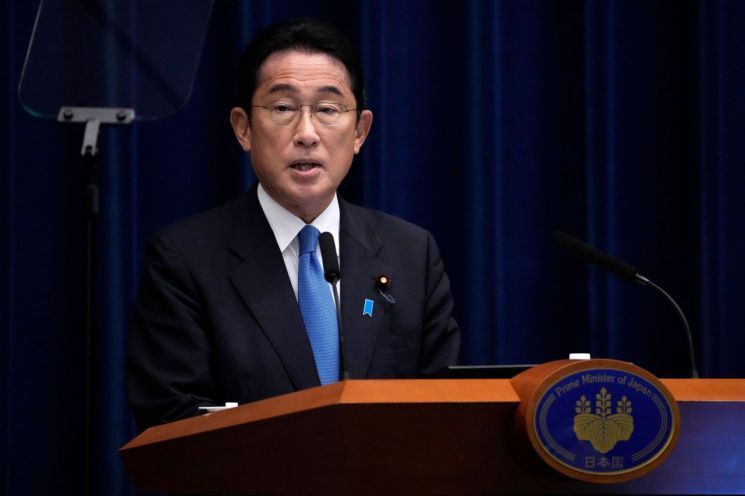
Bloomberg reported on the 1st that the Kishida Cabinet plans to set the budget for the new economic policy announced last month at 21.8 trillion yen. The supplementary budget for this is expected to be organized at 13.1 trillion yen. Including income tax cuts and subsidy-related budgets, the supplementary budget is expected to swell to 17 trillion yen.
Specifically, the supplementary budget is expected to allocate 2.7 trillion yen for inflation countermeasures, 3.4 trillion yen for investment promotion measures, and 1.3 trillion yen for policies to raise wages and revitalize local economies. Disaster prevention measures for low birth rates and public safety are expected to be allocated 1.3 trillion yen and 4.3 trillion yen respectively. A budget of 1.1 trillion yen has been allocated for fixed-amount tax cuts, reducing income tax and resident tax by 30,000 yen and 10,000 yen per person respectively. Including private sector spending, Bloomberg reported that the total scale of the Kishida Cabinet’s economic stimulus projects will expand to 37.4 trillion yen.
According to Jiji Press, after deciding on the new economic measures at the Cabinet meeting on the day, Prime Minister Kishida will explain the contents of the economic measures including income tax cuts and the supplementary budget for fiscal year 2023 at a press conference.
The Kishida Cabinet appears to have introduced a large-scale economic stimulus policy to raise its approval rating. Last month, the Cabinet’s approval rating recorded 25% according to Mainichi, marking the lowest since the Cabinet reshuffle launched in October 2021. The ruling party, the LDP, had a support rate of only 23%. In Japanese politics, it is considered a signal that regime maintenance is impossible if the combined approval rating of the ruling party and coalition falls below 50%.
Especially, despite the Cabinet reshuffle last month, the approval rating continued to decline, leading to speculation within the party that Prime Minister Kishida will find it difficult to dissolve the House of Representatives within the year. Until now, there was a scenario in political circles that Kishida might seek a rebound in approval ratings through new economic policies and then dissolve the House of Representatives within the year. However, with the approval rating falling, the certainty of the Prime Minister’s reappointment has become uncertain.
However, there is growing weight to the view that it will be difficult to raise the declining approval rating with a 21 trillion yen economic stimulus package. Public opinion is not showing strong support for the Kishida Cabinet’s economic policies. According to a public opinion poll conducted last week by Nihon Keizai Shimbun, 58% of respondents said they do not have positive expectations for Prime Minister Kishida’s economic stimulus policies.
Voices expressing dissatisfaction with the massive budget allocation are also emerging. Asahi Shimbun pointed out, “Although the supplementary budget for the new economic measures plans to utilize a reduction of 2.5 trillion yen from contingency funds, most of the funding will be covered through government bond issuance,” and warned, “There are concerns that fiscal deterioration will accelerate.”
© The Asia Business Daily(www.asiae.co.kr). All rights reserved.

















