Release of the 3rd Discharge Started at 10:30 AM
Debris Removal Work "Postponed Without Even Starting"
As Tokyo Electric Power Company (TEPCO) in Japan plans to begin the third phase of contaminated water discharge into the ocean on the 2nd, the removal work of the 'nuclear fuel debris (debris)'?the actual cause of the contaminated water?has entered its third delay. Critics point out that there is still a long way to go before the final goal of decommissioning the nuclear power plant, which is the ultimate objective of the Fukushima accident cleanup.
On the 2nd, TEPCO announced that if there are no issues with weather conditions, it will start operating the contaminated water transfer pump around 10:30 a.m. to commence the third phase of ocean discharge. Like the first and second phases, the third discharge will proceed over 17 days, releasing approximately 7,800 tons of contaminated water.
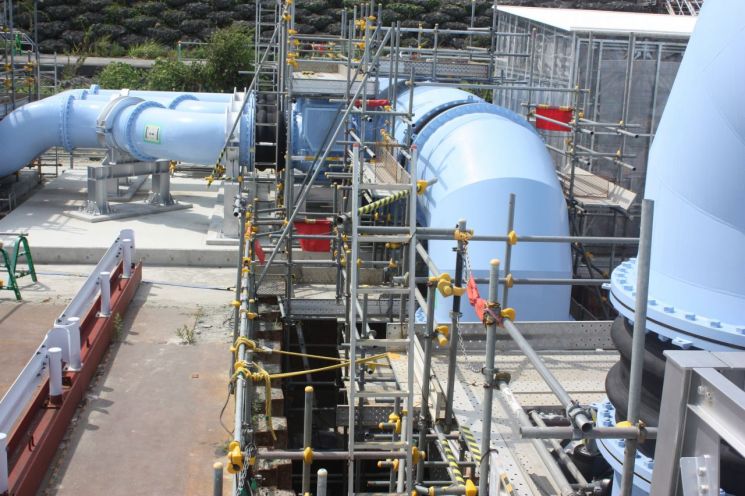
However, the timeline related to the decommissioning of the nuclear power plant, which fundamentally resolves the contaminated water discharge, has become difficult to predict.
The Nihon Keizai Shimbun (Nikkei) reported that the plan to remove debris inside the Fukushima Daiichi Nuclear Power Plant is undergoing a review process. The inside of the cover leading to the reactor is blocked by sediment, making it impossible to extract debris from inside the containment vessel.
Debris refers to material formed when melted nuclear fuel in the reactor fuses with surrounding metal or concrete. It emits extremely high levels of radiation, preventing workers from approaching. Remote operation is the only method to remove it.
The Japanese government and TEPCO initially planned to start debris removal work in 2021 but postponed it twice due to delays in device development. They announced plans to begin debris extraction by the end of this year, but since the reactor is blocked and machines cannot reach the containment vessel, it is highly likely that this will be delayed again. Nikkei expressed concern, stating, "If the path to decommissioning is blocked even at this early stage, it will inevitably become increasingly uncertain."
On October 16th last month, TEPCO workers used a remotely operated robot to open the reactor lid of Unit 2 at Fukushima Daiichi to extract debris. However, Nikkei reported that the inside was blocked by sediment such as melted electrical cables, making it impossible to even see inside the reactor.
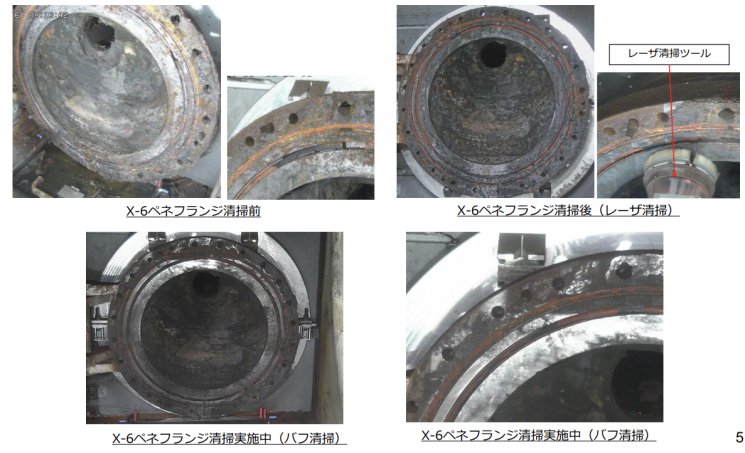 The appearance of the reactor lid section scheduled for sediment removal work. (Photo by IRID report)
TEPCO originally planned to insert a robotic arm into a 55 cm diameter hole leading into the reactor and gradually scrape the debris with a metal brush. The robotic arm, 22 meters long and made of high-strength stainless steel, was developed by a British company. It was designed to withstand a cumulative radiation dose of 1 million Sv without malfunctioning, but it has become unusable.
TEPCO took six months just to open this lid. They expected to open it within one month after starting work in April, but the work was only completed in October. They faced difficulties loosening bolts, which had already raised concerns at the time that "the inside of the lid might already be blocked."
To proceed with the plan somehow, TEPCO began developing thin, fishing rod-like tools that could be inserted into narrow gaps. However, changing the method like this requires another review by the Nuclear Regulation Authority. As a result, starting work within this year is no longer feasible.
Experts estimate that there are about 880 tons of debris inside the buildings of Units 1 to 3, and removing this debris is considered essential for true decommissioning. Since rainwater and other factors continuously contact the debris, generating contaminated water, failure to remove the debris means that contaminated water discharge will have to continue indefinitely.
Nikkei pointed out, "The Japanese government aims to complete decommissioning in 30 years, but this applies to general nuclear power plants." It added, "Currently, the amount that can be removed at once is equivalent to a few grams, like a single ear pick. Debris removal will take at least 50 years, and possibly up to 100 years."
© The Asia Business Daily(www.asiae.co.kr). All rights reserved.
![Clutching a Stolen Dior Bag, Saying "I Hate Being Poor but Real"... The Grotesque Con of a "Human Knockoff" [Slate]](https://cwcontent.asiae.co.kr/asiaresize/183/2026021902243444107_1771435474.jpg)

















