Jungsang Jin, Head of Equity Management at Korea Investment Trust Management
The Essential Factor for Long-Term Stock Price Increase is 'Growth Potential'
"Caution Needed Against Vague Expectations of Interest Rate Cuts Next Year"
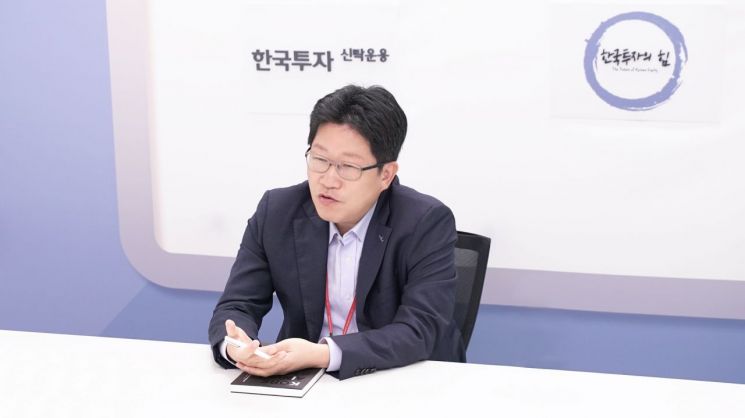
“The essential factor for stock price increases is ultimately ‘growth potential.’ Therefore, next year, it is necessary to focus on the commercialization of artificial intelligence (AI) and the semiconductor theme in the stock market.”
Jung Sang-jin, Head of Equity Management at Korea Investment Management, recently answered a question about next year’s stock market outlook in an interview with Asia Economy. As Jung Sang-jin mentioned, global big tech companies are currently focusing on the commercialization of AI. Since the end of last year, OpenAI has led the AI boom with ‘ChatGPT,’ and Microsoft (MS) and Google have successively unveiled AI-integrated services. In Korea, Naver has also officially entered the AI contract market between companies by releasing ‘Clova Studio’ and ‘NeuroCloud for HyperClovaX.’
Jung said, “Regardless of industry or factors, the essential element for stock prices to rise in the long term is ‘growth potential.’ All stocks show characteristics of value stocks but rise significantly when they grow. Ultimately, next year is a game of predicting which stocks will have the best performance. Looking back at this year, the stocks with the best performance and growth potential rose the most.”
He added, “However, supply and demand are strictly lagging indicators, so you should not assume that stock prices will continue to rise just because money flows in. For example, secondary battery-related stocks, which experienced sharp price fluctuations this year, rose when money flowed in, but at some point, that effect may no longer work, and the trend could reverse.”
He pointed out AI commercialization as a theme to watch next year. He said, “Although countries recognize the risks, AI-related technology development is a situation that cannot be stopped. This is because no one can just watch the huge market of AI commercialization.” He also emphasized, “While humans are the main agents of economic activity and consumption, AI can greatly increase productivity or provide solutions to various social problems, so in a low birthrate situation, the utilization of AI will inevitably increase.” However, he recommended investing in the entire related industry rather than making long-term investments in specific companies, noting that big tech is the fastest-changing field in terms of technology.
Jung also explained that the semiconductor sector is another theme to watch next year. He said, “Semiconductors are essential in all industrial sectors, so demand will structurally continue to increase. The semiconductor demand triggered by the AI sector will also be explosive.” He added, “If international conflicts worsen as they are now, countries will try to produce semiconductors themselves, but building a semiconductor factory takes 3 to 5 years, and most countries lack the related technology. Therefore, it is highly likely that 소재·부품·장비 (materials, parts, and equipment) companies will enter a long-term boom cycle.”
Regarding the global economic outlook, he cautioned against vague expectations of ‘interest rate cuts.’ Jung said, “With stock and real estate prices rising, expectations for asset inflation remain alive. If interest rates are lowered for economic stimulus, a situation could arise where hyperinflation and other issues cannot be resolved.” Therefore, he believes it is unrealistic to expect the U.S. to cut interest rates soon. Since expectations for assets remain intact and inflation issues must be addressed, governments around the world find it difficult to lower interest rates significantly at this time.
© The Asia Business Daily(www.asiae.co.kr). All rights reserved.

















