The 321st Regular Session Held... Administrative Audit and Budget Approval Scheduled for 52 Days from November 1 to December 22
- Stable Livelihoods Essential for Individual and Social Well-being, Ensuring No Shortage in Livelihood Support Budget
- Seoul's Growth Plate Blocked for 10 Years, Bold Future Investment Budget Support for Seoul's Global TOP5 Ambition
- Proactive Response to Subway Strike, Call for Cooperation on Climate Companion Card, Request for Precise Policy Design for Riververse Introduction
- Thorough Preparation for College Entrance Exam, Prompt Basic Academic Assessment, Declining Student Population
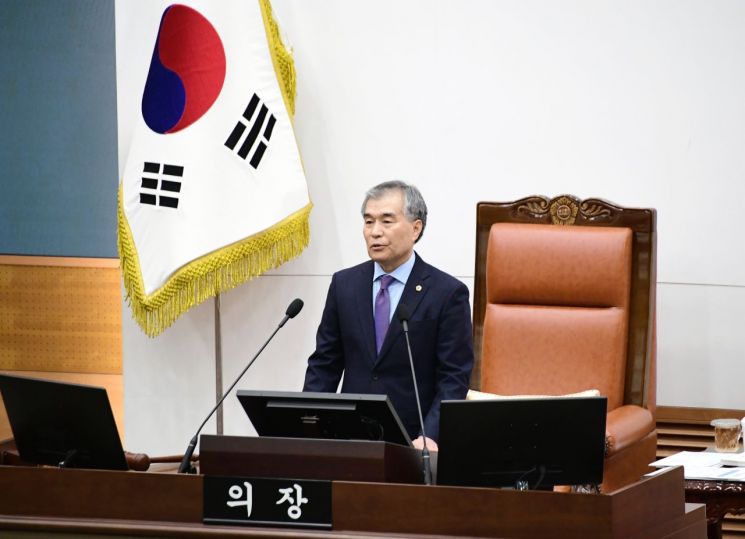
The Seoul Metropolitan Council (Chairman Kim Hyun-gi) will hold the 321st regular session from November 1 to December 22, 2023, for 52 days to conduct administrative audits, question Seoul city administration and education administration, and deliberate and approve the 2024 budget proposals for the Seoul Metropolitan Government and the Seoul Metropolitan Office of Education.
In his opening remarks, Chairman Kim Hyun-gi emphasized, “Regarding the first anniversary of the October 29 tragedy, although institutional improvements and system enhancements have been made, citizens still see them as insufficient and lacking. Going forward, citizen safety must remain the top policy priority, and we must always stay vigilant, cautious, and continuously improve.”
He also stated, “We are currently in a difficult period of high inflation, high interest rates, and high exchange rates, so next year’s budget focus will be on ‘livelihood’ and ‘future.’” Chairman Kim said, “As the saying goes, ‘Muhangsan Muhangsim (無恒産無恒心)’?without stable livelihood, there is no stable mind. Only when life is stable can individuals and society properly exist. We will ensure that the budget for livelihood support is sufficient.”
Furthermore, he declared, “Seoul’s growth has been blocked for the past 10 years. To elevate Seoul into the ranks of the global TOP 5 cities, we will boldly support future investment budgets.”
On this day, Chairman Kim asked the Seoul Metropolitan Government, “There is heated political debate about adjusting and aligning living areas and administrative districts, so-called building a mega-city Seoul. Citizens are curious about the position of the Seoul Mayor, who is the party concerned.”
He also urged the Seoul Metropolitan Government to take preemptive measures against the subway strike scheduled for the 9th and to continuously promote downtown redevelopment for Seoul’s leap forward. Regarding the Climate Companion Card initiative, he requested cooperative governance with metropolitan area local governments and precise policy design for the Hangang River Rebirth (Hangang River Rebirth) project.
Chairman Kim pointed out the late-night taxi shortage that has not been resolved despite the increase in base fares and changes in late-night surcharge hours, emphasizing the urgent need for countermeasures during the expected high demand at the year-end and New Year period.
Meanwhile, he asked the Seoul Metropolitan Office of Education to thoroughly prepare for the 2024 College Scholastic Ability Test (CSAT) on the 16th, ensuring no inconvenience for examinees by maintaining test sites and transportation.
He also urged the prompt implementation of the Seoul-type Basic Academic Achievement Assessment and the preparation of precise and effective measures in response to the declining school-age population. Expressing concerns about digital education (Dibut), he said a fundamental review of digital education policies is required.
This regular session will begin with an opening ceremony on November 1 and a policy speech on the submission of the 2024 budget proposal, followed by ▲14 days of administrative audits from November 2 to November 15 ▲representative speeches by negotiation groups and policy questions on Seoul city administration and education administration from November 16 to November 20 ▲and deliberations on the Seoul Metropolitan Government and Seoul Metropolitan Office of Education budget proposals and other agenda items by standing committees and the Special Committee on Budget and Accounts from November 21 to December 21.
Chairman of the Seoul Metropolitan Council
Opening Remarks
321st Regular Session. 23. 11. 1. -
Respected citizens of Seoul!
Esteemed senior and fellow council members!
Mayor, Superintendent of Education, and related public officials!
The first anniversary of the October 29 tragedy has passed.
Since then, we have worked to improve systems and revise institutions so that the tragic loss of 159 lives will not be in vain.
However, from the citizens’ perspective, it remains insufficient and lacking.
Citizen safety must be the top policy priority; we must always be vigilant, cautious, verify, and continuously and diligently improve.
This regular session will review administrative audits, the 2024 budget proposal, and about 200 livelihood-related ordinances.
The Seoul Metropolitan Government and the Seoul Metropolitan Office of Education have submitted budget proposals smaller than last year’s.
In particular, Seoul’s budget proposal is the first reduction in 13 years.
The council’s budget focus for next year is ‘livelihood’ and ‘future.’
As the saying goes, ‘Muhangsan Muhangsim (無恒産無恒心).’
Only when life is stable can individuals and society properly exist.
We will ensure that the budget for livelihood support is sufficient.
For the past 10 years, Seoul’s growth plate has been completely blocked.
To elevate Seoul into the ranks of the global TOP 5 cities,
we will boldly support future investment budgets.
Respected senior and fellow council members!
This is the second administrative audit since the opening of the 11th council.
It is also the first audit of the budget and policies approved by the council last year.
The ‘Three No Principles’?no unnecessary use, no unclear execution purpose, no unclear effect?budgets and policies must be thoroughly checked during administrative audits and reviewed from a zero base during budget deliberations.
Please deliberate and judge solely for the livelihood of citizens and the future of Seoul.
As this session is an opportunity to prove to citizens what the true role of the council is,
please devote yourselves fully to the 52-day regular session.
To the Mayor:
There is heated political debate about adjusting and aligning living areas and administrative districts, the so-called building of mega-city Seoul.
Citizens are curious about the position of the Seoul Mayor, who is the party concerned.
The subway union has announced a strike scheduled for the 9th of this month, citing workforce reduction.
Citizens absolutely do not agree with fare increases and strikes.
Strikes that hold citizens hostage are absolutely unacceptable.
We request active and preemptive countermeasures.
The Seoul Metropolitan Government recently announced the redevelopment plan for Sewoon Shopping Center.
It is evaluated as a decision for the future of Seoul.
We urge continuous downtown redevelopment for Seoul’s leap forward.
On the other hand, fundamental measures are required for the Sewoon Shopping Center pedestrian walkway and Seoul 7017, which have become eyesores in the city center.
The pilot project for the Climate Companion Card to transition to an eco-friendly transportation system has the positive effect of reducing transportation costs for low-income citizens and guaranteeing mobility rights.
However, to enhance policy synergy, a metropolitan-wide approach including the Seoul metropolitan area is required. A cooperative governance model with relevant local governments is necessary.
The introduction of the Hangang River Rebirth (River Bus) project raises both necessity and concerns.
In terms of suitability for commuting and cost-effectiveness, in-depth discussions are required. We request more precise policy design.
The participation of a public institution specializing in housing construction in the project is also considered surprising.
Seoul raised the taxi base fare by 26% last November and moved the late-night surcharge to start at 10 p.m.
However, the late-night taxi shortage has not been resolved.
Ultimately, only citizens suffer.
Thorough analysis of the problem and preparation of countermeasures for the year-end and New Year demand are urgent.
Currently, regions such as the Middle East are at war.
The civilian casualties, especially children, are tragic.
As a global central city, it is time to deeply consider expanding humanitarian aid.
The medical vacuum in local areas is severe.
Seoul is also facing serious difficulties in securing essential medical personnel due to the closure of general hospitals and public medical facilities.
Local governments are desperately pursuing the establishment and expansion of medical schools.
Seoul also needs to consider establishing a medical school at the University of Seoul to secure medical personnel in essential departments for public medical institutions.
To the Superintendent of Education:
November 16 is the 2024 College Scholastic Ability Test day.
Please ensure thorough preparation for the test, including maintenance of test sites and transportation, so that examinees experience no inconvenience.
Last year, the council allocated 3 billion KRW to develop a Seoul-type basic academic diagnostic tool.
However, the development and implementation of the diagnostic tool have been continuously delayed.
This year, pilot assessments and full implementation of the basic academic diagnostic evaluation must be actively promoted.
Due to the declining school-age population, school closures are increasing even in Seoul.
The number of elementary, middle, and high school students in Seoul, currently 780,000, is expected to nearly halve to 420,000 in 12 years.
We strongly urge precise and effective measures for the future Seoul-type school policy, such as urban campus models.
Concerns about digital education (Dibut) among education consumers persist.
The Office of Education has urgently announced a ban on elementary students carrying devices home.
In Europe, including Sweden, which previously introduced electronic textbooks, there is a trend to reintroduce paper textbooks and handwriting.
A fundamental, future-oriented review of digital education policies is required.
The Seoul Metropolitan Office of Education has filed lawsuits again against ordinances passed by the council.
This is unprecedented and shows a blatant disregard for the decisions of the council, the representative body of citizens.
As an educational institution that teaches the process of autonomously resolving diverse opinions, habitual Supreme Court litigation is contradictory and shameful.
So far, Seoul has supported the education budget through statutory transfers and ordinances.
However, Seoul has accumulated 12 trillion KRW in debt, while the Office of Education has about 3.6 trillion KRW in cash reserves, including stabilization funds.
With the serious imbalance between general and education finances, breaking down financial barriers is both a means and a remedy to jointly solve Seoul’s financial shortage. This is the ‘financial swap’ proposed by the council.
Mayor and Superintendent of Education, please join forces.
Senior and fellow council members!
Mayor, Superintendent of Education, and related public officials!
It is said that without reflection, there is no growth.
We share the common goals of ‘enhancing citizen happiness’ and ‘Seoul’s leap forward.’
Let this regular session be one where we all reflect on how much effort we have made to achieve these goals and prepare anew.
Thank you.
© The Asia Business Daily(www.asiae.co.kr). All rights reserved.
![Clutching a Stolen Dior Bag, Saying "I Hate Being Poor but Real"... The Grotesque Con of a "Human Knockoff" [Slate]](https://cwcontent.asiae.co.kr/asiaresize/183/2026021902243444107_1771435474.jpg)
















