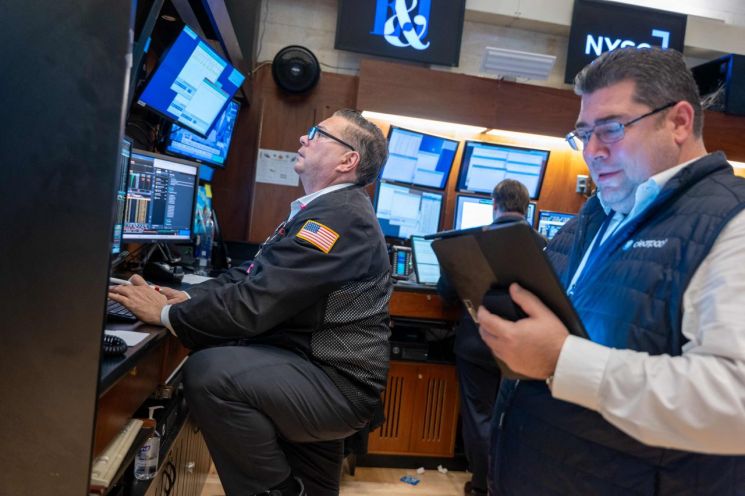
The three major indices of the U.S. New York stock market are showing mixed movements near the flat line in early trading on the 31st (local time), the last trading day of the month, as they closely watch the Federal Open Market Committee (FOMC) meeting, which began a two-day schedule.
At around 10:50 a.m. at the New York Stock Exchange (NYSE), the Dow Jones Industrial Average, centered on blue-chip stocks, was trading at 32,924, down 0.01% from the previous close. The S&P 500, focused on large-cap stocks, rose 0.14% to 4,172, while the tech-heavy Nasdaq index fell 0.05% to 12,783. A cautious wait-and-see stance is evident as investors await the FOMC regular meeting results to be released the next day.
Currently, nine sectors of the S&P 500, excluding energy and telecommunications stocks, are on the rise. Real estate-related stocks rose more than 1% as housing price indicators continued to climb. Pinterest jumped over 18% from the previous close after its quarterly earnings exceeded expectations. Chooey rose 4% after Morgan Stanley upgraded its investment rating due to increased weighting. On the other hand, JetBlue fell nearly 15% after releasing disappointing earnings. Pfizer also dropped more than 1% due to decreased demand for its COVID-19 vaccine and other factors. Nvidia is down over 2% after the Wall Street Journal (WSJ) reported that the Biden administration’s tightened export controls could lead to the cancellation of orders worth billions of dollars from China.
Investors are awaiting the FOMC regular meeting results, scheduled for 2 p.m. the next day, while closely monitoring key economic indicators and movements in Treasury yields. The Federal Reserve (Fed) is expected to keep the benchmark interest rate steady at 5.25?5.5% during this meeting, with investors focusing on hints regarding future monetary policy moves. At the September FOMC, the Fed indicated that an additional rate hike could follow within the year despite the rate hold. However, with core inflation slowing and some officials suggesting that the recent rise in Treasury yields has reduced the need for further tightening, attention is focused on the economic assessment and outlook to be presented at this FOMC.
The market currently favors a rate hold. According to the CME FedWatch tool, the federal funds futures market reflects over a 97% probability that the Fed will keep rates unchanged at 5.25?5.5% in this meeting. The probability of a hold in December is also above 68%, while the chance of a “baby step” hike in December stands at around 29%. Despite expectations of prolonged high rates, the possibility of a rate increase within the year is viewed relatively low.
This week, key U.S. economic data such as the October employment report and PMI will be released. The nonfarm payroll increase, scheduled for release on the 3rd, is expected to be around 170,000 to 180,000. The unemployment rate is forecasted at 3.8%. Since the Fed has stated that below-trend low growth and labor market cooling are necessary to reduce inflation, market attention is focused on whether signs of employment slowdown will be confirmed in this month’s report. Meanwhile, the Bank of Japan (BOJ), which recently held a monetary policy meeting, maintained its long-term yield target at 0% but revised the upper limit to 1%.
In the New York bond market, the benchmark 10-year U.S. Treasury yield fell to around 4.84%. The 30-year yield also dropped slightly to about 4.99%. The BOJ’s announcement reduced the appeal of Japanese government bonds, leading to increased demand for U.S. Treasuries. Rising bond prices indicate falling yields. The 2-year Treasury yield, sensitive to monetary policy, is trading around 5.06%.
The Treasury Department’s fourth-quarter borrowing plan, expected to impact the bond market, was scaled back more than anticipated. On the previous afternoon, the Treasury announced plans to issue $776 billion in debt from October to December this year, significantly below the $1.01 trillion issued in the third quarter. This is also less than the $800 billion forecast by JP Morgan. Therefore, the key point in the Treasury’s maturity-specific borrowing plan report to be released the next morning will be whether the issuance of medium- to long-term bonds will decrease or increase. Efek Ozkadeskaya, senior analyst at Swissquote Bank, emphasized, “The really important event this week is the Treasury’s issuance size by maturity.”
Despite continued high interest rates, the housing price index hit an all-time high. According to S&P CoreLogic Case-Shiller, the housing price index for August this year rose 2.6% year-over-year. It also increased 0.4% month-over-month, marking seven consecutive months of gains. U.S. consumer confidence declined for the third consecutive month. According to the Conference Board, the October consumer confidence index was 102.6, exceeding market expectations (100) but down from the previous month’s 104.3.
After the market closes on the 2nd, Apple, the largest company by market capitalization, will release its earnings. As a large-cap stock accounting for over 7% of the S&P 500, Apple’s stock movement will inevitably impact the overall market immediately. The earnings results of major big tech companies that have already reported have shown mixed reactions depending on future earnings outlooks. According to LSEG, among the 251 S&P 500 companies that have reported so far, 77.7% have posted earnings exceeding Wall Street expectations.
The dollar index, which measures the value of the U.S. dollar against the currencies of six major countries, is trading around 106.5, up 0.4%. The Chicago Board Options Exchange (CBOE) Volatility Index (VIX), known as Wall Street’s “fear gauge,” fell nearly 3%, breaking below the 20 level.
European stock markets are rising. Germany’s DAX index rose 0.61%. The UK’s FTSE index increased 0.1%, and France’s CAC index gained 0.97%.
© The Asia Business Daily(www.asiae.co.kr). All rights reserved.

















