71% of Residents Say "Once a Drug-Free Zone, Not Anymore"
Urgent Need for Youth Prevention Education, Publicity, and Addiction Management Center
Survey Results from Gangnam-gu Council's 'Drug Eradication Measures Research Group'
"42.5% of Gangnam-gu residents identified public health centers (27.5%) and district offices (15%) as institutions that can help people exposed to narcotics. This indicates that many perceive narcotics issues as both a therapeutic and public agenda. Responses for police stations and hospitals were 27% and 18.5%, respectively." (Park Dami, Gangnam-gu Council Member)
It was found that 7 out of 10 Gangnam-gu residents believe that "our country was once a drug-free zone but is no longer" (71%). 9 out of 10 residents answered that "our country is no longer a drug-free zone."
According to a survey conducted by the Gangnam-gu Council's Drug Eradication Policy Research Group (led by Council Member Park Dami), 90.5% of respondents said, "Our country is no longer a drug-free zone." 10% responded that "it has not been a drug-free zone for a long time," and 9.5% said "it was not in the past and is not now." Only 6.5% answered that "it is still maintained as a drug-free zone."
This survey was commissioned by the Gangnam-gu Council's Drug Eradication Policy Research Group to the Korea Policy Management Institute and conducted from August to September among 600 residents within Gangnam-gu.
78% of residents responded that "the drug problem in Korean society is serious." Among them, 16% thought it was "very serious." Only 6% answered that it was "not serious at all" or "not serious."
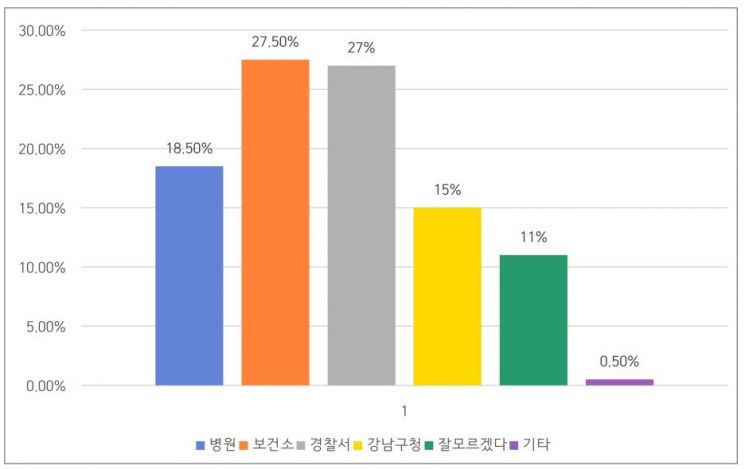 Institutions that can provide assistance to people exposed to narcotics. (Source: Gangnam-gu Council Narcotics Eradication Policy Research Group)
When specifically asked about Gangnam-gu, where drug incidents are frequent, 81.5% of residents thought that "the problem of narcotics misuse in Gangnam-gu is serious" (including 40.5% who said very serious). The causes of the increase in illegal distribution and misuse of narcotics in Gangnam-gu were identified as "the spread of digital distribution channels such as the dark web and SNS" (50%), "lax monitoring and light punishments" (19%), and "excessive abuse of medical narcotics for treating depression and concentration disorders" (18.5%).
As groups needing narcotics misuse prevention education, respondents pointed to adolescents (29.6%), university students (22.9%), and parents (18.3%). For projects that Gangnam-gu should strengthen to prevent misuse, responses included "expansion and strengthening of narcotics monitoring personnel system" (46%), "grasping and strengthening supervision of narcotics drug distribution status" (28%), and "strengthening application requirements for narcotics handlers' permits (designation)" (13%).
Council Member Park Dami said, "After interviewing experts within the district office and police officers experienced in narcotics investigations, it is true that since COVID-19, the misuse and spread of narcotics have accelerated, and the age of narcotics offenders is decreasing due to the normalization of non-face-to-face lifestyles. We need to strengthen prevention education through establishing an Integrated Addiction Management Support Center and also focus on treatment and rehabilitation."
Gangnam-gu has a significantly higher rate of narcotics spread and misuse of psychotropic drugs compared to other areas due to increased floating population, concentration of entertainment establishments, and dense clusters of hospitals and clinics such as plastic surgery clinics.
© The Asia Business Daily(www.asiae.co.kr). All rights reserved.


















