Reflecting Hot Interest in Secondary Battery Stocks... Semiconductor Sector Hopes for Industry Bottom
Bio Stocks Show Poor Results in New Drug Development... Harsh Valuation of Corporate Value at IPO
This year, the initial public offering (IPO) prices of companies showed mixed results across different industries. While semiconductor and secondary battery-related companies often set their offering prices above the expected range, bio companies tended to price at or below the lower end.
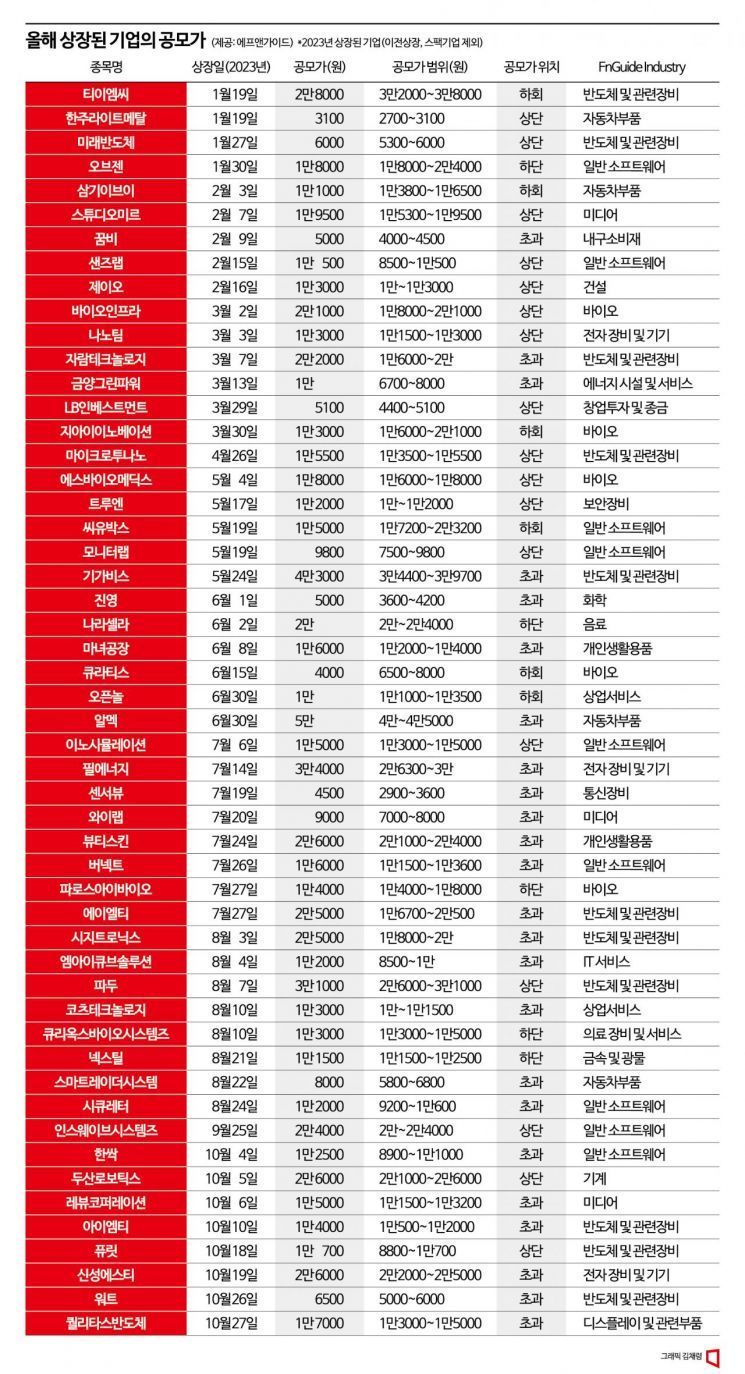
According to FnGuide, 52 companies entered the stock market from the beginning of this year until October 27. Among them, 41 companies set their offering prices at or above the upper limit of their expected price range. Twenty-four companies, including Qualitas Semiconductor, IMT, Phil Energy, and Shinseong ST, exceeded their expected offering prices. Notably, most companies that surpassed their expected offering prices were related to semiconductors and secondary batteries. IMT, which confirmed its offering price at 14,000 KRW exceeding the expected range of 10,500 to 12,000 KRW, is a semiconductor equipment company. It produces ultra-precision components such as laser and carbon dioxide (CO2) dry cleaning technology and extreme ultraviolet (EUV) mask laser baking equipment (Mask Laser Baking).
Shinseong ST, which set its offering price at 26,000 KRW, exceeding the upper limit of 24,000 KRW, manufactures busbars used in electric vehicles (EV) and energy storage systems (ESS). It is considered a secondary battery-related stock. Phil Energy focuses on laser notching process equipment and stacking process equipment, which are key facilities in secondary battery assembly processes. Although its expected offering price was 26,300 to 30,000 KRW, the confirmed offering price was 34,000 KRW.
A securities industry official analyzed, "Although secondary battery stocks have recently undergone significant corrections, this is interpreted as a result of the hottest interest this year." Semiconductor-related stocks also seem to reflect expectations of a bottoming out in the industry.
Companies engaged in unfamiliar businesses and cosmetics firms also received high offering prices. YLAB, which went public in July, is the industry's first studio-type production company that vertically integrates the webtoon production value chain. It confirmed its offering price at 9,000 KRW, exceeding the upper limit of the expected range of 7,000 to 8,000 KRW. Additionally, Revu Corporation, the first influencer platform, set its offering price at 15,000 KRW, far exceeding the expected range of 11,500 to 13,200 KRW.
Cosmetics companies Manya Gongjang and Beauty Skin also exceeded their expected offering prices due to expectations of benefits from the end of COVID-19. Manya Gongjang's demand forecast range was 12,000 to 14,000 KRW but was set at 16,000 KRW, and Beauty Skin confirmed its offering price at 26,000 KRW, exceeding the range of 21,000 to 24,000 KRW.
A total of 11 companies set their offering prices at or below the lower end of their expected range. Among them, bio companies often showed poor performance. Six bio and medical device companies, including Curatis and Pharos iBio, went public this year. None of these companies exceeded their expected offering prices. Only Bioinfra and SBioMedics were at the upper end.
Among them, Pharos iBio and Curiox Biosystems set their offering prices at the lower end of the expected range. Notably, GI Innovation and Curatis priced below their expected ranges. GI Innovation set its offering price at 13,000 KRW, below the expected range of 16,000 to 21,000 KRW. Curatis set its offering price at 4,000 KRW, below the range of 6,500 to 8,000 KRW.
The harsh reality of bio companies' IPOs is currently unfolding. Kurocell, Korea's first company specializing in chimeric antigen receptor T-cell (CAR-T) therapy development, conducted demand forecasting over five business days starting from the 20th of last month and confirmed its offering price at 20,000 KRW. This is below the expected range of 29,800 to 33,500 KRW.
The main reason for the bio sector's poor performance is deteriorated investor sentiment. Although many bio companies have gone public, they have failed to deliver tangible results such as new drug development, leading to decreased credibility. Consequently, it is difficult to achieve success in the offering market. A securities industry official explained, "Ultimately, the offering price is determined based on the market valuation. Even if a bio company was highly valued before listing, its corporate value inevitably decreases as it follows the stock market upon listing."
© The Asia Business Daily(www.asiae.co.kr). All rights reserved.

















