Police Raid Dental Association
Former KT CEO Also Fined
"Legal and Institutional Improvements Needed"
As the police recently conducted a search and seizure of the Korean Dental Association (KDA) amid suspicions of 'split donations,' the issue of split donations to members of the National Assembly has come back into the spotlight. Under current law, corporations or interest groups are fundamentally prohibited from making political donations, but illegal donations continue through the exploitation of anonymous donations allowed for small amounts. Split donations are difficult to detect and mostly result in light punishments.
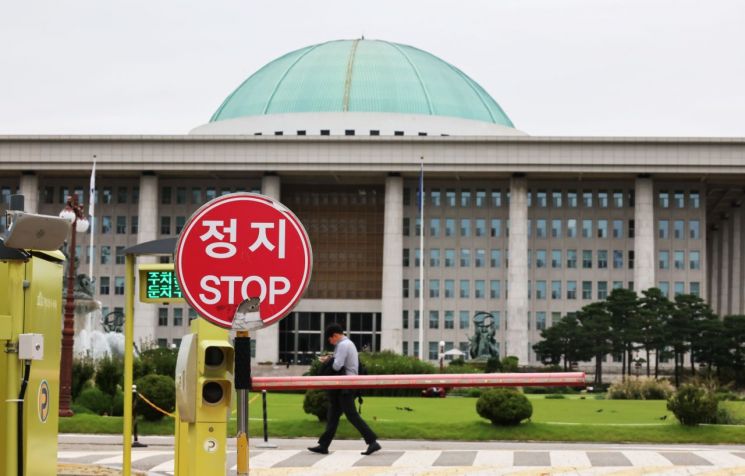
On the 20th of last month, the Seongdong Police Station in Seoul conducted a search and seizure of the KDA office on suspicion of violating the Political Funds Act. KDA President Park and others are suspected of repeatedly withdrawing association funds and sending donations to 16 members of the National Assembly under their own names and those of association executives. The police estimate the embezzled amount for donations to be 100 million won. A police official stated on the 1st, "We have secured internal KDA documents, accounting records, computer hard disks, etc., and are analyzing them. We plan to investigate the related parties soon."
The police view this case as a typical illegal split donation. According to the Political Funds Act, domestic and foreign corporations or organizations cannot donate political funds. Even as individuals, donations to presidential candidates or presidential primary candidates are limited to 10 million won each, and donations to members of the National Assembly, candidates, party leaders, primary candidates, and local government candidates are limited to 5 million won each. However, donations of 100,000 won or less per instance and 1.2 million won or less annually can be made anonymously.
Split donations are made by exploiting these anonymous donations, where corporations or interest groups donate small amounts to members of the National Assembly under the names of employees themselves, other staff, family members, or acquaintances. Although there are many detected cases, most resulted only in fines. Former executives A and B of the Korea Specialty Contractors Association were fined 7 million won and 2 million won respectively on September 6 for violating the Political Funds Act. They were prosecuted for making split donations under the names of family and acquaintances to members of the National Assembly around the 20th general election in 2016 to revive the construction participant system abolished by the revision of the Construction Industry Basic Act. Earlier, in July, former KT CEO Gu Hyun-mo, who was indicted for violating the Political Funds Act, was also fined 7 million won. Former CEO Gu was tried for splitting donations to 99 members of the 19th and 20th National Assembly from both ruling and opposition parties, along with nine current and former executives, using 337.9 million won of slush funds generated by buying and reselling gift certificates from May 2014 to October 2017.
Detecting split donations is not easy. Since donations are made anonymously, it is difficult to even grasp the circumstances without internal whistleblowing from the relevant corporation or organization. Politicians who receive donations claim that it is hard to know who made the donations when the amounts are small, and investigative agencies also find it difficult to prove whether the lawmaker was aware in advance that the donations came from corporations or organizations. A police official said, "This has been a problematic behavior for a long time, but unless there is an internal tip-off, it is difficult to prove illegality. If it is claimed that the donations were made voluntarily by individuals, it is also difficult to send the case to prosecution."
Voices are emerging that legal and institutional improvements are needed to eradicate split donations and ensure transparent political funding. Professor Lee Jun-han of the Department of Political Science and Diplomacy at Incheon National University said, "Since split donations are hard to detect without internal whistleblowing, there must be proper protection for public interest whistleblowers to encourage active reporting, and the punishment for those who give and receive donations should be increased. Although members of the National Assembly may not want to change the law themselves, to achieve transparent donations, measures such as disclosing the entire list of donors and lowering the threshold for anonymous donations should be considered."
© The Asia Business Daily(www.asiae.co.kr). All rights reserved.

















