Eyeing Dominance from iPhone to PC
Qualcomm and Intel Chips Lead with Preemptive Offensive
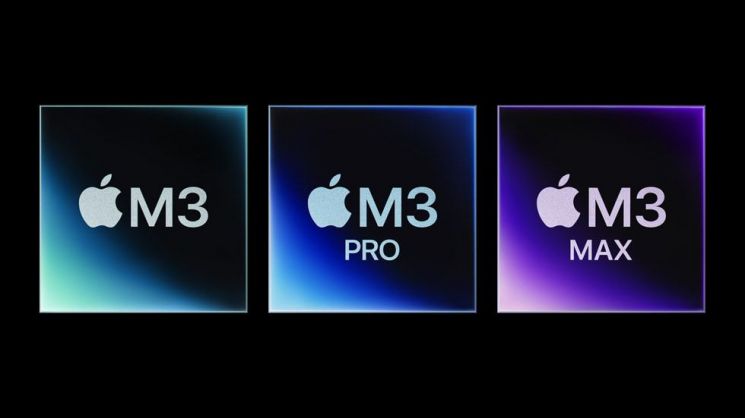
Apple has unveiled its second 3-nanometer semiconductor. Following the iPhone, the company is now seeking to secure a competitive edge in personal computers (PCs) through 3-nanometer semiconductors, but analysts see signs of concern behind this move. On the 30th of last month (local time), Apple revealed the ‘M3’, ‘M3 Pro’, and ‘M3 Max’ chips. These chips were designed in-house by Apple and manufactured using Taiwan Semiconductor Manufacturing Company’s (TSMC) 3-nanometer (1 nanometer equals one billionth of a meter) process. After launching the ‘A17 Pro’ chip for the iPhone 15 Pro last month, Apple has now ushered in the 3-nanometer era for its M series chips for PCs.
Rumors had spread that the unveiling of Apple’s M3 chip would be delayed until next year due to slow yield improvements in TSMC’s 3-nanometer process. However, Apple surprised the market by announcing a new product launch event and showcasing PCs equipped with the M3 chip. Apple CEO Tim Cook emphasized, "The M3 chip is the most advanced chip for PCs, realized with the latest Apple Silicon technology." Apple described the M3 launch event as ‘Scary fast’ to highlight the new chip’s performance.
Apple’s new chip launch is certainly unusual. Unlike the M1 and M2 launches, this time Apple released three types of chips simultaneously, including high-performance variants. The low-cost PC using the basic M chip, such as the MacBook Air, was not introduced.
The most affordable PC using the M3 chip is now the 14-inch MacBook Pro. This is priced in the 2 million KRW range, which is higher than the mid-1 million KRW range for entry-level PCs. The 13-inch MacBook Pro was also not introduced. Regarding this, an industry expert said, "Given the insufficient yield of TSMC’s 3-nanometer process, Apple may have chosen to limit sales by using the new chip in high-end PCs instead of low-cost ones." The Wall Street Journal asserted that aside from the chip, the new Apple PC has seen no changes. Some have noted that the addition of new colors is the only difference.
Intensifying competition in the PC chip market may also have prompted Apple to rush the product launch. Qualcomm, which had been competing with Apple using its smartphone ‘Snapdragon’ chips, recently introduced a PC chip called ‘Snapdragon X Elite’. Qualcomm acquired Nuvia, founded by former Apple engineers, and is determined not to fall behind in the ARM-based PC market. Intel also plans to retaliate against Apple with its latest ‘Meteor Lake’ chip. Meteor Lake is Intel’s first CPU manufactured using a 7-nanometer process.
Apple caused a stir in the semiconductor industry when it introduced its self-developed PC chip, the ‘M1’, at the end of 2020. Compared to Intel’s chips, the leader in PC chips, Apple’s M1 gained attention for its superior performance and price. Since then, Apple has reaffirmed its intention to maintain its lead over competitors like Intel and Qualcomm by releasing the M2 chip last year and the M3 this year.
However, the start of Apple’s ambitious 3-nanometer chip strategy has not been smooth. Although Apple effectively holds a monopoly on TSMC’s 3-nanometer process, the strategy to overwhelm competitors with the first 3-nanometer semiconductor has already faltered. The world’s first 3-nanometer chip, the A17 Pro, failed to meet expectations for significant improvements in performance or battery life compared to the A16, which was made using the 4-nanometer process. Despite a process miniaturization of over 30%, the performance gains were not as substantial. The heating issues with the iPhone 15 Pro have raised doubts about TSMC’s 3-nanometer FinFET process.
© The Asia Business Daily(www.asiae.co.kr). All rights reserved.

















