Presentation of ESS Industry Development Strategy at the Industry-Academia-Research Roundtable
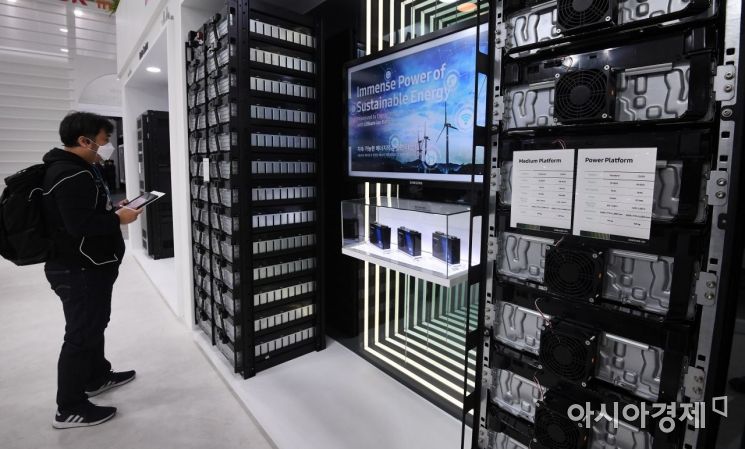 Visitors are touring the Samsung SDI exhibition hall at 'InterBattery 2020,' a battery industry exhibition held at COEX in Gangnam-gu, Seoul.
Going forward, a project will be promoted to equip ships and vehicles with energy storage systems (ESS) to store electricity and use it when needed. A safety inspection system will also be established to conduct thorough inspections and reuse batteries from electric vehicles. Tax credits are expected to be expanded when companies invest in ESS facilities.
On the 31st, the Ministry of Trade, Industry and Energy held an industry-academia-research institute meeting on energy storage at the LS Electric Global Research and Development (R&D) campus in Anyang, Gyeonggi Province, chaired by Deputy Minister Kang Kyung-sung, and announced the "ESS Industry Development Strategy." On this day, the ministry presented a goal to achieve a 35% share of the global ESS market by 2036 by implementing a flexible power system based on ESS, aiming to become one of the world's top three ESS industry powers alongside the United States and China.
ESS refers to technology that uses secondary batteries, pumped storage, and other technologies to store excess electricity generated during normal times and use it when needed. As the share of renewable energy has significantly increased worldwide, the ESS market is also rapidly growing. BloombergNEF forecasted that the scale of ESS facilities (excluding pumped storage) will increase more than tenfold from 91.5 gigawatt-hours (GWh) in 2022 to 1,432 GWh in 2030.
On the other hand, the scale of new ESS installations in Korea peaked at 3,836 megawatt-hours (MWh) in 2018 but shrank to 252 MWh last year. The market stagnated due to reductions in renewable energy certificate (REC) weighting, charging fee discounts, and installation cost support. Additionally, a series of fire accidents rapidly contracted the market. According to the ministry, there have been 50 ESS fires since 2017, including 10 incidents this year alone.
In Korea, renewable energy continues to increase, and under the Yoon Suk-yeol administration, the share of nuclear power plants (NPPs) is also set to expand, making the dissemination and expansion of ESS essential. Both renewable energy and nuclear power are considered inflexible power sources. ESS is a means to mitigate the volatility of power supply and demand.
The government will first secure 3.7 gigawatts (GW) of necessary energy storage facilities by 2030 according to the 10th Basic Plan for Electricity Supply and Demand, proactively acquiring 600 megawatts (MW) annually from 2025. In particular, 1.4 GW will be procured by 2026 in the Honam region, where grid stability is urgently needed due to excess renewable energy generation, through low-carbon central contract markets and others.
The government also plans to support smooth expansion of ESS facility investments through new market systems such as long-term contract markets, renewable energy bidding markets, and stored electricity sales businesses. It will expand ESS loan scales for small and medium-sized enterprises and consider expanding tax credits for ESS facility investments. ESS-based microgrids will be activated in industrial complexes with high electricity usage, military bases, hospitals, villages, and islands.
A testing and certification system will be established to enable the reuse of used batteries from electric vehicles in ESS. The ministry plans to implement a safety inspection system that conducts thorough inspections of used batteries with 70-80% of their lifespan remaining compared to new products, on an individual product basis, for reuse. To promote the use of used batteries in ESS, a public-private joint system called the "Used Battery ESS Alliance" will also be formed and operated involving industry, academia, and research institutes.
The government will also promote demonstration and dissemination projects for mobile ESS that equip ships and vehicles with ESS to supply electricity to required areas. The so-called "battery ship" concept involves storing electricity produced in regions dense with renewable energy and offshore in batteries and transporting it to demand sites via ships (battery tankers). The Vehicle to Grid (V2G) service, which uses electric vehicle batteries as power storage devices, will also be expanded.
Technologically, the government plans to maintain a super-gap competitiveness in ternary lithium-ion batteries and promote mass production of lithium iron phosphate (LFP) batteries. In addition, it will secure a storage mix centered on long-duration technologies such as flow batteries, sodium-sulfur (NaS) batteries, compressed air storage, thermal storage, and pumped storage, which are expected to be low-cost, highly safe, and large-capacity in the future.
The government will form an "Energy Storage Industry Development Council (tentative name)" to implement detailed tasks related to ESS and establish an overseas market information system to support the expansion of domestic companies' overseas market entry. It will also strengthen safety management systems to enhance ESS safety.
Experts attending the meeting requested the government to steadily implement the measures as the domestic ESS market, which has been depressed due to consecutive fires, urgently needs revitalization. Deputy Minister Kang Kyung-sung said, "The dissemination of energy storage is essential for grid stability, and we will foster energy storage as a new strategic industry through core ESS technology development, establishment of an industrial development foundation, and securing fire response safety."
Meanwhile, Deputy Minister Kang visited the development site of a new power conversion system (PCS), a core ESS component exported to the United States, and praised LS Electric's efforts while encouraging its employees.
© The Asia Business Daily(www.asiae.co.kr). All rights reserved.
!["The Woman Who Threw Herself into the Water Clutching a Stolen Dior Bag"...A Grotesque Success Story That Shakes the Korean Psyche [Slate]](https://cwcontent.asiae.co.kr/asiaresize/183/2026021902243444107_1771435474.jpg)
















