Sharing Safety Test Results with Government Before AI Service Launch
Watermarking AI-Generated Content
Appearing Two Days Before 'AI Jeongsanghoe'
Leading Global AI Regulation Discussions Amid G7 and EU Announcements
"The artificial intelligence (AI) executive order will prevent terrorists from developing weapons of mass destruction and stop fake news from being used in elections." (The New York Times)
This is the assessment from foreign media following U.S. President Joe Biden's signing of an executive order on the 30th (local time) to curb the side effects caused by AI misuse. The executive order was issued two days before the world's first 'AI Summit,' scheduled to be held in the UK on the 1st of next month, to formally discuss AI regulation. It essentially signals the U.S.'s intention to lead the global AI regulatory discussions. The New York Times (NYT) described it as "a first step to put guardrails (safety measures) on a global technology with great potential but also great risks."
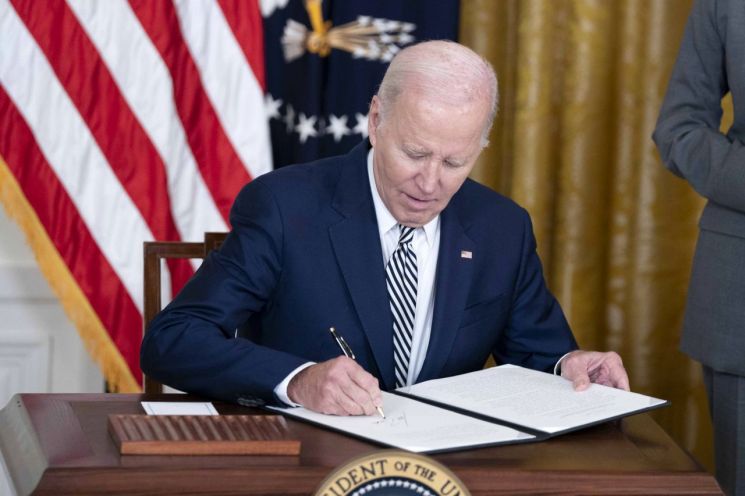
President Biden signed the 'Executive Order on Safe and Trustworthy AI' at the White House that day. The order includes measures for the safe use of AI and national security-level AI responses. According to the executive order, companies must share safety test results with the government before launching AI services. In particular, AI services that pose risks to national security, the economy, or public health must be reported to the federal government from the testing phase. To this end, the U.S. government applied the Defense Production Act. Given the high risks of AI, the government intends to strengthen oversight from before the service launch through 'pre-regulation.'
To prevent the spread of AI-generated fake news, AI-generated content must be labeled with a separate identification mark (watermark), and the government will develop standards for this. Separate safety guidelines will be established for specific fields such as healthcare and education regarding AI use. The NYT reported that this measure "requires companies to pre-report to the federal government if their AI systems could assist a nation or terrorists in developing weapons of mass destruction," and "includes efforts to reduce the risks of deepfakes (AI-based image synthesis technology of specific individuals) that could disrupt elections or deceive consumers."
Additionally, the order includes measures to promote AI technological advancement, such as easing visa issuance requirements for overseas AI talent and expanding the number of accepted individuals. It also contains provisions to develop principles aimed at minimizing AI-related harm to workers and maximizing benefits amid growing concerns about job losses due to AI development.
Ahead of the AI Summit in the UK on the 1st of next month, G7 leaders, including the U.S., agreed on an AI Code of Conduct on the same day. According to foreign media, the code of conduct consists of 11 items that require companies to regularly monitor AI risks and take appropriate actions. Similar to the U.S. executive order, it includes measures for AI companies to disclose safety and security evaluation reports, share related information with governments, and attach watermarks to AI-generated content.
The European Union (EU) has unveiled the draft of the world's first AI regulation, the 'AI Act,' aiming to pass it within the year. The U.S. business magazine Fortune analyzed, "While the EU narrowly defines high-risk AI, the U.S. covers all AI fields concerning risk," and "Unlike the EU, the U.S. focuses on harm prevention rather than prohibition and emphasizes research and development (R&D) and technology."
The successive announcements of AI regulatory proposals by the U.S., G7, and EU reflect the international competition to take the lead in regulatory discussions related to rapidly advancing AI technology. The NYT evaluated the executive order announcement as "President Biden's effort to show that the U.S., a strong AI power, will also lead in regulation." Fortune reported, "President Biden's AI executive order marks a groundbreaking moment in pursuing responsible technology," adding that "it will resonate across various economic sectors and have a significant impact on the global AI environment."
© The Asia Business Daily(www.asiae.co.kr). All rights reserved.

















