Unanimous Opinion: "There Is Room to See the Red Card as Given for Educational Purposes"
The Constitutional Court annulled the prosecutor's decision to suspend prosecution, which recognized a teacher's act of attaching name tags of students who misbehaved during class next to a red card on the blackboard as 'emotional abuse' against children.
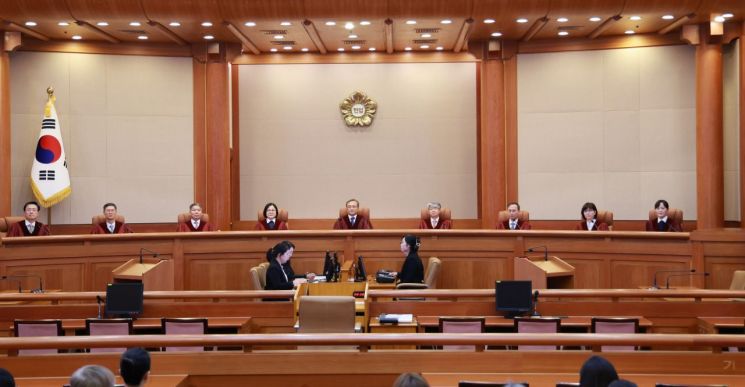 Chief Justice Yoo Nam-seok of the Constitutional Court and the constitutional justices are seated before the start of the trial on the 26th at the Grand Bench of the Constitutional Court in Jongno-gu, Seoul. [Image source=Yonhap News]
On the 31st, the Constitutional Court announced that it unanimously canceled the decision of the prosecutor from Jeonju District Prosecutors' Office to suspend prosecution against teacher A for violating the Child Abuse Punishment Act. The court ruled that the prosecutor's decision infringed on A's right to equality and pursuit of happiness.
A, a homeroom teacher at an elementary school in Jeonju, operated a red card system by attaching a red card to the classroom blackboard and placing the name tags of students who misbehaved during class next to the red card. Students whose name tags were attached were required to clean the classroom with the teacher after school before leaving.
In April 2021, during class, A warned a student who was twisting a nearly empty PET bottle by hand to make a loud noise. When the student continued to twist the bottle and make noise, A attached the student's name tag next to the red card. The student stayed after school holding a broom, and seeing this, A instructed the student to leave.
Upon learning of this, the student's mother kept the student from attending school for a certain period and repeatedly requested the principal to replace the homeroom teacher, filing multiple complaints with related agencies. The mother claimed that due to A's emotional abuse, her child was diagnosed with night terrors, a type of sleep disorder, and post-traumatic stress disorder.
Eventually, the student's mother filed a complaint against A for child abuse, and the prosecution decided to suspend prosecution against A. Suspension of prosecution means that although the charges are acknowledged, the prosecutor decides not to bring the suspect to trial considering various circumstances.
The prosecution acknowledged the charges, stating that although A was a mandatory reporter of child abuse crimes, "A attached the victim child's name tag next to the red card in the classroom, did not allow the victim child to leave after class, and made the child clean the classroom for about 14 minutes, causing emotional abuse that harmed the child's mental health and development."
In response, A filed a constitutional complaint, claiming that the suspension of prosecution infringed on their rights to equality and pursuit of happiness.
The Constitutional Court judged, "Considering A's statement that the red card system was an agreement between A and the students, and the fact that the Jeollabuk-do Education Administration Appeals Committee ruled that the operation of the red card system by the petitioner does not constitute school violence, there is room to see that A gave the red cards to students for educational purposes."
Furthermore, the court found it difficult to definitively conclude whether the student's diagnosis of night terrors and post-traumatic stress disorder was caused by the red card or by other incidents.
Meanwhile, when the student's mother demanded the replacement of the homeroom teacher and filed multiple complaints with related agencies, A submitted a report on the infringement of educational activities. In the lawsuit that followed, the Supreme Court ruled that "a teacher's judgment in the process of educating students should be respected unless there are special circumstances."
© The Asia Business Daily(www.asiae.co.kr). All rights reserved.

















