FDI in September 72.8 Billion Yuan... 34% Decrease YoY
Largest Monthly Decline Since 2014
Impact of US-China Conflict and Sharp Rise in US Treasury Yields
Acceleration of Foreigners' 'China Exodus'
Foreign direct investment (FDI) from foreigners is sharply declining. The Chinese government is facing increasing pressure to revive the economy by calming sluggish exports and consumption, stabilizing the real estate market, and attracting foreign investment.

According to major foreign media on the 30th, foreign direct investment (FDI) in China in September this year was 72.8 billion yuan, down 34% compared to the same period last year. This is the largest monthly decline since 2014.
The slowdown in foreign investment in China became visible from the beginning of the year. After the Chinese government lifted the COVID-19 lockdown at the end of last year, FDI to China increased by 15% in January, but as the reopening effect disappeared, it continued to decline by double digits every month from May.
The Ministry of Commerce of China reported that foreign investment inflows have decreased by a total of 8% in yuan terms since the beginning of this year. The decline is expected to be much larger in dollar terms. As foreign direct investment in China decreases, the Ministry of Commerce abruptly stopped announcing monthly FDI figures in dollar terms from August and now only releases FDI data based on yuan, whose currency value has depreciated.
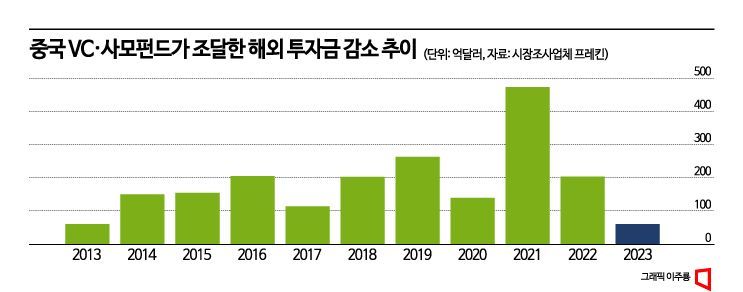
According to market research firm Preqin, foreign capital raised by venture capital (VC) and private equity groups investing in China amounted to $5.7 billion this year, only a quarter of last year's level.
Brad Setser, senior fellow at the Council on Foreign Relations, said, "Foreign companies are no longer reinvesting in China," adding, "They are trying to take profits earned in China out as quickly as possible."
The background accelerating foreigners' China exodus includes the US-China conflict and the recent sharp rise in US Treasury yields. Amid escalating geopolitical tensions between the US and China under the Joe Biden administration and the US's efforts to exclude China from global supply chains, overseas capital is reluctant to reinvest and is withdrawing from China.
Additionally, the recent rise in US Treasury yields has led investors to seek higher-yielding investment destinations, contributing to the decline in FDI to China. With the Federal Reserve's outlook for prolonged high interest rates combined with a surge in federal government deficits and bond issuance, the benchmark US 10-year Treasury yield soared from around 4.0% in early August to about 4.8% currently. In mid-month, it even surpassed 5% for the first time in 16 years since 2007. In contrast, China’s central bank, the People's Bank of China, has cut the loan prime rate (LPR), a benchmark interest rate, twice this year to stimulate the economy. The yuan's value against the dollar has also fallen 6.1% this year to around 7.3 yuan per dollar.
Larry Hu, chief China economist at Macquarie Securities, analyzed, "The main reason for the FDI decline is the high interest rates in the US," adding, "This has led US companies to 'reshore' their operating funds from China back to their home country." He further noted, "US bond yields continue to rise while Chinese bond yields remain stagnant, creating a very large arbitrage opportunity."
In fact, as interest rates fell due to monetary easing by the People's Bank of China, speculative investors have shown increased interest in the "yuan carry trade," borrowing yuan to invest in currencies or assets of countries with higher interest rates.
One foreign media outlet analyzed, "Chinese President Xi Jinping announced last week, on the 10th anniversary of the Belt and Road Initiative, the complete removal of restrictions on foreign investment approvals in the manufacturing sector," interpreting this as "a sign that concerns about an FDI drought in China are growing."
© The Asia Business Daily(www.asiae.co.kr). All rights reserved.
![Clutching a Stolen Dior Bag, Saying "I Hate Being Poor but Real"... The Grotesque Con of a "Human Knockoff" [Slate]](https://cwcontent.asiae.co.kr/asiaresize/183/2026021902243444107_1771435474.jpg)

















