Major commercial banks recorded strong performances in the third quarter of this year as well. KB Kookmin Bank, Shinhan Bank, and Hana Bank all continued their growth by increasing net profits, except for Woori Bank. In particular, banks achieved strong results by generating substantial interest income centered on corporate loans amid the financial authorities' household loan restriction policies.
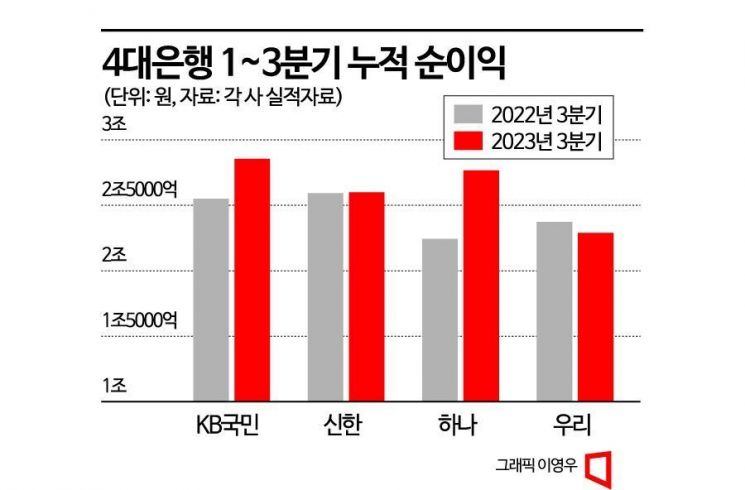
On the 30th, the cumulative net profit of KB Kookmin Bank, Shinhan Bank, Hana Bank, and Woori Bank for the third quarter reached 10.5107 trillion won. This represents a 7.7% increase compared to the same period last year (9.7604 trillion won). Looking at each bank, KB Kookmin Bank recorded 2.8554 trillion won, up 12% year-on-year; Hana Bank grew 23.3% to 2.7664 trillion won; and Shinhan Bank increased slightly by 0.3% to 2.5991 trillion won. Only Woori Bank saw a decrease in cumulative net profit to 2.2898 trillion won, down 3.5% from the previous year.
KB Kookmin Bank maintained its position as the leading bank with a third-quarter net profit of 996.9 billion won, a 21% increase year-on-year. The bank's strong performance was driven by net interest income and net fee income. In particular, won-denominated loans increased by 7.8 trillion won year-on-year, mainly in corporate loans, boosting interest income.
As of the third quarter, KB Kookmin Bank's won-denominated loans stood at 336.4 trillion won, up 2.4% from 328.6 trillion won in the same period last year. Corporate loans grew by 5.8% year-on-year, driving credit growth. Specifically, corporate loans reached 172.4 trillion won in the third quarter, an increase of 9.5 trillion won (5.8%) from 162.9 trillion won in the same period last year. This contrasts with a 1% decrease in household loans during the same period. Among corporate loans, large corporate loans increased significantly by 25.6% to 36.8 trillion won from 29.3 trillion won year-on-year, leading the growth in corporate lending. A KB Kookmin Bank official explained, "This is attributed to the contraction of the corporate bond issuance market and an overall increase in loan demand."
Shinhan Bank also saw corporate loans act as a 'breakwater' against net profit decline. Shinhan Financial Group's consolidated net profit for the third quarter fell 26.6% year-on-year to 1.1921 trillion won, but Shinhan Bank itself posted a 1.0% increase in net profit to 918.5 billion won, continuing its growth trend.
Shinhan Bank conservatively managed household loans, attaching conditions such as 'under 34 years old' to the 50-year mortgage loan products that commercial banks have competitively expanded recently. As a result, household loans remained at 127.2926 trillion won, down 3.1% year-on-year. However, corporate loans increased by 8.1%, mainly among large corporations, offsetting this decline. Consequently, the balance of won-denominated loans rose 2.8% to 286.2761 trillion won.
Shinhan Financial Group stated, "Household loans continued to decline due to reduced demand for unsecured loans amid rising interest rates and Debt Service Ratio (DSR) regulations, as well as the securitization of the Safe Conversion Loan. Meanwhile, corporate loans increased, driven by large corporations and high-quality small and medium-sized enterprises, leading overall growth."
Hana Bank was the most aggressive in corporate lending. Despite a 2.5% decrease in household loans to 126.644 trillion won due to strengthened DSR regulations and other factors, corporate loan balances surged 16.6% to 161.435 trillion won. This contributed to Hana Bank posting a net profit of 957 billion won in the third quarter, surpassing Shinhan Bank.
The increase in Hana Bank's corporate loans was also led by large corporate loans. Large corporate loans rose 59.65% year-on-year to 27.1 trillion won, while small and medium-sized enterprise loans increased 10.3% to 130.812 trillion won. SOHO loans also expanded by 1.2% to 59.547 trillion won.
This trend was also observed at Woori Bank. According to Woori Bank's loan status, household loans remained at 132.992 trillion won, down 1.8% year-on-year, but large and medium-sized corporate loans increased by 4.1% and 2.9% to 44.592 trillion won and 123.576 trillion won, respectively, offsetting the decline. Woori Bank recently declared the restoration of its reputation as a corporate finance specialist and is strengthening corporate operations by establishing two BIZ Prime Centers nationwide in Gyeonggi and Busan.
However, the industry expresses concern that aggressive corporate lending could backfire. A representative from a commercial bank said, "As household loan demand decreases, banks are strengthening loan operations not only to large corporations but also to small and medium-sized enterprises. While this will enhance profitability through external growth in the short term, it will also accumulate non-performing assets, which could eventually hamper performance after some time."
© The Asia Business Daily(www.asiae.co.kr). All rights reserved.


















