After the endemic phase, South Korea's economic growth rate remained at a mid-to-lower level among advanced economies. In contrast, it ranked high in inflation stability indicators. This has been interpreted as a 'macroeconomic indicator trade-off,' where the country's growth has been low over the past two years while inflation has been kept in check.
According to the International Monetary Fund (IMF) World Economic Outlook (WEO) on the 29th, South Korea is projected to record an annual growth rate of 1.4% this year, following 2.6% last year. This forecast aligns with projections from the Bank of Korea and the government.
The combined growth rate over the two years is 4.1%. Among the 41 advanced economies classified by the IMF, this ranks 25th, just behind the United States (4.15%). It is lower than the average growth rate of 5.9% for the 41 countries, indicating a relatively low growth rate.
Macau showed the highest growth rate at 47.6%, followed by Ireland (11.4%), Andorra (10.9%), Malta (10.7%), Iceland (10.6%), Israel (9.6%), Portugal (9.0%), Croatia (8.9%), Greece (8.4%), and Spain (8.2%).
Among the 11 countries with nominal Gross Domestic Product (GDP) exceeding 1 trillion dollars, comparable to South Korea, Spain had the highest growth rate at 8.2%, followed by Australia at 5.5%, the Netherlands at 4.9%, Canada at 4.7%, the United Kingdom at 4.6%, Italy at 4.4%, the United States at 4.15%, South Korea at 4.1%, France at 3.5%, Japan at 3.0%, and Germany at 1.3%. In South Korea's case, the semiconductor industry has been sluggish since the second half of last year, and the effect of China's reopening (resumption of economic activities) has fallen short of expectations.
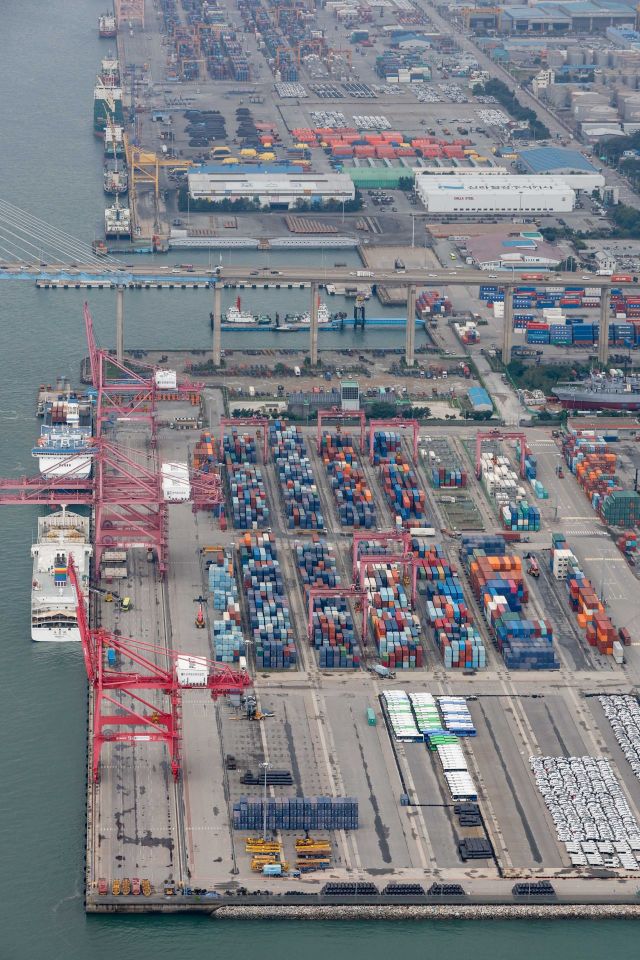 On the 27th, cargo containers are stacked at Pyeongtaek Port as seen from the air. [Aerial photography cooperation = Seoul Metropolitan Police Agency Aviation Unit, Pilots: Inspector Shin Seung-ho - Inspector Park Ji-hwan, Crew: Inspector Park Sang-jin] Photo by Kang Jin-hyung aymsdream@
South Korea performed well in inflation indicators. The IMF projects that the country's Consumer Price Index (CPI) will rise by 3.4% this year, following a 5.1% increase last year. The combined increase over two years is 8.5%, showing more stability compared to the average inflation rate of 13.6% among the 41 countries. This ranks as the sixth lowest inflation rate among the 41 advanced economies.
Macau recorded the lowest inflation rate at 1.9%, followed by Hong Kong (4.1%), Switzerland (5.0%), Taiwan (5.1%), and Japan (5.7%) occupying the top five positions. Among the 11 countries with nominal GDP over 1 trillion dollars, Japan had the lowest two-year inflation rate at 5.7%, followed by South Korea (8.5%), Canada (10.4%), France (11.5%), Spain (11.8%), and the United States (12.1%). The United Kingdom experienced the highest inflation rate at 16.7%.
According to OECD standards, inflation indicators are also favorable. Compared to December 2021 (base index 100), South Korea's Consumer Price Index rose to 108.6 in September, an increase of 8.6%. Among 34 countries with comparable data up to September, South Korea had the fourth lowest increase after Switzerland (104.7), Japan (106.1), and Israel (108.3). The average for the 34 countries was 118.2, a rise of 18.2%.
© The Asia Business Daily(www.asiae.co.kr). All rights reserved.

















