Hyundai Motor·Kia Achieve Record High Cumulative Performance in Q1-Q3 This Year
Annual Performance Expected to Be the Highest Ever
Only Domestic Listed Company Likely to Enter 'Operating Profit 10 Trillion Club'
Operating Profit Margin Expected at 10% This Year, Largest Increase Compared to Last Year
Operating Profit Margin Expected to Surpass Tesla, Volkswagen, and Toyota
Hyundai Motor Company and Kia are showing the fastest profitability improvement among global automakers this year. This is thanks to increased sales of high-margin vehicles such as eco-friendly cars and sport utility vehicles (SUVs), mainly in advanced markets. Hyundai Motor and Kia are also building record-breaking cumulative results for the first to third quarters of this year. Their annual operating profit margin is expected to reach double digits in the 10% range, surpassing major automakers such as Tesla, Volkswagen, and Toyota.
On the 29th, Hyundai Motor announced that its sales for the third quarter of this year increased by 8% year-on-year to 41.0026 trillion KRW, and operating profit rose by 146% to 3.8217 trillion KRW. Although this quarter's operating profit did not reach the record high of around 4.2 trillion KRW, it remains significantly higher compared to last year's average of 2.4 trillion KRW.
Kia also continued its strong performance by achieving an operating profit margin of over 11% in the third quarter. Kia's third-quarter sales increased by 10% year-on-year to 25.5454 trillion KRW, and operating profit surged by 273% to 2.8651 trillion KRW. Hyundai Motor and Kia are recording their highest-ever cumulative results for the first to third quarters this year.
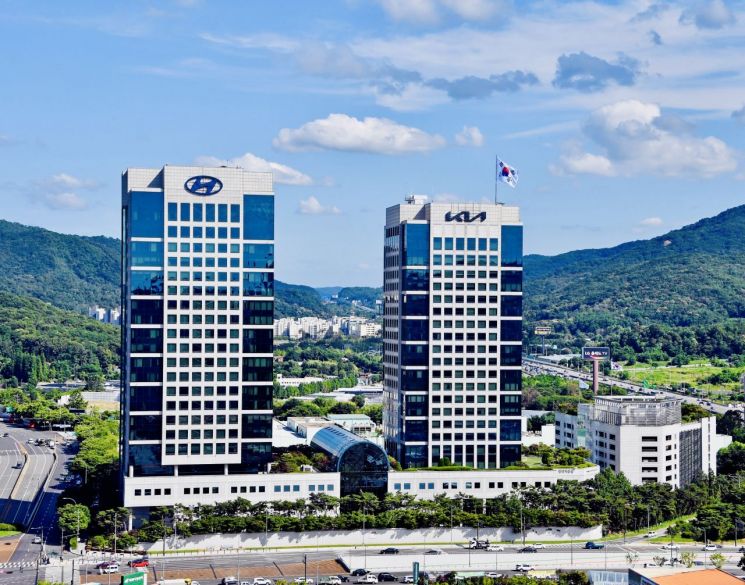 Hyundai Motor Group headquarters located in Yangjae-dong, Seocho-gu, Seoul [Photo by Hyundai Motor Group]
Looking at the annual operating profit margin forecasts of major global automakers, Hyundai Motor and Kia show the fastest increase. They are focusing on improving profitability by emphasizing premium models, SUVs, and eco-friendly vehicles. Now ranked as the third-largest automaker globally by sales, they have decided to prioritize qualitative growth over quantitative growth.
Asia Economy analyzed the operating profit margin forecasts for this year of major global automakers based on Bloomberg consensus data. The analysis showed that Hyundai Motor and Kia had the largest year-on-year increase among major companies, indicating the fastest profitability improvement. Hyundai Motor and Kia are expected to achieve an operating profit margin of 10.3% this year (Hyundai Motor 9.2%, Kia 11.8%), up 2.9 percentage points from last year. Toyota ranked second with a 2.3 percentage point increase, followed by BMW Group with 1.7 percentage points, Stellantis with 1.4 percentage points, and BYD with 0.6 percentage points, making up the top five.
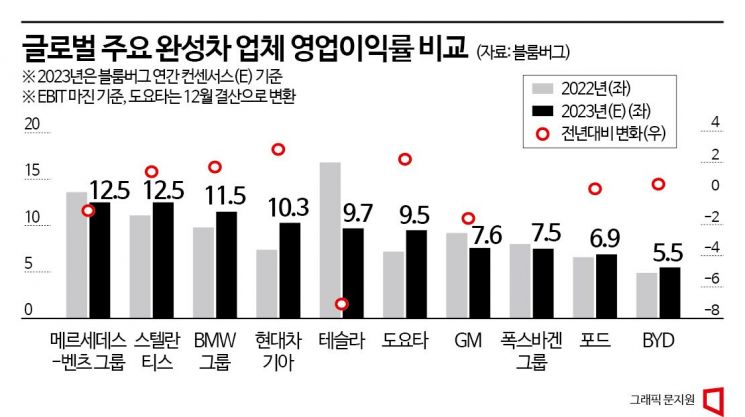
Based on operating profit margin rankings, Mercedes-Benz and Stellantis are expected to compete for first and second place with 12.5% each. BMW Group (11.5%) and Hyundai Motor and Kia (10.3%) are anticipated to have a close contest for third and fourth place. It is also notable that Tesla, which once surprised the industry with an operating profit margin exceeding 16%, is forecasted to have a single-digit margin (9.7%). This year, Tesla is pursuing market share expansion through aggressive discount strategies rather than profitability. This contrasts with Hyundai Motor and Kia’s strategy of shifting from quantitative to qualitative growth.
The industry attributes Hyundai Motor and Kia’s rapid profitability improvement to several factors. First, their brand status has changed in advanced markets such as North America and Europe. Hyundai Motor and Kia are expanding their eco-friendly vehicle market share by increasing their lineup of electric and hybrid vehicles. Advanced features are widely equipped in eco-friendly vehicles, raising the average selling price (ASP) per unit.
From the first to third quarters of this year, Hyundai Motor and Kia sold 213,270 eco-friendly vehicles in the U.S., a 61% increase year-on-year. Among these, 67% were hybrid models, and they actively increased the proportion of electric vehicles sold to fleets (corporate, rental, and used car dealers) excluded from the Inflation Reduction Act (IRA) benefits. Currently, fleet vehicles in the U.S. can receive government subsidies even if they are not locally produced electric vehicles.
Second, the increased proportion of premium brand Genesis and SUVs in total sales contributed to profitability. Selling expensive and large vehicles raises costs but also increases the profit margin for manufacturers. In the third quarter, Genesis accounted for 5.1% and SUVs for 54.7% of Hyundai Motor’s global sales. This means that six out of every ten Hyundai vehicles sold globally in the third quarter were either Genesis or SUVs. Kia’s RV (recreational vehicle) share in total sales also approached 70% in the third quarter.
Lastly, low fixed costs and flexible production policies are cited as reasons. Hyundai Motor and Kia have almost completed depreciation on their existing internal combustion engine production facilities. This means that producing internal combustion engine vehicles now generates profit. Additionally, some internal combustion engine production lines also produce electric vehicles simultaneously. They can now flexibly adjust their production portfolio among internal combustion engine, hybrid, and electric vehicles according to market demand while maintaining steady profits.
During the third-quarter earnings conference call, Seok Kang-hyun, head of Hyundai Motor’s Planning and Finance Division, emphasized, "In the past, overseas subsidiary executive evaluation indicators were based on sales volume, but now profitability targets are also set together." He added, "Hyundai Motor’s corporate structure, including decision-making and evaluation systems, has shifted from volume-centered to profitability-centered."
© The Asia Business Daily(www.asiae.co.kr). All rights reserved.

![Clutching a Stolen Dior Bag, Saying "I Hate Being Poor but Real"... The Grotesque Con of a "Human Knockoff" [Slate]](https://cwcontent.asiae.co.kr/asiaresize/183/2026021902243444107_1771435474.jpg)
















