Scheduled for phased operation from June next year
Target congestion rate reduced from 247% to within 200%
Gyeonggi Gimpo City announced that it will increase the number of vehicles on the Gimpo Gold Line. Through this, it plans to reduce the congestion rate, which once reached as high as 290%, to within 200%.
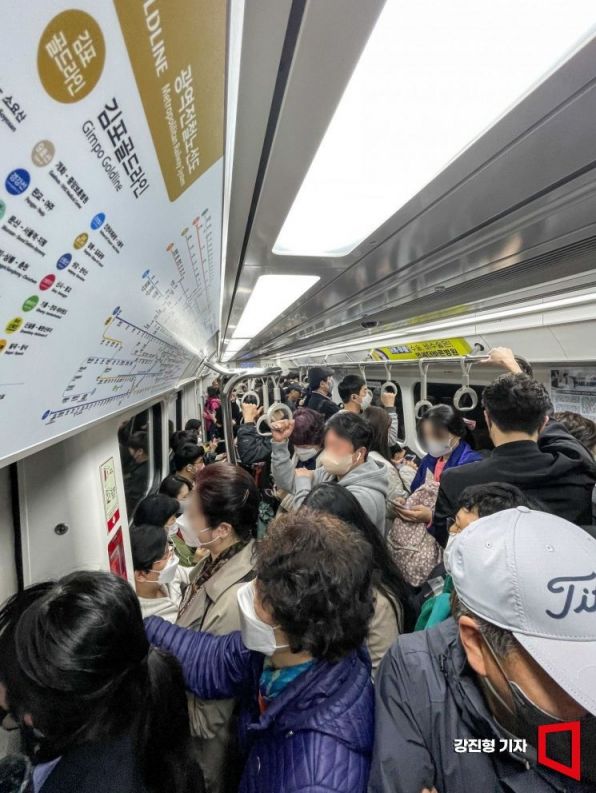
On the 27th, Gimpo City reported that one train set (2 cars, capacity 172 people) of the Gimpo Gold Line was brought into the Gimpo Hangang Vehicle Depot.
Additionally, four train sets (two each in November and December) are scheduled to be brought in. These vehicles will undergo preliminary runs and test operations and will be gradually put into service starting from June next year.
If a total of five train sets are added as planned, the current 23 train sets of the Gimpo Gold Line will increase to 28. The interval between trains during rush hours will be gradually shortened from the current 3 minutes 7 seconds to 2 minutes 30 seconds, increasing the transport capacity by about 2,000 passengers per hour.
Gimpo City aims to reduce the congestion rate during rush hours to within 200%. Currently, the hourly transport capacity of the Gimpo Gold Line during rush hours is about 6,000 passengers. However, it records the highest congestion rate nationwide with extreme congestion rates reaching up to 290% at peak and averaging around 240%.
On Mondays, there have been frequent cases of patients experiencing breathing difficulties, with 6 to 7 people affected daily, raising concerns about casualties. In response, since June, Gimpo City has been preparing for safety accidents by deploying 6 emergency medical technicians and 28 safety personnel.
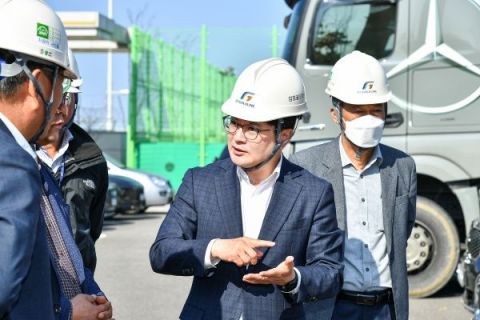 On the 27th, Mayor Kim Byung-su visited the site where Gold Line vehicles were being delivered for inspection.
 [Photo by Gimpo City Hall]
Kim Byung-su, Mayor of Gimpo City, said, "To improve the extreme congestion rate of the Gimpo Gold Line, we have promoted the project to increase the number of electric trains, and the first train set has been brought into the vehicle depot," adding, "This shortened the project period by about six months compared to the original plan."
The Gimpo Gold Line is an unmanned light rail transit operating on a 23.67 km section with 10 stations from Yangchon Station in Gyeonggi to Gimpo Airport Station.
Earlier this year, through the 'Gimpo Gold Line Congestion Improvement Task Force' led by the Ministry of Land, Infrastructure and Transport, various measures such as establishing new bus routes and creating bus-only lanes were implemented. As a result, about 3,000 passengers during rush hours used buses to travel to Gimpo Airport Station, reducing demand at Pungmu and Gochon Stations and alleviating congestion.
However, due to the recent settlement of Geomdan New Town, road traffic congestion on Olympic-daero and other roads has worsened, lengthening the waiting lines during commuting hours. The demand for rail transport, which ensures punctuality, is continuously increasing. Currently, the average daily ridership is 82,651, setting a record high since opening, and congestion rates have worsened back to levels similar to before the improvement measures.
Mayor Kim emphasized, "Even if we increase transport capacity by shortening train intervals through the electric train increase project, there is a limit to improving congestion rates because the demand for rail transport while waiting is so high," and added, "The extension of Seoul Subway Line 5 to Gimpo must be promptly finalized."
© The Asia Business Daily(www.asiae.co.kr). All rights reserved.
![Clutching a Stolen Dior Bag, Saying "I Hate Being Poor but Real"... The Grotesque Con of a "Human Knockoff" [Slate]](https://cwcontent.asiae.co.kr/asiaresize/183/2026021902243444107_1771435474.jpg)












