Localization of Core Equipment and Technology
HD Hyundai has successfully developed an independent low-carbon electric propulsion system for large vessels.
HD Hyundai's shipbuilding affiliates, HD Korea Shipbuilding & Offshore Engineering and HD Hyundai Heavy Industries, recently announced on the 27th that they have obtained the Approval in Principle (AIP) from Lloyd's Register (LR) in the UK for the "low-carbon electric propulsion system (Phase II) for ultra-large crude carriers (VLCC) based on high-voltage direct current power systems (MVDC) and large-capacity solid oxide fuel cells (SOFC)."
Earlier, in February of this year, HD Korea Shipbuilding & Offshore Engineering and HD Hyundai Heavy Industries received the Concept Design Approval from LR for the system configuration. Since then, they have continuously collaborated with LR, and have now acquired this certification, which includes verification of system efficiency and propulsion drive performance.
The certified system is a 30 MW-class electric propulsion system applied to 300,000-ton ultra-large crude carriers. It features the use of ammonia dual-fuel medium-speed engines and high-efficiency large-capacity fuel cells, achieving propulsion efficiency equivalent to large engines while enabling net-zero (carbon neutrality). Compared to existing solutions, it improves energy integration efficiency by 20%. Power quality has also been enhanced by 40%, and the overall system weight has been reduced by 20%.
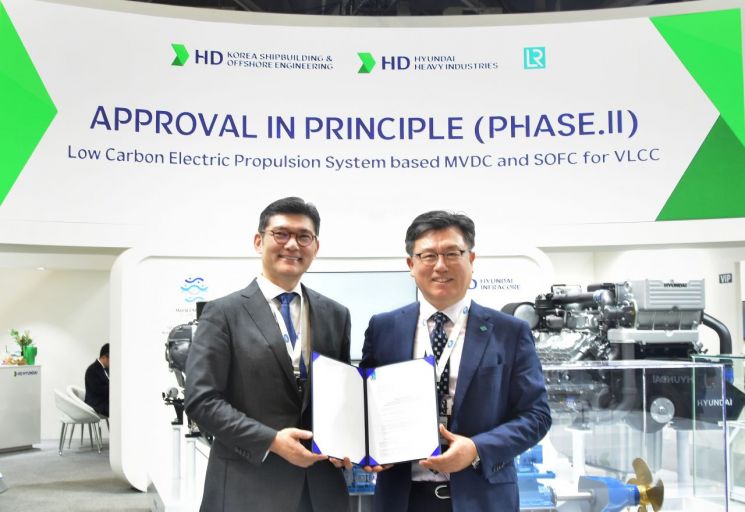 Kim Sung-jun, Head of Future Technology Research Institute at HD Hyundai Heavy Industries (left), and Kim Young-doo, Vice President and Head of Far East Asia Technology at Lloyd's Register
 [Photo by HD Hyundai]
To obtain this certification, HD Hyundai independently developed key equipment and technologies, achieving complete domestic production. HD Hyundai plans to complete onshore demonstration of the developed large-vessel low-carbon electric propulsion system by 2027 and pursue commercialization by 2028.
Kim Seong-jun, Head of Future Technology Research Institute at HD Korea Shipbuilding & Offshore Engineering, stated, "With the development of advanced ship electric propulsion technologies such as ammonia dual-fuel engines and large-capacity fuel cells, we have taken a step closer to realizing electrification of large vessels. By combining related technologies specialized for ship electrification, including hull forms and propellers, we will lead the decarbonization trend of large vessels."
Kim Young-doo, Vice President and Head of Technology for Far East Asia at Lloyd's Register, said, "Various technological developments are underway to respond to global decarbonization regulations led by Europe. In shipbuilding, the development of low-carbon, high-efficiency electric propulsion systems will provide significant competitiveness."
© The Asia Business Daily(www.asiae.co.kr). All rights reserved.

















