Assemblyman Lee Joo-hwan "Poor Performance in Introducing Korean-Style Street Sweepers"
Korean-Style Street Sweepers, Zero Units Distributed in Daejeon, Ulsan, and Sejong
In the past five years, the number of sanitation workers who have died reached 280, and the number of injured exceeded 30,000.
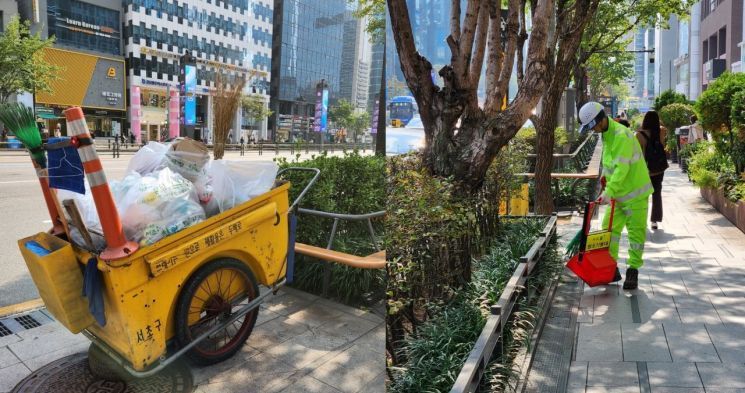 A sanitation worker is cleaning in front of Gangnam Station on Seoul Subway Line 2.
 [Photo by Im Chunhan]
According to the 'Sanitation Worker Accident Occurrence and Disaster Approval Status' received by Rep. Lee Joo-hwan of the National Assembly's Environment and Labor Committee from the Korea Workers' Compensation and Welfare Service on the 27th, 280 sanitation workers died and 30,258 were injured from 2019 to 2023.
Among the deceased, 230 received industrial accident approval, and among the injured, 29,129 were recognized as industrial accidents.
The number of deaths by year decreased from ▲2019 (73) ▲2020 (62) ▲2021 (51) but increased again to 67 last year.
This year, 27 deaths were reported by the end of July.
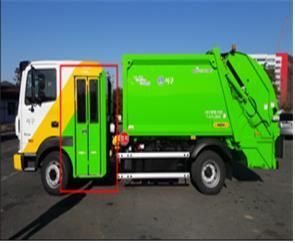 Korean-style street sweeper.
 Photo by Lee Joo-hwan's office
As safety accidents involving sanitation workers frequently occurred, six government ministries and local governments announced in October 2018 that they would introduce 224 'Korean-style cleaning vehicles' with a separate boarding and alighting space in the center instead of a rear footboard. However, the actual performance has been poor.
The number of vehicles distributed by region is ▲Jeonbuk (37) ▲Gangwon (35) ▲Jeonnam (35) ▲Gyeonggi (33) ▲Seoul (7) ▲Busan (3) ▲Jeju (2) ▲Chungbuk (1) ▲Chungbuk (1), and none have been introduced in Daejeon, Ulsan, or Sejong.
Earlier on the 5th, an incident occurred in Daejeon where a sanitation worker was hit and killed by a drunk driver. The perpetrator was tried on charges including reckless driving causing death and hit-and-run under the Act on the Aggravated Punishment of Specific Crimes and was sentenced to eight years in prison.
In September, a street sanitation worker was also killed after being hit by a dump truck at the Jang-dong intersection in Dong-gu, Gwangju.
Rep. Lee said, "Sanitation workers are still exposed to danger and fatal accidents continue to occur, but government policies are still out of touch with the field," adding, "There are also criticisms that the Korean-style cleaning vehicles have less collection capacity than existing cleaning vehicles and that their large size makes them unsuitable for alleyway collection visits."
© The Asia Business Daily(www.asiae.co.kr). All rights reserved.

















