WD Notifies Kioxia of Negotiation Suspension
"Failed to Obtain Consent from SK Hynix and Bain Capital"
The merger negotiations between Western Digital (WD), a global NAND flash memory company based in the United States, and Japan's Kioxia have ultimately fallen through. It is understood that the talks failed to bridge differences amid opposition from Kioxia's major shareholders. Although both companies have stated their intention to continue their cooperative relationship, attention is focused on what survival strategies they will pursue in an increasingly competitive and consolidating semiconductor industry.
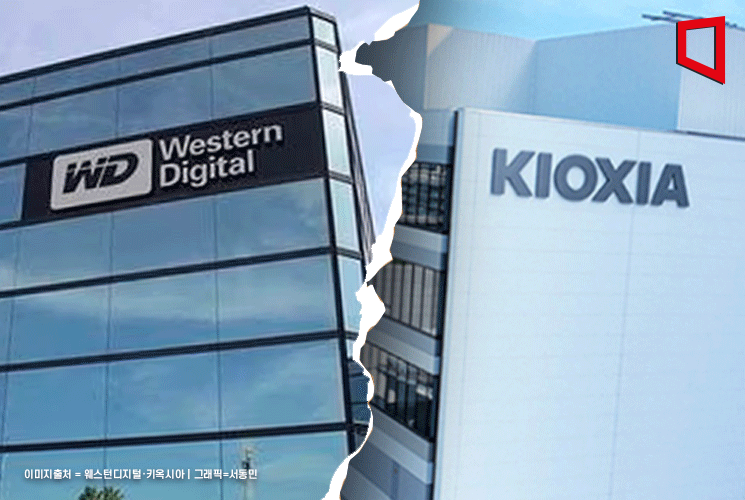
According to the Nihon Keizai Shimbun (Nikkei) on the 27th, WD announced the day before that it was suspending merger talks between its semiconductor division and Kioxia Holdings. Initially, the two companies had been negotiating with the goal of reaching a final agreement on the merger by the end of this month.
Nikkei analyzed that the main reason for the breakdown in negotiations was opposition from Kioxia's major shareholders. WD failed to obtain consent from SK Hynix, which has an indirect stake in Kioxia, and also could not narrow differences regarding merger terms with Bain Capital, a U.S. private equity firm and Kioxia's largest shareholder.
Previously, in 2017, Toshiba's memory business unit, the predecessor of Kioxia, was sold to Bain Capital. At that time, Bain Capital formed a Korea-U.S.-Japan consortium and purchased 49.9% of the shares. SK Hynix also became a major shareholder by investing 4 trillion won in this consortium. Due to this shareholding structure, SK Hynix's consent was necessary to proceed with Kioxia's merger.
However, during the Q3 earnings conference call held the day before, SK Hynix publicly opposed the merger, stating, "Considering the value of our investment in Kioxia comprehensively, we do not agree to the merger between Kioxia and WD," and added, "We will make choices that benefit all stakeholders, including investors and Kioxia."
Both Kioxia and WD are global NAND flash companies, and if the merger had been successful, SK Hynix, which competes with them in this field, would have faced the risk of market share contraction. According to market research firm TrendForce, the global NAND flash market shares in Q2 this year were Samsung Electronics (31.1%), Kioxia (19.6%), SK Hynix (17.8%), and WD (14.7%). Nikkei reported, "If the world's second-largest Kioxia and fourth-largest WD merge, their combined scale would rival that of Samsung Electronics, the market leader," adding, "It appears to be an attempt to secure profits through scale expansion and continue growth."
Besides becoming an industry leader through the merger, there were concerns that WD might become an obstacle in future negotiations with Kioxia. The Yomiuri Shimbun reported, "SK was considering future collaboration with Kioxia," and "They opposed the merger fearing that WD's strengthened leadership would be detrimental."
With the merger talks collapsed, the two companies plan to individually initiate improvement measures such as fundraising and business restructuring. This is because both companies' profits are declining amid the global economic downturn and international uncertainties such as the wars in Ukraine and Israel.
However, the two companies have agreed to continue their business collaboration. Currently, Kioxia and WD are jointly investing equally in manufacturing bases located in Mie Prefecture and Iwate Prefecture in Japan, and are cooperating in development and manufacturing processes.
© The Asia Business Daily(www.asiae.co.kr). All rights reserved.

















