U.S. Treasury Secretary Janet Yellen reinforced the possibility of a soft landing, stating that the rise in U.S. Treasury yields exceeding 5% reflects the strength of the U.S. economy rather than an expanding fiscal deficit. Regarding U.S.-China relations, she assessed that the worst phase has passed and praised the first face-to-face meeting between U.S. President Joe Biden and Chinese President Xi Jinping in November last year for establishing a new channel of communication between the two countries.
On the 26th (local time), in an interview with Bloomberg News, Yellen said that the recent surge in U.S. Treasury yields (10-year) to the highest levels since the financial crisis "reflects the resilience of the U.S. economy." She added, "(The rise in Treasury yields) is an international phenomenon occurring mainly among developed countries," emphasizing, "This reflects people's expectations of the flexibility of the U.S. economy and is not a sign of an economic downturn."
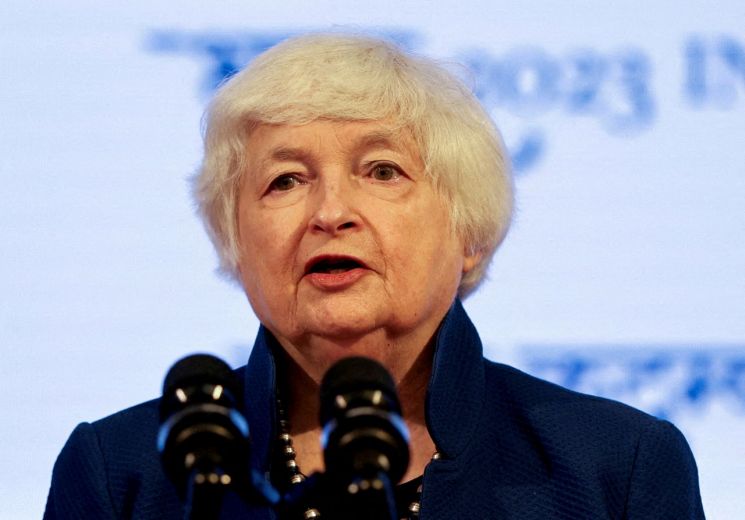
She also stressed that the U.S. economy is showing solid growth. Referring to the surprise data showing the U.S. third-quarter Gross Domestic Product (GDP) growth rate at an annualized 4.9%, she said, "The strong pace of economic expansion can be interpreted as a signal of a soft landing where interest rate hikes do not cause a recession and the 2% inflation target can be achieved."
She added, "There is certainly a possibility that Treasury yields will decline in the long term, but no one can guarantee it." U.S. Treasury yields have shown a steeper rise since the Federal Open Market Committee (FOMC) meeting in September. While the market acknowledges the solid momentum of the U.S. economy, concerns have grown that the sharp rise in Treasury yields and prolonged high interest rates could stimulate various debt risks, including consumer sentiment and expanding fiscal deficits.
Regarding the impact of the Israel-Palestine conflict on the global economy, she said, "So far, there has been no significant impact, and international oil prices remain stable," adding, "Of course, if the conflict escalates, there will be additional effects, but it is premature to get ahead of the situation at this point."
On the re-freezing of Iranian oil export payments, which were linked to Iran, identified as the backer of the Palestinian militant group Hamas that attacked Israel, she stated, "Not a single penny of those funds has been touched," elaborating, "Most of the funds that were frozen in South Korean banks were transferred to Qatar and were in the process of being sent to Iran, and the funds remain in that state." The Treasury Department imposed the re-freezing measure on $6 billion of Iranian oil export payments transferred from South Korean banks to Qatar on the 12th, following Hamas's invasion of Israel.
Regarding U.S.-China relations, she said, "The U.S. has been overly dependent on China in certain areas such as clean energy," adding, "These are areas where compromise is difficult from a national security perspective, and export controls and investment restrictions will continue in this context."
However, Yellen reaffirmed the U.S. government's consistent principle of narrowly targeting areas directly related to security, stating, "There is absolutely no intention to harm China's economic growth," and pointed out that there are also areas requiring cooperation with China, such as climate change.
She particularly referenced the first face-to-face summit between President Biden and President Xi in November last year, noting, "Until then, there had been no high-level meetings between the U.S. and China for about two years," and assessed, "It is true that during the pandemic, the U.S. and China were in a dangerous situation."
She continued, "Through the COVID-19 pandemic and the Russia-Ukraine war, we became aware of supply chain crises and realized that supply chains were concentrated in certain countries, including China." To reduce such vulnerabilities and diversify supply chains, she emphasized the need for reshoring (the return of overseas companies to the domestic market) and the importance of 'friend-shoring,' which involves strengthening investments in trustworthy countries.
© The Asia Business Daily(www.asiae.co.kr). All rights reserved.

















