The Jogye Order of Korean Buddhism criticized the Supreme Court ruling that a Japanese temple holds ownership of a Goryeo Dynasty gilt-bronze seated Avalokitesvara Bodhisattva statue (Buddha statue), which was stolen and taken to Japan before being brought back to Korea by thieves, calling it "anti-historical."
In a statement on the 26th, the Jogye Order said, "The 'Gilt-Bronze Seated Avalokitesvara Bodhisattva Statue' of Seosan Buseoksa Temple was created in 1330 and enshrined at Seosan Buseoksa. It has been sufficiently verified and acknowledged by previous rulings that it was forcibly taken to Japan due to plundering by Japanese pirates in the early Joseon period," and pointed out that the Supreme Court "dismissed the case simply on the grounds of the completion of the statute of limitations, ignoring the special nature of looted cultural properties."
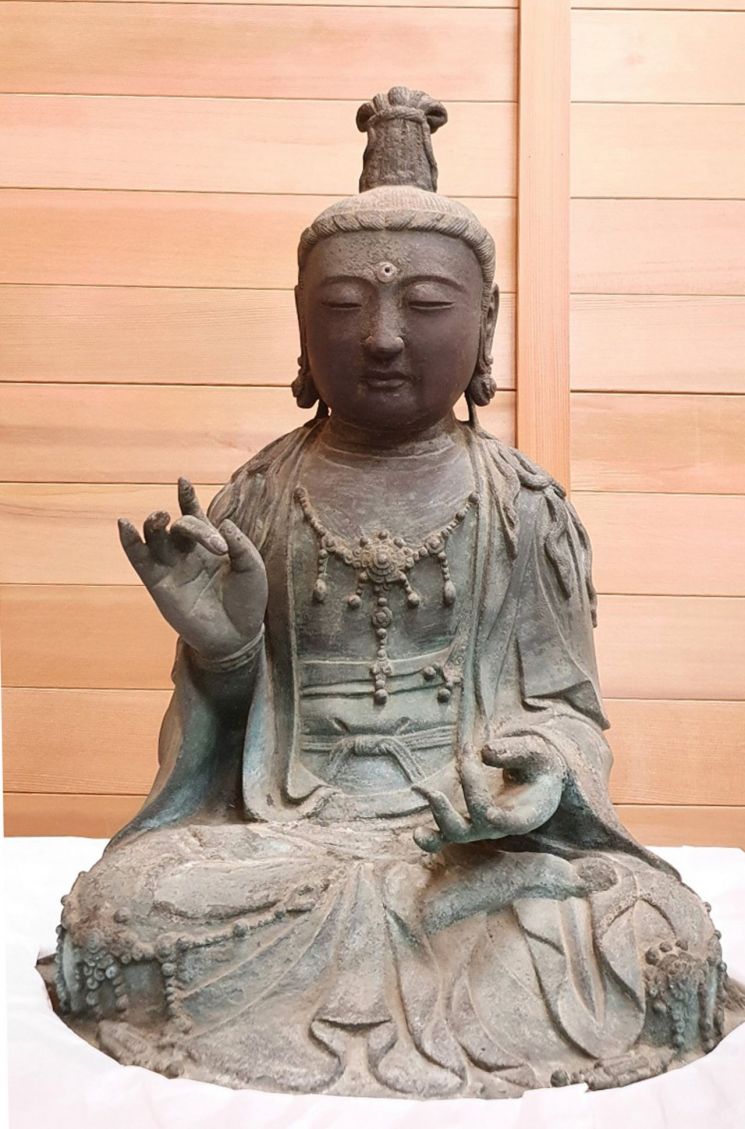 A Goryeo Dynasty gilt-bronze seated Avalokitesvara Bodhisattva statue (Buddha statue) brought into the country from Japan by a thief
They continued, "Recognizing the statute of limitations for stolen cultural properties that were forcibly taken out of the country is not only illogical but also encourages the concealment and illegal possession of looted cultural properties."
Furthermore, they explained, "Article 5 of the 1995 UNIDROIT Convention on Stolen or Illegally Exported Cultural Objects declares that member states can request the return of illegally exported cultural properties regardless of the statute of limitations."
The Jogye Order stated, "If the statute of limitations for looted cultural properties is recognized as the Supreme Court ruled, it is clear that the looting countries will claim ownership in all future cases of looted cultural properties," and added, "Despite this ruling, the Order will make every effort to restore the Gilt-Bronze Seated Avalokitesvara Bodhisattva Statue of Seosan Buseoksa to its original place."
The Goryeo Dynasty gilt-bronze seated Avalokitesvara Bodhisattva statue was stolen by Korean thieves in October 2012 from the Kannonji Temple (觀音寺) on Tsushima Island, Japan, and brought back to Korea. After a seven-year ownership dispute with the Japanese temple, it was returned to Japan. The Supreme Court's First Division (Presiding Justice Oh Kyung-mi) on the 26th upheld the lower court's ruling against Seosan Buseoksa Temple's claim for the delivery of the movable property in a lawsuit filed against the state.
© The Asia Business Daily(www.asiae.co.kr). All rights reserved.

















