Gwangju Mayor Kang Ki-jung Announces 'Yeongsan River 100-ri Trail Y Project'
20 Projects Based on Four Core Values: Clear Water, Exciting, Eco, Connection
Total Budget of 378.5 Billion KRW... Sequential Launch Starting Next Year
Gwangju will be completely transformed into a fun city full of life and charm centered around the Yeongsan River.
On the 26th, Kang Ki-jung, Mayor of Gwangju Metropolitan City, unveiled the blueprint for the 'Yeongsan River 100-ri Road, Y Project,' a core pledge of the 8th term of the local government. While Gwangju has so far focused on developing the old downtown area centered around Mudeungsan Mountain and Gwangjucheon Stream, the Y Project now aims to transform the city into a vibrant and attractive place all year round, centered on the Yeongsan River.
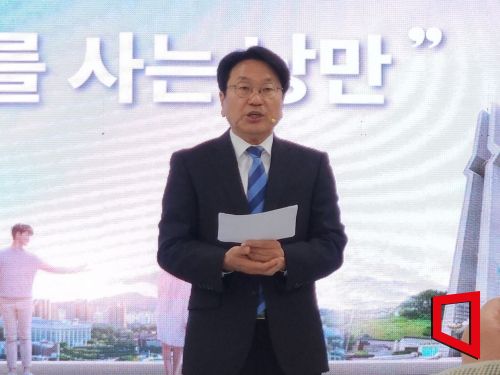 Gwangju Mayor Kang Ki-jung is presenting the blueprint for the 'Yeongsan River 100-ri Trail, Y Project,' a key pledge of the 8th term of the local government, on the 26th.
The Y Project values ‘clean water,’ ‘exciting,’ ‘eco,’ and ‘connection,’ and to realize this, it will implement 20 projects (8 leading, 9 mid-term, 3 ongoing) through 4 core strategies in 3 directions.
The four core strategies are ▲ Yeongsan River, the river of life with clean water flowing ▲ Yeongsan River Exciting Park to enjoy the river ▲ Hwangryong River Eco Land connected by stories ▲ Riverline 100-ri Road connecting riverside forest trails.
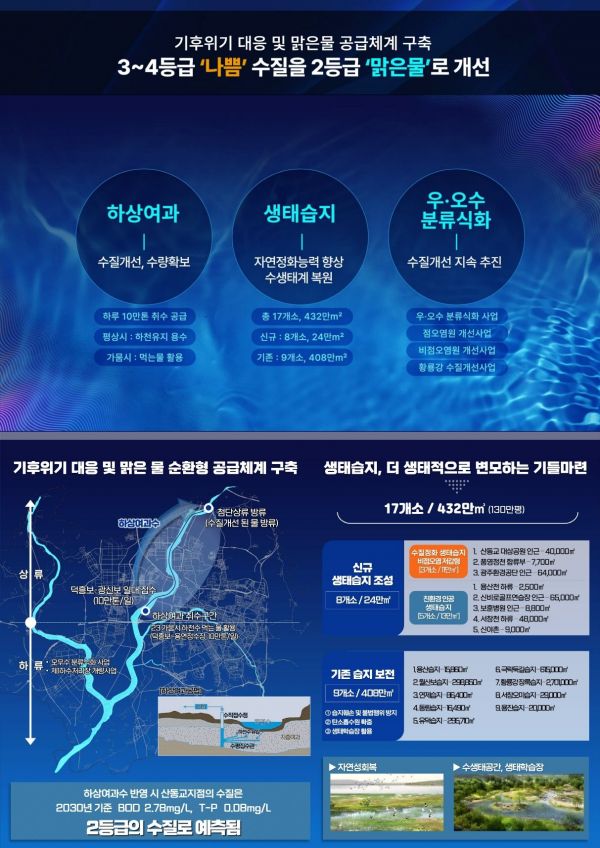
▲ Creating a Grade 2 Clean Yeongsan River by 2030
The core of the Y Project is, above all, to purify the water. Currently, the Yeongsan River has the worst water quality among Korea’s four major rivers. While the other three rivers have been managed as drinking water sources, the Yeongsan River has been managed as agricultural water. The plan is to improve the current poor water quality, rated 3rd to 4th grade, to clean water of 2nd grade by 2030.
Using the bed filtration method, 100,000 tons of clean water will be drawn daily to be used as drinking water during droughts or crises, and normally as maintenance water for the Yeongsan River, establishing a two-in-one circulating supply system. Additionally, eight new wetlands will be created and nine existing wetlands reinforced to reduce pollution sources and strengthen the river’s natural purification function. Projects such as the separated sewer system (separating sewage and stormwater), point source pollution improvement, non-point source pollution improvement, and Hwangryong River water quality improvement will continue according to the basic sewerage maintenance plan.
▲ ‘Exciting Park’ in the heart of the city where water and mountains meet
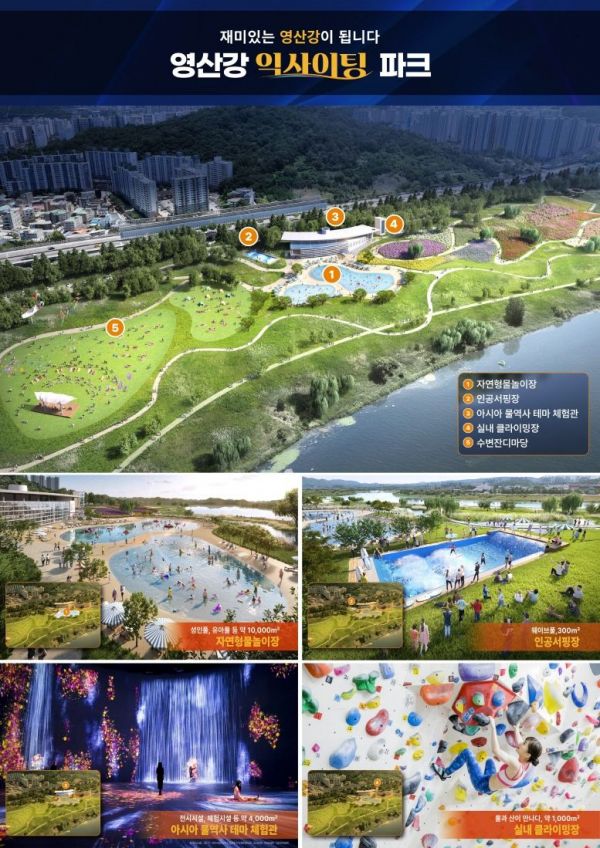
The second core strategy, ‘Yeongsan River Exciting Park,’ aims to create an exciting fun line to transform the Yeongsan River into an enjoyable place. An exciting zone will be established around Sandonggyo Bridge in the heart of the city where water and mountains meet, a place alive with the big history of the Mahan period.
An ‘Asia Water History Theme Experience Center’ will be built to digitally experience the development of civilization exchange and urban formation through the Yeongsan River. The project budget has been included in the government budget, with design competitions for five facilities planned next year and completion targeted for 2026.
Also, a 10,000㎡ natural water playground will be created to recreate childhood memories of bathing in the Yeongsan River. Plans include an ‘artificial surfing site’ for unique surfing experiences on land, an ‘indoor climbing gym’ where water and mountains meet, and a roughly 12,000㎡ ‘waterside lawn yard’ where citizens can enjoy outdoor performances, picnics, and festivals.
Ecological and emotional attractions that preserve the Yeongsan River ecosystem will also be installed. At the old Seochang Port, an observatory will be built to enjoy the three moods (sunset, silver grass, wind), and an ecological sculpture symbolizing the love and hope of mandarin ducks inhabiting Deokheung-dong Hajungdo will be created.
Seungchon Island will be reborn as an ‘island of romance and healing’ full of nature and memories. It will feature a healing camping site with 170 spots including pet camping, glamping, and auto camping, making it a ‘camping mecca.’ The ‘Bitgoeul Floating Performance Hall,’ a theater on the water for events such as riverside song festivals, film festivals, and concerts, will also be established here.
▲ Hwangryong River Eco Land where stories flow
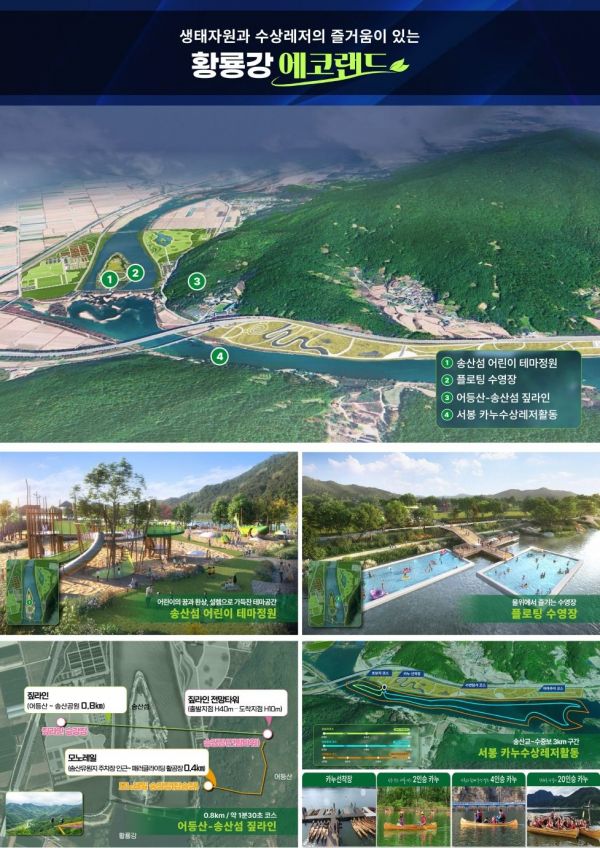
The third core strategy, ‘Hwangryong River Eco Land,’ will transform the Hwangryong River into the ‘Hwangryong River Ecological Leisure Line’ where visitors can enjoy water leisure activities harmonized with the river’s ecological resources.
The Hwangryong River embraces the Jangnok Wetland, a national wetland in the city center. Covering 2.67 million㎡, the Jangnok Wetland acts as the lungs of the city. An ecological learning center and carbon sink will be established here to raise awareness of the wetland’s value and preserve it as a precious gift for future generations.
Additionally, Songsan Island and Seobong District’s latent ecological value will be developed with facilities such as a children’s theme garden, floating swimming pool, zip line, and canoe water leisure facilities.
Songsan Island, a well-known recreational area of 44,000㎡, will be specialized as a ‘children’s theme garden’ with a 500㎡ floating swimming pool, children’s playground, lawn yard, and a mysterious mist zone.
In the Hwangryong River Seobong District, courses for beginners, amateurs, and waterside exploration will be prepared to enjoy ‘canoe water leisure’ even in the city.
A zip line crossing the Hwangryong River from Eodeungsan Mountain will be installed to provide a dynamic thrill. For tourism and leisure projects like the zip line, private investment attraction linked to the central government’s ‘Regional Revitalization Investment Fund’ will be considered to improve services and reduce costs.
Especially, if the recently submitted project plan for the Eodeungsan Tourism Complex is realized, the Hwangryong River Eco Land is expected to be specialized as the ‘Hwangryong River Eco Travel Belt’ alongside the Jangseong Yellow Flower Festival.
▲ Creating the ‘Riverline 100-ri Road’ connecting waterways, forest trails, and Sarim trails
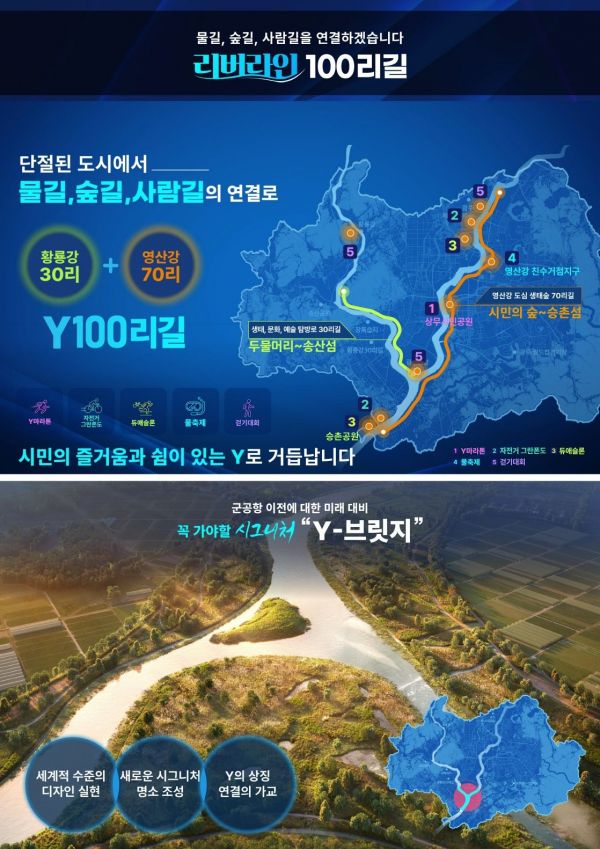
Finally, the ‘Riverline 100-ri Road’ is a strategy to restore Gwangju as a pedestrian-centered city by connecting waterways, forest trails, and walking paths along 100 ri?30 ri of the Yeongsan River and 70 ri of the Hwangryong River.
The Yeongsan River Riverline 100-ri Road will be completed as the ‘Gwangju RE100 Walkable Road’ by connecting disconnected bicycle paths and riverside walking trails along the urban ecological forest path.
At the confluence of the Yeongsan and Hwangryong Rivers, the ‘Y Bridge’ will be constructed. Serving as a communication path where humans, nature, technology, and art meet, the Y Bridge is expected to emerge as the ‘new center of Gwangju’ in conjunction with the relocation of the military airport.
Gwangju City plans to cultivate it as a unique ‘signature landmark’ through a planning and design competition.
Moreover, to make the Yeongsan and Hwangryong Rivers vibrant places of enjoyment and rest for citizens, events such as the Y Marathon, bicycle gran fondo, duathlon, water festival, and walking competitions will be organized for citizens to actively participate in creating.
▲ 378.5 billion KRW investment in 4 strategies and 20 projects
The total budget for the Y Project is 378.5 billion KRW. The main allocations are ▲ 123.9 billion KRW for the climate crisis response clean water creation project ▲ 101.9 billion KRW for the Yeongsan River Exciting Project ▲ 60.4 billion KRW for the Hwangryong River Eco Land creation ▲ 92.3 billion KRW for the Riverline 100-ri Road connection and park creation projects.
Gwangju City will invest 5.7 billion KRW next year to start the projects. Specifically, the climate crisis response clean water project will begin related administrative procedures next year to attract central government support. The Exciting Project will hold a design competition in 2024, start construction in 2025, and aim for completion in 2026. The Hwangryong River Eco Land project will enter design in 2024, start construction in 2025, and complete in 2026. The Riverline 100-ri Road connection project will undergo design next year and begin construction in 2025.
Gwangju City plans to establish the ‘Yeongsan River Area Administrative Council’ with neighboring cities to discover and jointly promote super-regional cooperation projects for greater mutual growth and prosperity.
Additionally, to secure national funding, communication with the central government will be strengthened, and an organic cooperative system with related organizations such as the Yeongsan River Basin Environmental Office will be established to secure momentum for project implementation.
Mayor Kang Ki-jung of Gwangju said, “We have dreamed of transforming into a new Gwangju through imagination. From the Gwangju that revolutionized history, we will change to a new era of Gwangju that enhances the value of my life,” and added, “We will succeed in the Y Project together with the citizens of Gwangju so that the city grows bigger, more ecological, and full of vitality and charm.”
© The Asia Business Daily(www.asiae.co.kr). All rights reserved.



















