The three major indices of the U.S. New York stock market fell collectively in early trading on the 25th (local time) due to rising Treasury yields and concerns over Google Alphabet's cloud performance.
At around 10:04 a.m. at the New York Stock Exchange (NYSE), the Dow Jones Industrial Average, which focuses on blue-chip stocks, was trading at around 33,020, down 121.37 points (0.37%) from the previous close. The S&P 500, centered on large-cap stocks, fell 41.08 points (0.97%) to around 4,206, while the tech-heavy Nasdaq dropped 178.87 points (1.36%) to 12,961.
Currently, all 11 sectors within the S&P 500 are in decline. The telecommunications sector is down more than 4%. Alphabet's stock is trading down over 8% despite its Q3 revenue and earnings, released after the previous day's close, beating expectations, due to confirmed weakness in its cloud division. Apple is down about 2%, and Amazon is down in the 3% range. Boeing, which released earnings before the market opened, fell more than 1%. Meta Platforms, which is about to release earnings, is also down about 1%. On the other hand, Microsoft (MS) rose more than 4%.
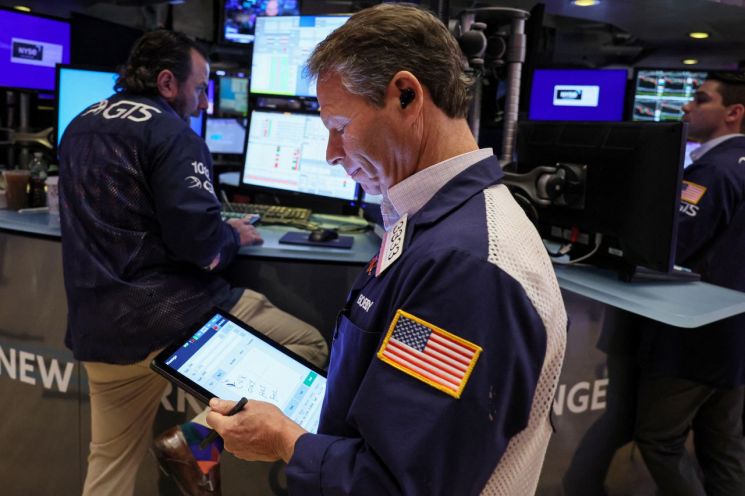
Investors are closely watching earnings reports from major companies including big tech, Treasury yield movements, and geopolitical risks stemming from the Middle East. As Q3 earnings continue to be released, investor attention is particularly focused on big tech, which drove the New York stock market in the first half of the year. Alphabet and MS both posted quarterly growth rates exceeding expectations, but mixed results in the cloud segment are reflected in today's stock movements. Meta Platforms and others will release their quarterly results after the market closes today. According to LSEG, over 80% of the S&P 500 companies that have reported so far have beaten expectations.
Ed Moya, senior market strategist at OANDA, told CNBC, "Earnings are dominating the headlines, but you can't take your eyes off the bond market." He added, "We haven't seen Treasury yields rise this sharply since 1982, and this will be a problem for the stock market."
In the New York bond market, Treasury yields are showing a slight upward trend. The benchmark 10-year U.S. Treasury yield, which had previously pressured the market by exceeding 5%, had stabilized at the 4.8% range the day before. As of this morning, it is trading around 4.90%. The 2-year yield, sensitive to monetary policy, is at 5.09%. The rise in long-term yields is putting pressure on interest rate-sensitive tech and growth stocks.
Federal Reserve Chair Jerome Powell is scheduled to deliver the opening remarks at a lecture in Washington, D.C. today. However, since this is a blackout period during which officials are prohibited from commenting on monetary policy, no related statements are expected.
Later this week, the U.S. Q3 Gross Domestic Product (GDP) growth rate and the Personal Consumption Expenditures (PCE) price index, the Fed's preferred inflation gauge, will also be released. The September PCE price index is estimated to have risen 0.4% month-over-month. The Q3 economic growth rate is expected to reach the mid-4% range annually, supported by robust consumption. If these indicators exceed expectations, concerns about Fed tightening could intensify.
The market widely expects the Fed to hold rates steady in November. According to the CME FedWatch tool, as of today, federal funds futures are pricing in a greater than 99% probability that the Fed will keep rates unchanged at 5.25-5.5% at the FOMC meeting scheduled for October 31 to November 1. Since Chair Powell's remarks last week, there is nearly a 1% chance of a rate cut rather than a hike. Despite expectations of prolonged high rates, the possibility of an immediate rate increase is considered very low.
Additionally, geopolitical risks from the conflict between Israel and the Palestinian militant group Hamas continue. Major foreign media, citing sources, reported that the delay in Israel's ground offensive is due to U.S. concerns about the aftermath of driving Hamas out of the Gaza Strip. The international community is divided over whether a ceasefire or hostage release should come first amid ongoing military actions.
European stock markets are also down. Germany's DAX index fell 0.56%. The UK's FTSE and France's CAC indices declined by 0.10% and 0.47%, respectively.
© The Asia Business Daily(www.asiae.co.kr). All rights reserved.

















