Japan and the European Union (EU) announced that JT-60SA, a fusion experimental device jointly developed by the two, has succeeded in achieving the plasma state, which is the basic stage of nuclear fusion. As competition intensifies among major countries including the United States and China over nuclear fusion power generation technology, Japan and the EU are also expected to secure independent technological capabilities based on joint research.
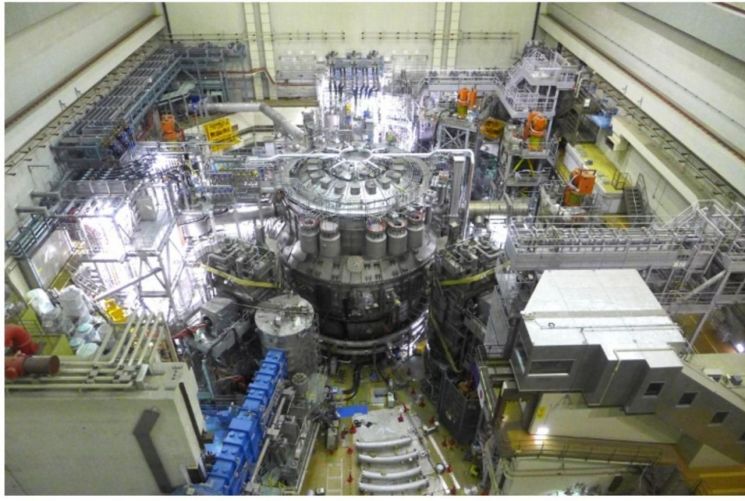 The nuclear fusion experimental device 'JT-60SA' jointly developed by Japan and the European Union (EU). [Image source=Japan Quantum Science and Technology Research and Development Organization (QST)]
According to Japanese local media such as Nihon Keizai Shimbun (Nikkei) and Mainichi Shimbun on the 25th, the National Institutes for Quantum and Radiological Science and Technology (QST), Japan’s nuclear fusion technology research organization, announced that it succeeded in realizing the plasma state in JT-60SA, which is jointly developed with the EU. QST confirmed the plasma state on the 23rd at the device located in Naka City, Ibaraki Prefecture, and began test operations.
The plasma state refers to the condition where hydrogen atomic nuclei and electrons are separated, which is considered an important basic stage for nuclear fusion power generation. In the plasma state, ultra-high pressure and ultra-high temperature heating can induce nuclear fusion of atomic nuclei.
Previously, in December last year, the United States announced success in so-called "ignition," where the energy produced by the nuclear fusion reaction exceeded the energy input to initiate fusion. Currently, competition to secure nuclear fusion technology is intensifying among countries including the United States and China.
The International Thermonuclear Experimental Reactor (ITER), jointly developed by seven countries including South Korea, the United States, China, the EU, India, Japan, and Russia, is being constructed in France, but each country is competing separately to secure independent technology.
Japan and the EU are currently jointly developing JT-60SA at the experimental reactor stage, which is an early phase, but it is expected that they will independently design the next stages of nuclear fusion power plants such as prototype reactors and demonstration reactors.
Mainichi Shimbun reported, "QST has started basic design to decide on the construction of a prototype reactor by 2035," adding, "International competition will intensify from the prototype reactor development stage, and while Japan and the EU will cooperate, they plan to independently build their own prototype reactors. The United States and the United Kingdom also plan to develop independent prototype reactors by around 2040."
© The Asia Business Daily(www.asiae.co.kr). All rights reserved.

















