"We will build a global bio cluster that will lead the domestic bio-industry ecosystem, similar to the ‘Boston Bio Cluster’ in the United States."
Kang Byung-chul, Deputy Director of the SNU Global Bio Cluster Promotion Team (Director of Research Affairs at Seoul National University), said this in an interview with Asia Economy on the 25th. Deputy Director Kang oversees policy direction establishment and cooperation with academia, industry, medical sectors, and government agencies as part of the Global Bio Cluster Promotion Team formed to promote the ‘Global Bio Cluster’ that Seoul National University plans to establish around the Siheung Campus in Gyeonggi Province.
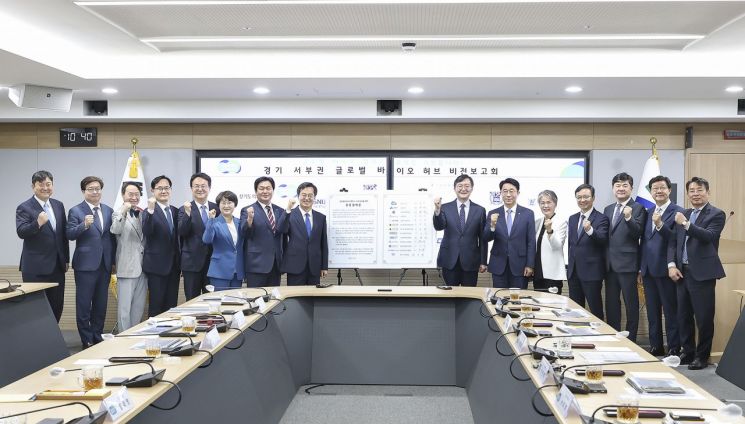 Seoul National University, Gyeonggi Province, and other officials held the "Western Gyeonggi Global Bio Hub Vision Report Meeting" last May to discuss plans for fostering a bio cluster.
 [Photo by Seoul National University]
The bio-industry is a representative future growth engine. The Korea Institute for Industrial Economics and Trade predicted that the global bio-industry market size will grow from $11 trillion in 2020 to $16 trillion by 2026, with an average annual growth rate of 6.1%. The size of South Korea’s bio-industry is also expected to grow from $171.8 billion to $269.9 billion during the same period. President Yoon Suk-yeol declared in February that he would foster the bio-industry as the ‘second semiconductor.’
Seoul National University’s bio cluster initiative began last February when the World Health Organization (WHO) selected South Korea as the sole recipient of the ‘Global Bio Workforce Training Hub’ project. Following WHO’s announcement, the Ministry of Health and Welfare launched a call for the ‘Global Bio Campus Construction Project,’ and Seoul National University participated by forming a consortium with Siheung City. In September of last year, Seoul National University signed a memorandum of understanding (MOU) with Gyeonggi Province and Siheung City, expanding the project to establish a large-scale global bio cluster at the SNU Siheung Campus that integrates bio workforce training, innovative new drug research and development (R&D), and industry convergence. Deputy Director Kang explained, "We thought that just conducting the WHO education project would lack scalability, so we set the goal to build a bio cluster where workforce training, R&D facilities, and bio-company cultivation can all be carried out in one place."
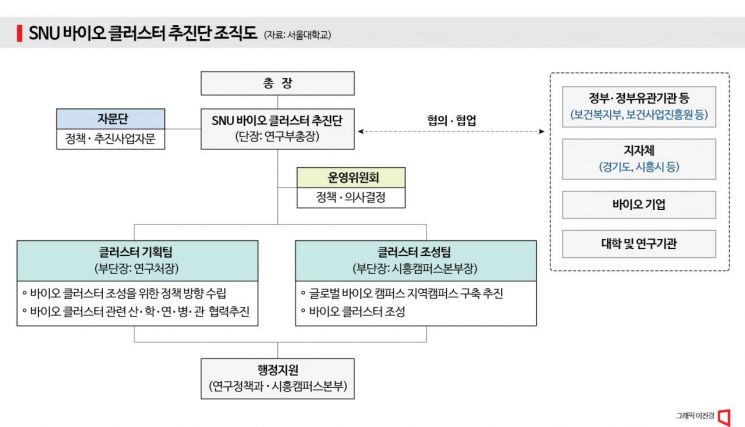
The SNU Bio Cluster aims to create an innovative ecosystem where universities, R&D, companies, and hospitals operate organically, similar to the Boston Bio Cluster in the United States. Boston is home to prestigious universities such as Harvard and the Massachusetts Institute of Technology (MIT), along with over 1,000 bio companies, research institutes, and hospitals. Moderna, known for developing the COVID-19 vaccine, and global bio company Biogen also grew in Boston. Deputy Director Kang said, "By benchmarking the Boston Bio Cluster, we aim to establish a large-scale bio cluster in the southwestern Gyeonggi region that brings together talent development, innovative new drug R&D, and bio companies."
To this end, Seoul National University plans to open a global bio campus for workforce training by the end of next year and establish a Contract Research Organization (CRO) facility. New drug development proceeds in the order of fundamental technology research → candidate substance development → preclinical and clinical trials → approval and commercialization. Research facilities for conducting new drug clinical trials are necessary in this process. Deputy Director Kang said, "We plan to create an innovative new drug ecosystem centered on CRO research facilities." Efforts will also accelerate to attract bio companies and foster a startup ecosystem. Kang added, "For the bio cluster to succeed, it must be linked with sizable bio companies. We also plan to create many bio startups. Once such an industrial ecosystem is established, it will naturally create an environment where students can study and conduct research."
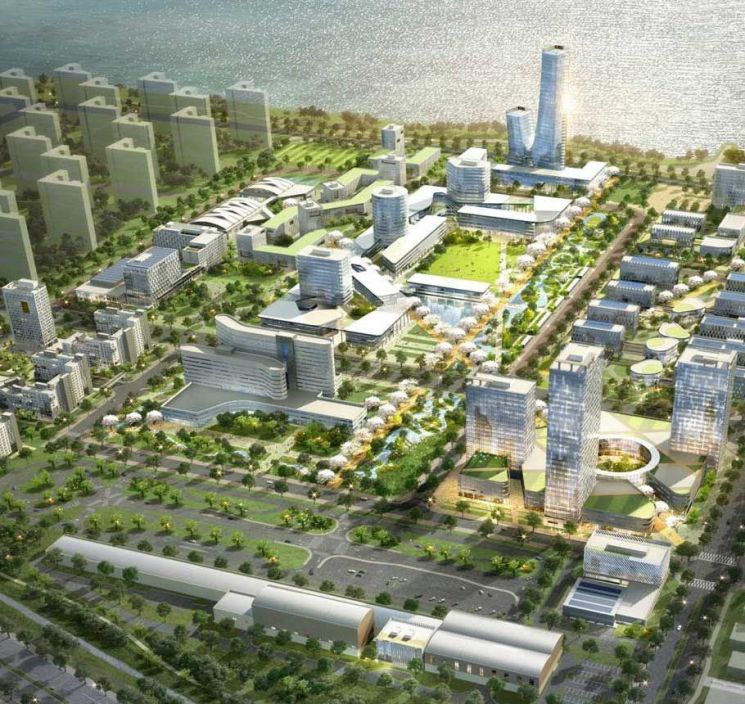 A bird's-eye view of Seoul National University Siheung Campus, which will be the center of the Seoul National University Bio Cluster. [Photo by Seoul National University]
Cooperation with related organizations and groups is also being strengthened. On the 18th, Seoul National University signed an agreement with Rutgers University in the United States. Since New Jersey, where Rutgers is located, also has an active bio industry, it is expected that outstanding talents from Seoul National University will benefit from exchanges with Rutgers and conduct industry-academia collaborative research with American bio companies. Additionally, in June, Seoul National University signed an agreement with the International Vaccine Institute to cooperate on academic information exchange and joint research for new vaccine discovery. Deputy Director Kang said, "We are continuously planning specific directions across education, research, and industry necessary for building the bio cluster," and added, "We will strive to ensure that the bio cluster to be established will build an innovative bio-industry ecosystem."
© The Asia Business Daily(www.asiae.co.kr). All rights reserved.
![Clutching a Stolen Dior Bag, Saying "I Hate Being Poor but Real"... The Grotesque Con of a "Human Knockoff" [Slate]](https://cwcontent.asiae.co.kr/asiaresize/183/2026021902243444107_1771435474.jpg)













