Seoul, Gyeonggi-do, and Incheon Policies Differ
"Dialogue Needed for Integration Before System Implementation"
The metropolitan public transportation fare support policies triggered by Seoul Mayor Oh Se-hoon's 'Climate Companion Card' are diverging in different directions among Seoul, Gyeonggi Province, and Incheon, increasing confusion among the 23 million residents of the metropolitan area. Experts warn that confusion among metropolitan public transportation users is inevitable if this continues, and advise that each party should engage in dialogue for integration before the system is implemented.
According to Seoul City and others on the 23rd, Seoul, Gyeonggi Province, and Incheon plan to hold a metropolitan area council meeting in early next month with transportation directors at the bureau chief level participating. This meeting was previously held once on the 26th of last month.
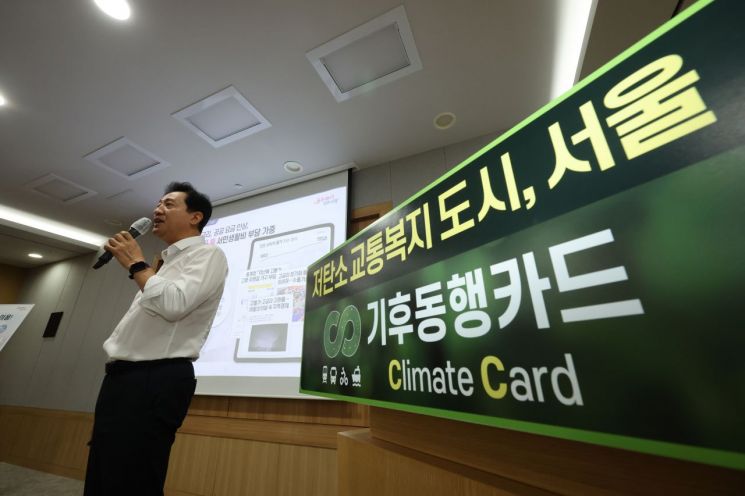 Seoul Mayor Oh Se-hoon is briefing at the press conference for the introduction and implementation of the Climate Companion Card held at the Seoul City Hall briefing room on the 11th of last month. Photo by Yonhap News
The Climate Companion Card promoted by Seoul City allows unlimited use of Seoul buses, subways, and the public bicycle system 'Ddareungi' for 65,000 KRW per month. On the other hand, Gyeonggi Province's 'The(The) Gyeonggi Pass' program reimburses part of the transportation costs to Gyeonggi residents who use all public transportation nationwide without any age restrictions. It plans to link with the government's 'K Pass,' which will be introduced in July next year, and expand the benefits for Gyeonggi residents. Incheon recently received data on the budget requirements for the Climate Companion Card from Seoul City and commissioned the Incheon Research Institute to conduct a study. Based on the study results, Incheon is reviewing alternatives, including the option not to participate in the Climate Companion Card.
As public transportation fare support policies diverge, confusion among users seems unavoidable. Since one person can subscribe to the Climate Companion Card, K Pass, and The Gyeonggi Pass simultaneously, they need to evaluate which option is more advantageous for them. For example, the Climate Companion Card allows unlimited use of the upcoming River Bus (Han River water bus) and Ddareungi. Also, for sales workers who are Gyeonggi residents but frequently travel within Seoul, the Climate Companion Card may be more beneficial. The Gyeonggi Pass supports metropolitan buses and the Shinbundang Line. Additionally, for Seoul citizens who use public transportation more than 21 times a month but do not commute daily, the K Pass may be more advantageous.
Budget is also an issue. The Climate Companion Card is estimated to benefit 500,000 people and require a budget of 75 billion KRW. However, Gyeonggi Province and Incheon operate metropolitan buses with a base fare of 3,000 KRW. If they participate in the Climate Companion Card, they will have to bear much higher costs than Seoul City. Furthermore, since Gyeonggi Province's buses are not under a semi-public operation system, negotiations with bus companies and local governments are necessary.
Experts point out that the only way is to narrow differences through dialogue. Professor Ko Jun-ho of Hanyang University's Department of Urban Engineering said, "The most sensitive part of administrative system implementation is the budget, but it is fortunate that all three local governments are united in their intention to spend budgets to reduce the burden of public transportation," adding, "The three local governments must find a solution through consultation for the convenience of metropolitan residents."
© The Asia Business Daily(www.asiae.co.kr). All rights reserved.

















