Prefers Hot and Humid, Narrow Cracks... Look for Excretion Traces
If Bitten by Bindae, Apply Warm Compress Then Visit Dermatologist
Bedbugs, which had disappeared from South Korea since the 1980s, have recently been spotted in areas such as Incheon and Daegu. The more Westernized living environments compared to the past are favorable for bedbug habitation, and the increased resistance of bedbugs to insecticides makes eradication difficult, raising concerns about their spread nationwide.
Bedbugs were recently found in a jjimjilbang in Incheon and also appeared in a university dormitory in Daegu. Although the jjimjilbang and university disinfected the indoor areas and took quarantine measures, experts say that complete eradication of bedbugs is difficult and they may have already spread to other locations.
Yang Young-cheol, a professor in the Department of Health, Environment, and Safety at Eulji University, appeared on YTN's "News Rider" on the 20th and explained, "Bedbugs are indoor-dwelling insects that live around residential environments. While bedbugs are not vectors that transmit diseases, they cause significant discomfort and mental stress due to their continuous bloodsucking."
If bitten by bedbugs, symptoms such as skin rashes and itching may occur. In case of bedbug bites, it is recommended to apply warm compresses to break down the bedbug saliva or antigenic substances to relieve itching, and then visit a hospital for diagnosis.
Professor Yang pointed out that the recently Westernized housing culture in South Korea provides an environment conducive to bedbug habitation and reproduction. He explained, "Nowadays, most housing cultures are Westernized, using beds, carpets, and sofas, and when the boiler is turned on, the entire house becomes a warm environment. Bedbugs have difficulty hatching and growing at temperatures below 10 degrees Celsius, but their reproductive ability improves at temperatures above 25 degrees Celsius."
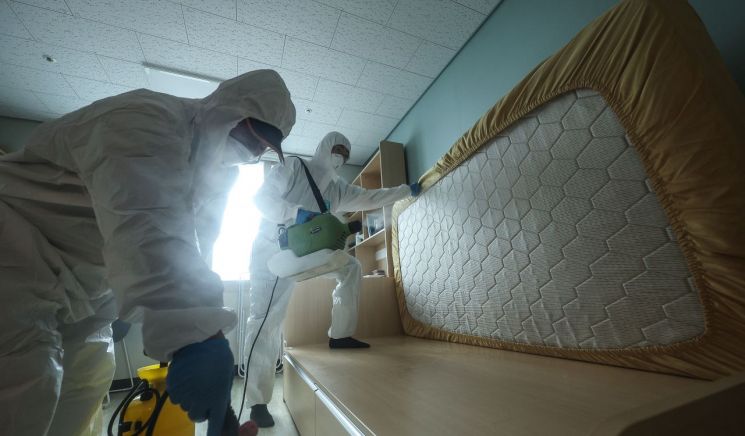 Disinfection company officials are conducting pest control at a university dormitory in Dalseo-gu, Daegu, where bedbugs were found on the 19th.
 [Image source=Yonhap News]
Eradicating bedbugs is also difficult. The bedbugs found in South Korea are presumed to have been introduced from overseas, and according to Professor Yang, many of these bedbugs have developed resistance due to frequent insecticide use abroad.
Professor Yang emphasized, "When bedbugs are abundant, they form populations living around beds. As their numbers increase, they also inhabit behind picture frames next to beds, and even inside electrical outlets. It is most important to diagnose the extent to which bedbug populations are residing within a building or facility."
He added, "All bedbugs in South Korea are imported from abroad, and because insecticides are heavily used overseas, they have developed resistance and do not die easily from insecticides."
To check for bedbugs in a residence, one should look for traces of their excrement. Professor Yang explained, "Bedbugs like narrow gaps. If suspicious, check around the bed, along the edge seams, and joints of the bed frame for traces of bedbug excrement. Bedbug excrement has a distinctive smell. At first, it may be hard to recognize, but it has a slightly musty and unpleasant odor."
If bedbugs are found indoors, the best method for eradication is heat treatment. Professor Yang said, "The best method is to apply high heat of about 50 to 60 degrees Celsius for around 2 hours, which dries them out and kills them. Bed sheets or clothes can be boiled or put in a dryer, and using a hairdryer to blow hot air on items is also effective."
© The Asia Business Daily(www.asiae.co.kr). All rights reserved.

















