Seoul Leasehold Registration Orders Increase 600% Year-on-Year
Nationwide Average Rises 482% Year-on-Year as of July
Seoul's court orders for leasehold registration have increased by 600% compared to the previous year. This appears to be due to the rise in tenants who have not been able to recover their deposits even after the end of their jeonse or monthly rent contracts, following the recent downturn in the real estate market and the decline in jeonse prices.
On the 20th, real estate brokerage firm Jiptoss analyzed the status of leasehold registration (leasehold registration orders) applications in the Court Registry Information Plaza from July 2020 to September 2023. As a result, the number of court leasehold registration orders nationwide in July this year rose by 482% to 6,165 cases. This figure only includes cases where the registration was completed after applying for leasehold registration.
A leasehold registration order refers to a court recording on the real estate registry that the tenant has not been reimbursed the money after the contract period has expired and the landlord has failed to return the deposit.
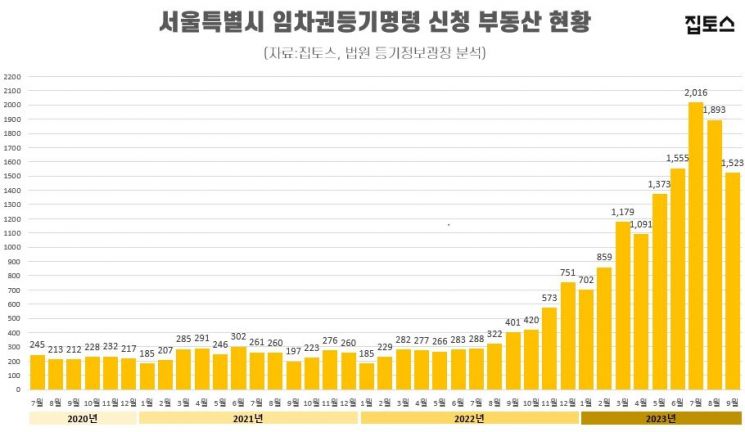
By region, as of July 2022 and 2023, the numbers changed as follows: Seoul 277 cases → 2,016 cases, Busan 42 cases → 281 cases, Daegu 16 cases → 147 cases, Incheon 277 cases → 1,234 cases, Gwangju 12 cases → 80 cases, Daejeon 30 cases → 188 cases, Ulsan 5 cases → 49 cases, Sejong 1 case → 39 cases, Gyeonggi-do 239 cases → 1,570 cases.
The nationwide leasehold registration status from January to September 2022 was 8,755 cases, but one year later, from January to September 2023, it was recorded at 37,684 cases. Considering that the figure for January to September 2021 was 7,970 cases, this represents a surge of 327% and 372% in 2023, respectively.
Leasehold registration orders are expected to continue increasing. This is because jeonse fraud cases, such as the recent incidents in Suwon and Daejeon, are still rampant, and houses whose lease contracts have not yet expired cannot apply for leasehold registration orders.
Jin Tae-in, head of Jiptoss Real Estate Brokerage Business Team, said, "Due to the decline in publicly announced prices and stricter requirements for subscribing to jeonse deposit insurance, landlords find it difficult to find the next tenant unless they significantly lower the deposit. Many landlords delay returning the deposit by promising to return it once they find the next tenant, but if the contract has expired, tenants can apply for leasehold registration."
Leasehold registration orders can be applied for after the lease contract period has expired and must be submitted to the court with jurisdiction over the location of the leased property. The cost is relatively cheaper than litigation, and the procedure is simple enough to allow direct lawsuits. The process generally takes less than three weeks, but if the landlord cannot be contacted or the location is unknown, it may be delayed by a few more weeks due to address or document corrections. To claim damages, after the leasehold registration is completed, tenants must remove their belongings and share the password with the certified real estate agent or landlord; only then can damages incurred thereafter be calculated.
© The Asia Business Daily(www.asiae.co.kr). All rights reserved.


















