Strong Performance in Q3 GDP and Economic Indicators
Concerns Over Economic Downturn Ease, Focus Shifts to Yuan Defense
China's central bank, the People's Bank of China, has frozen the loan prime rate (LPR), which is the de facto benchmark interest rate. This move is interpreted as a step to adjust the pace of monetary easing policies following a rebound in recent key economic indicators that exceeded expectations.
On the 20th, the People's Bank of China announced in a statement that it would keep the 1-year LPR at 3.45% and the 5-year LPR at 4.20%, maintaining the rates for the second consecutive month since August.
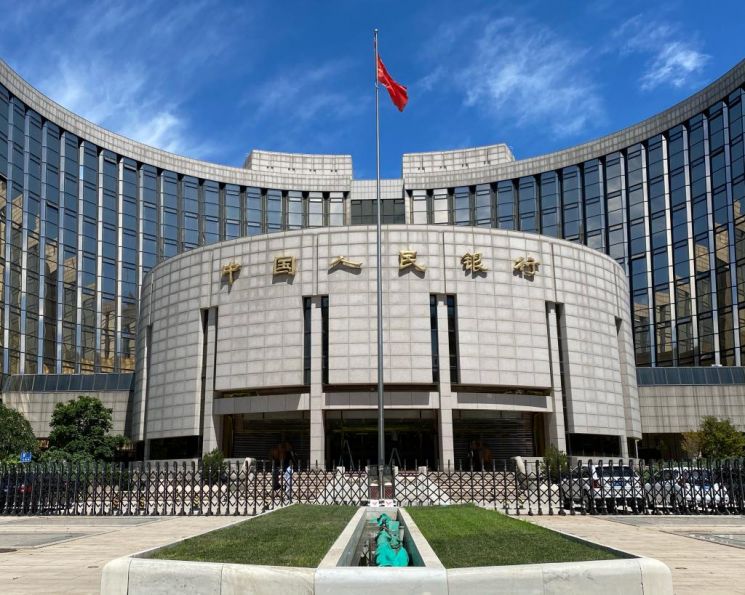
The LPR is calculated by aggregating the lending rates offered to the best customers by 18 designated banks. Local financial institutions use this as a benchmark for lending, so it functions as the actual benchmark interest rate. The 1-year rate affects general loans, while the 5-year rate influences mortgage loans. Until early 2020, the 1-year LPR was maintained in the 4% range, but the People's Bank of China began cutting rates starting in April 2020 as the COVID-19 pandemic intensified.
This LPR freeze was an expected outcome following the People's Bank of China’s decision to keep the 1-year Medium-term Lending Facility (MLF) rate, a policy rate, unchanged. Typically in China, when the MLF is adjusted, the LPR moves accordingly. Earlier, the Chinese economic media Caixin surveyed seven economic institutions, all of which predicted that the 1-year and 5-year LPRs would remain unchanged in October.
The People's Bank of China stated that it implemented 789 billion yuan (approximately 146 trillion won) worth of 1-year MLF loans to appropriately maintain liquidity in the banking system. This involved extending the maturity of 500 billion yuan of MLF loans due and injecting an additional 289 billion yuan, the largest amount in over three years since December 2020. The MLF interest rate remained at 2.50%, as before. Additionally, 134 billion yuan of short-term liquidity was injected through open market operations.
Subsequently, economic indicators confirmed on the 18th mostly exceeded expectations and performed well. The third-quarter gross domestic product (GDP) growth rate recorded 4.9% year-on-year, surpassing the forecast of 4.4%. China only needs to achieve 4.4% growth in the remaining fourth quarter to meet the government's annual target of around 5.0%. The fourth quarter includes the National Day Golden Week, during which domestic consumption in China typically surges, and recent indicator recoveries have positively influenced sentiment. Moreover, the growth rate in the fourth quarter of last year was relatively low at 2.9%, suggesting a base effect. With concerns over a sharp economic downturn easing, there is growing expectation that authorities will maintain a moderate policy stance focused on monetary and credit policies rather than fiscal measures. Pressure concerns over the yuan’s value, which has fallen more than 5% this year, also contribute to the monetary authorities’ hesitation to cut rates. In the Caixin survey, five institutions forecasted the October USD-CNY exchange rate to average 7.29 yuan.
However, major foreign media pointed out that China’s local governments are increasing bond sales to stimulate the economy, which raises the need for the People's Bank of China to expand liquidity supply. In fact, multiple local governments such as Liaoning and Chongqing are issuing special refinancing bonds this month to resolve outstanding debts. The market estimates that the scale of such bond issuance will reach at least 1 trillion yuan this year.
© The Asia Business Daily(www.asiae.co.kr). All rights reserved.

















