Announcement of Growth Strategies for Semiconductors, Secondary Batteries, Displays, and Bio Sectors
The government has decided to invest 2.3 trillion KRW over 10 years to support research and development (R&D) in advanced industries such as semiconductors, secondary batteries, and displays. It will also promote the 'Industrial Supply Chain 3050' plan to reduce dependence on specific countries for core materials, parts, and equipment (SoBuJang) to below 50%.
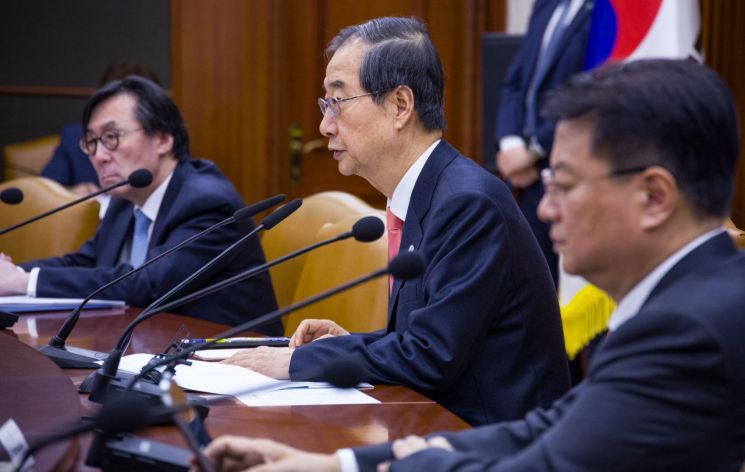 Prime Minister Han Duck-soo is attending the meeting of ministers related to national issues held at the Government Seoul Office in Jongno-gu, Seoul, on the morning of the 19th, explaining the agenda to be discussed at the meeting.
 [Image source=Yonhap News]
On the 19th, the Ministry of Trade, Industry and Energy announced that it discussed the 'Current Status and Future Plans for National Advanced Industry Promotion Policy' at the 30th National Policy-Related Ministers' Meeting chaired by the Prime Minister. The meeting further detailed the three basic strategies presented in the Basic Plan for National Advanced Industries in May: securing overwhelming manufacturing capabilities, advancing as a technology and talent powerhouse, and establishing a stable supply chain.
By early next year, the government plans to establish detailed development plans for specialized complexes in advanced strategic industries to secure overwhelming manufacturing capabilities, and to promote package support and the removal of killer regulations. It is also considering introducing three major regulatory innovation programs: developing an advanced enterprise regulation index, establishing an advanced industry regulatory impact assessment, and reforming killer regulations.
To build an ecosystem for technological and talent innovation, a total of 2.3 trillion KRW worth of R&D projects will be planned, and policy and institutional foundations for securing excellent talent, such as a 'Global Talent Acquisition Strategy' and the 'Advanced Industry Talent Innovation Special Act,' will be established. In the semiconductor sector, 556.9 billion KRW will be invested in developing advanced packaging technology; in the secondary battery sector, 198.7 billion KRW will be allocated for high-performance next-generation secondary battery development; in the display sector, 950 billion KRW will be invested in inorganic light-emitting displays; and in talent cultivation, 590 billion KRW will be spent on establishing and operating specialized graduate schools.
The government will establish the 'Industrial Supply Chain 3050 Strategy' to stabilize supply chains and strengthen support for SoBuJang specialized complexes. The Industrial Supply Chain 3050 Strategy aims to reduce dependence on specific countries to below 50% by 2030, including selecting core SoBuJang items and devising differentiation plans for key items.
Customized growth strategies will also be prepared for the four major advanced industries. In the semiconductor sector, a power supply roadmap to address the key challenge of power supply for semiconductor complexes such as Namsa (Samsung Electronics) and Wonsam (SK Hynix) will be finalized within the year. A 'Fabless Industry Development Plan (tentative name)' to foster the system semiconductor industry ecosystem will also be established by year-end. Large-scale R&D will be launched to secure future market leadership in next-generation system semiconductors such as AI semiconductors and power semiconductors, as well as advanced packaging. The Advanced Semiconductor Technology Center (ASTC), a SoBuJang technology testbed, will also be constructed.
In the secondary battery sector, supply chain and trade cooperation will be strengthened with key mineral resource countries such as Canada, Australia, and Indonesia to reinforce supply chain construction. Domestically, a private-sector-led integrated management system for used batteries will be established. A preliminary feasibility study worth 200 billion KRW to secure next-generation battery technologies such as all-solid-state and lithium-sulfur batteries will be completed within the year. Additionally, new R&D projects worth 23.3 billion KRW for LFP (Lithium Iron Phosphate) batteries and 28.2 billion KRW for sodium batteries will be pursued.
In the display sector, support will be provided for mass production investment of 8th-generation IT OLEDs to promote the spread of organic light-emitting diodes (OLED). To secure leadership in next-generation displays after OLED, a preliminary feasibility study for inorganic light-emitting displays such as microLED will be pursued.
In the bio sector, a Korean-style ARPA-H project worth a total of 1.9 trillion KRW will be launched over the next 10 years. In November this year, a roadmap for bio SoBuJang technology development will be announced. In the first half of next year, specialized complexes for advanced strategic industries will be designated to create a bio innovation ecosystem.
© The Asia Business Daily(www.asiae.co.kr). All rights reserved.

















