1.3 Trillion Won Net Loss in First Half of This Year, Approaching Full-Year Forecast in Just Six Months
HUG's Subrogation Payments for Jeonse Deposit Return Guarantees Exceed 2 Trillion Won from January to August
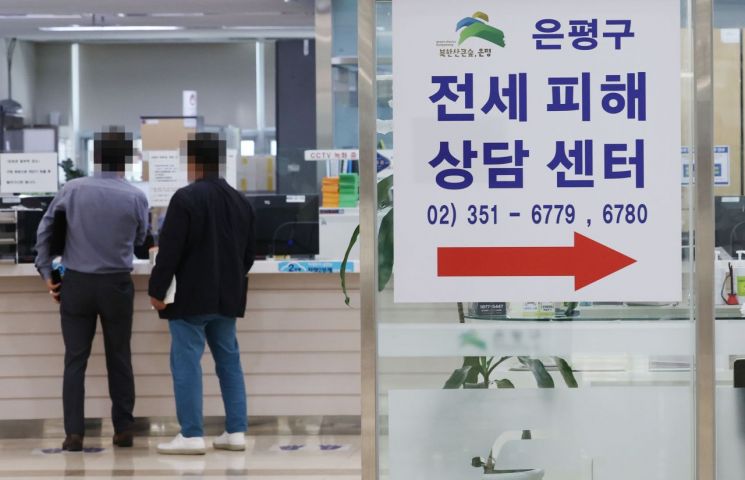
Due to the surge in jeonse fraud and reverse jeonse cases, instances where the Housing and Urban Guarantee Corporation (HUG) returns the deposit to tenants instead of landlords are increasing, thereby intensifying HUG's financial burden. Although HUG has announced plans to strengthen risk management, including debt recovery, as a response to financial deterioration, the outlook for debt recovery through auctions and public sales appears bleak considering the real estate market downturn and the stagnation of the auction market. There are calls to revise the guarantee system, which currently places the entire risk of deposit non-return on HUG instead of landlords, and to strengthen sanctions against malicious landlords.
According to the '2023-2027 Mid-to-Long-Term Financial Management Plan' submitted by HUG to Kang Dae-sik, a member of the National Assembly Land, Infrastructure and Transport Committee from the People Power Party, HUG's net income turned into a deficit, recording a net loss of 112.6 billion KRW in 2022 from a net profit of 362 billion KRW in 2021, due to a surge in individual guarantee accidents and subrogation payments. Guarantee accidents refer to cases where tenants fail to receive their jeonse deposit back within one month after terminating the jeonse contract or fail to recover the deposit after auctions or public sales occur during the contract period. When a guarantee accident occurs, HUG pays the jeonse deposit to tenants who have subscribed to the jeonse deposit insurance and then recovers the paid deposit from landlords through subrogation claims.
HUG's guarantee business accounts for a significant portion of its total assets, reaching 96.7% of its 8.7 trillion KRW in total assets. In fact, of the 112.6 billion KRW net loss recorded in 2022, losses from the guarantee business unit accounted for 106.4 billion KRW (94.5% of the total). Liabilities also increased significantly from 1.76 trillion KRW in 2021 to 2.225 trillion KRW in 2022, the largest scale since 2018, largely due to the rise in individual guarantee accidents.
Assemblyman Kang said, "The flawed real estate policies during the Moon Jae-in administration led to rising housing prices, and the hasty enactment of the three lease laws caused the jeonse crisis. These situations laid the groundwork for jeonse fraud, which ultimately resulted in individual guarantee accidents."
The situation this year is even more severe. In the '2023-2027 Mid-to-Long-Term Financial Management Plan' prepared in May, HUG projected a net loss of 1.7558 trillion KRW for this year. However, the net loss for the first half of the year (January to June) reached 1.3281 trillion KRW, nearly reaching the annual forecast within just six months and increasing sevenfold compared to the same period last year (184.7 billion KRW). As in the previous year, the main factor behind the expanded deficit was the increase of 1.0366 trillion KRW in guarantee business expenses, including subrogation payments.
The deterioration of HUG's financial soundness is largely due to the rapid increase in subrogation payments?deposits returned to tenants by HUG instead of landlords?caused by the spread of reverse jeonse and jeonse fraud since the end of last year. The amount of jeonse guarantee accidents recorded from the beginning of this year until last month totaled 3.1245 trillion KRW (13,903 cases). Considering that the total accident amount for last year was 1.1726 trillion KRW, the scale of guarantee accidents has nearly tripled this year. Due to the surge in guarantee accidents, HUG's subrogation payments for jeonse deposit return guarantees from January to August this year reached 2.0047 trillion KRW, surpassing 2 trillion KRW for the first time on an annual basis. Meanwhile, the recovery rate during the same period was only 14.4%.
As subrogation payments increase while recovery rates remain low, HUG's financial burden is intensifying. Typically, it takes about two years for HUG to recover the jeonse deposits paid through subrogation via auctions or public sales. Given that the guarantee accident amount this year is 3 trillion KRW, the likelihood of HUG's financial situation improving next year appears slim. Although HUG has stated plans to improve the guarantee system and strengthen risk management, including post-management debt recovery, the ongoing real estate market downturn and auction market stagnation, coupled with the fact that most properties held by landlords are villas, make recovery through auctions difficult. In fact, recovery rates have been declining, from 50% in 2020 to 42% in 2021 and 24% in 2022. Consequently, some predict that HUG's net loss this year could far exceed 2 trillion KRW.
There are concerns that if HUG's financial condition does not improve, it could lead to the worst-case scenario of halting guarantee issuance. Under the Housing and Urban Fund Act, HUG can issue guarantees only up to 60 times its equity capital. If this limit is exceeded, all guarantee issuance handled by HUG will be suspended. To address this concern, the government amended the enforcement decree of the Housing and Urban Fund Act last month, raising HUG's guarantee limit from 60 times to 70 times its equity capital. HUG also plans to inject 380 billion KRW in capital by the end of this year and an additional 700 billion KRW by next year.
© The Asia Business Daily(www.asiae.co.kr). All rights reserved.
![Clutching a Stolen Dior Bag, Saying "I Hate Being Poor but Real"... The Grotesque Con of a "Human Knockoff" [Slate]](https://cwcontent.asiae.co.kr/asiaresize/183/2026021902243444107_1771435474.jpg)
















