Foreigners Spend 1.39 Trillion Yen in Q3
Up 17.7% from Pre-COVID 2019
Surge in Foreign Tourist Inflow Due to Yen Depreciation
Last month, the spending of foreigners visiting Japan surpassed the levels seen before the COVID-19 pandemic. Thanks to the historic depreciation of the yen, foreign consumption has significantly increased, raising expectations that this will lead to a boost in Japan's domestic economy.
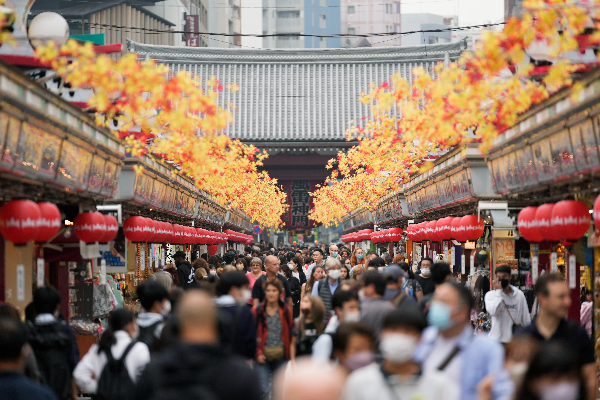
According to the Japan National Tourism Organization (JNTO) on the 18th, foreign visitors' spending in Japan during the third quarter of this year amounted to 1.39 trillion yen (approximately 12.53 trillion KRW), marking a 17.7% increase compared to the third quarter of 2019, the year immediately before the pandemic.
The sharp rise in the number of tourists visiting Japan played a major role. Last month, the number of foreign visitors to Japan reached 2.18 million, approaching the 2.27 million recorded during the same period in 2019, just before the pandemic. This represents a recovery to about 96% of pre-pandemic levels. Foreigners' consumption spending also increased accordingly.
By country, Chinese tourists accounted for the largest share, making up 20% of total foreign spending. Considering the heightened tensions between Japan and China?such as the Japanese government's decision to discharge contaminated water from the Fukushima nuclear plant and China's complete ban on imports of Japanese seafood?it appears that more Chinese tourists than expected are still visiting Japan and opening their wallets. Following China, Taiwanese tourists accounted for 15%, South Koreans 14%, and Americans 10% of the spending. The average spending per visitor was found to have increased by about 29% compared to pre-pandemic levels.
The background to the increase in foreign spending in Japan lies in the weak yen. While the United States has been implementing aggressive interest rate hikes since March last year, the Bank of Japan (BOJ) has continued its monetary easing policy, accelerating the depreciation of the yen. The yen-dollar exchange rate averaged 144.61 yen in the third quarter of this year, a sharp rise compared to the 107.34 yen average during the same period in 2019. This decline in the yen's value is analyzed to have led to an increase in foreign tourism and consumption spending in Japan.
Yuichi Kodama, chief economist at the Meiji Yasuda Research Institute, emphasized, "The recovery of domestic tourism demand in Japan is a positive factor for the economy," adding, "The weak yen will help expand domestic tourism demand in Japan." However, he also noted that the rise in import prices caused by the weak yen could directly burden households.
The Japanese government plans to continue encouraging foreign visits and increased spending to revive the domestic economy. The Kishida Fumio Cabinet has set a goal to raise annual foreign tourist consumption within the country to 5 trillion yen (approximately 45 trillion KRW) this year. This target surpasses the 4.8 trillion yen (approximately 43.27 trillion KRW) recorded before the COVID-19 pandemic in 2019.
© The Asia Business Daily(www.asiae.co.kr). All rights reserved.
![Clutching a Stolen Dior Bag, Saying "I Hate Being Poor but Real"... The Grotesque Con of a "Human Knockoff" [Slate]](https://cwcontent.asiae.co.kr/asiaresize/183/2026021902243444107_1771435474.jpg)
















