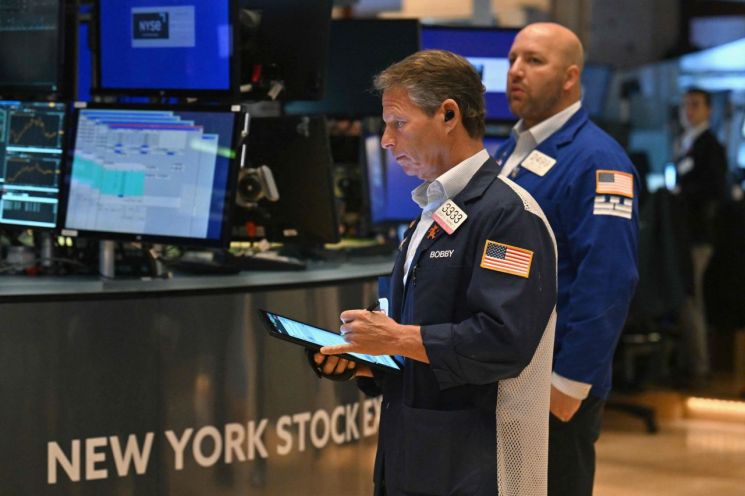
The three major indices of the U.S. New York stock market showed a unified decline in the early session on the 17th (local time) as bond yields rose following stronger-than-expected retail sales data. The benchmark 10-year U.S. Treasury yield surpassed the 4.8% level again.
At around 10:03 a.m. at the New York Stock Exchange (NYSE), the blue-chip-focused Dow Jones Industrial Average was trading at around 33,888, down 96.42 points (0.28%) from the previous close. The large-cap S&P 500 index fell 32.31 points (0.74%) to around 4,341, while the tech-heavy Nasdaq index dropped 168.67 points (1.24%) to about 13,399.
Within the S&P 500, technology, communication, utilities, discretionary consumer goods, and healthcare sectors were declining, while energy, materials, and industrial sectors were rising. The decline in technology stocks was particularly notable. The U.S. government additionally banned exports of low-end artificial intelligence (AI) chips to China on this day, causing semiconductor-related stocks to fall across the board. Leading AI semiconductor stock Nvidia dropped more than 5% from the previous close. Intel fell 2.8%, and AMD declined 2.6%. Other tech stocks such as Microsoft and Google Alphabet also showed downward trends. The dollar tree rose more than 2% after Goldman Sachs upgraded its investment rating. Bank of America (BoA) rose slightly on better-than-expected earnings. Lockheed Martin also rose over 1% after exceeding quarterly consensus. Johnson & Johnson moved slightly lower despite raising its annual guidance.
Investors are closely watching retail sales released before the market opened, bond yield movements, corporate third-quarter earnings announcements, and additional U.S. semiconductor export controls on China.
U.S. retail sales for September exceeded expectations. According to the U.S. Department of Commerce, September retail sales totaled $704.9 billion, up 0.7% from the previous month, surpassing the expert forecast of 0.2%. Despite market expectations of a slowdown in U.S. consumption due to accumulated tightening, depletion of excess savings, and the start of student loan repayments, consumption remained robust.
The stronger-than-expected retail sales immediately raised concerns about tightening, leading to a rise in bond yields. In the New York bond market, the 10-year yield surpassed 4.8% again. The 30-year yield rose to around 4.95%, and the 2-year yield, sensitive to monetary policy, climbed to about 5.17%.
Alex McGrath, Chief Investment Officer at NorthEnd Private Wealth, said, "Retail sales exceeded expectations, pushing bond yields to levels that are problematic for the market," adding, "The retail sales report continues to burden investors trying to digest the Fed's neutral statements." Gina Volbin, President of Volbin Wealth Management, also commented, "Today's retail sales have embarrassed the Federal Reserve (Fed)," and "The central bank will not like that rate hikes are not deterring consumer spending."
The U.S. government's additional ban on exports of low-end AI chips to China also worsened investor sentiment, especially among tech stocks. The export control measures on semiconductors to China, announced by the Department of Commerce on this day, included new performance density criteria for AI chips. As a result, Nvidia's low-end AI chips, A800 and H800, are now subject to export controls. Furthermore, the Department of Commerce decided to include semiconductor chips for overseas subsidiaries of Chinese headquarters to prevent sanctions evasion.
Geopolitical risks from the Middle East continue. Amid expectations that Israel's ground forces will soon enter the Gaza Strip, the Palestinian militant group Hamas stated, "We are not afraid of the occupier's (Israel's) threat to launch a ground attack. We are prepared." However, with U.S. President Joe Biden announcing a surprise visit to Israel and other Middle Eastern regions on the 18th, there are speculations that the timing of Israel's ground offensive might be delayed. Currently, the U.S. and the international community are engaged in intense diplomatic efforts to prevent a full-scale war.
International oil prices are rising following news of President Biden's visit to Israel. West Texas Intermediate (WTI) crude oil prices are trading above $87 per barrel, up more than 0.5% from the previous close. The Chicago Board Options Exchange (CBOE) Volatility Index (VIX), known as Wall Street's "fear gauge," jumped over 6% to around 18.3.
However, corporate third-quarter earnings are helping to ease concerns about economic uncertainty. The third-quarter sales of Goldman Sachs and BoA exceeded expectations. Johnson & Johnson raised its annual guidance. Lockheed Martin also announced expectations for increased sales this year. According to FactSet, the net profits of companies listed on the S&P 500 are estimated to increase by 0.4% compared to the same period last year. This would mark the first positive growth since the third quarter of 2022. Mark Heffel, CIO of UBS Global Wealth Management, expressed optimism in an investor memo, stating, "The earnings downturn is over, and the U.S. economy is on a trajectory for a soft landing supported by healthy consumer activity, easing inflation, and solid growth."
European stock markets showed mixed trends. Germany's DAX index fell 0.25%, France's CAC index dropped 0.24%, while the UK's FTSE index rose 0.47%.
© The Asia Business Daily(www.asiae.co.kr). All rights reserved.