Opened 190 CU and Emart24 Stores in Malaysia in About 2 Years
Aiming for 800 Cumulative Stores in 5 Years
Instant Cooked Products Like Tteokbokki and Eomuk Account for 50% of Sales
K-convenience stores are establishing themselves in everyday life in Malaysia based on K-foods such as tteokbokki and fish cakes. They are effectively serving as a gateway for Malaysians to enjoy K-food more easily. Unlike local convenience stores that simply sell processed foods, word has spread that "you can directly taste Korean instant cooked products like tteokbokki and fish cakes," leading to a remarkable scene of dozens lining up during the early days of the opening in April 2021.
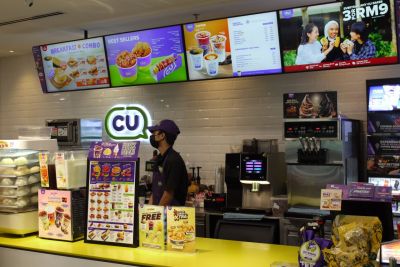 On the 13th, CU KLCC store located in downtown Kuala Lumpur, Malaysia. CU operates 132 stores in Malaysia.
On the 13th (local time), upon entering the CU KLCC store located in downtown Kuala Lumpur, Malaysia, the first thing that caught the eye was the instant cooked food sales counter alongside the cash register. Here, they sell tteokbokki, rabokki, fried chicken, fish cakes, and more. This food corner is CU's main product.
Seongwook Park, Manager of the Product Development Team at BGF Retail, explained, "In Korea, instant cooked food sales account for only 5-10% of total sales, but in Malaysia, this proportion reaches 50%. CU is establishing itself as a premium convenience store larger in scale than local stores specializing in K-food."
CU, which opened its first convenience store in Malaysia in April 2021, has so far opened a total of 132 stores mainly in downtown Kuala Lumpur. They plan to increase the number of stores to 500 within the next five years. Manager Park said, "The convenience store market in Malaysia is a blue ocean market like Korea was 10 years ago. As the number of young people enjoying Korean culture such as K-pop increases, awareness of K-food is rising, and the convenience store market is rapidly growing."
Emart24 also entered Malaysia in June of the same year and has opened 35 stores to date. Like CU, it operates a food corner. Baekhyun Lim, Deputy Manager of Emart24's Overseas Business Team, said, "As you move away from Kuala Lumpur, the proportion of Muslims increases. Emart24 targets them by increasing the proportion of halal-certified foods. All instant cooked foods are 100% halal, and half of the other processed foods are also halal-certified products. We are promoting halal certification for some Emart24 stores, similar to FamilyMart, which has halal-certified stores."
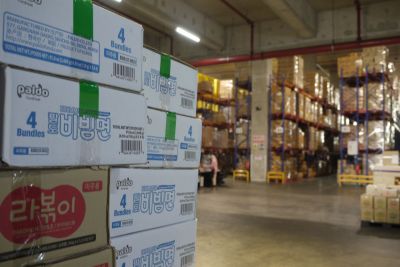 On the 12th, we visited KMT's logistics warehouse. KMT imports over 3,000 Korean food products from 30 Korean companies and distributes them in Malaysia.
While CU and Emart24 are K-food retailers, KMT, established in 1994, is a wholesaler supplying K-food to local supermarkets. KMT imports about 3,000 types of K-food from 30 Korean companies, including snacks, ramen, sauces, and dairy products, and supplies them throughout Malaysia. Among these, about 500 are halal-certified products. Due to the popularity of K-food, sales have significantly increased from 40 billion KRW in 2020 to 65 billion KRW last year.
KMT has been operating its directly managed supermarket, K Plus Market, in Selangor, a wealthy residential area near Kuala Lumpur, since October last year. On the 12th, Mr. Chua (55) visited K Plus Market and bought a roll of gimbap priced at 9.9 ringgit (about 2,800 KRW) along with some other items. He said, "Since my company is near the market, I visit about once a week to buy Korean food. I like Korean food so much that I even make kimchi with my friends at home." Only about 4% of the customers are Korean, with most being Malaysians visiting the store.
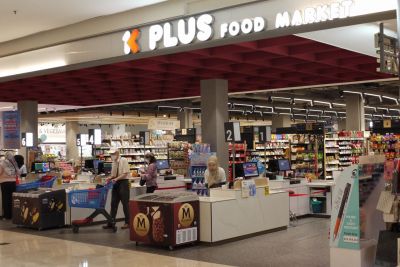
Sangyeol Song, Executive Director of KMT, explained, "We are implementing a strategy to have Malaysia's wealthy class purchase Korean products while buying necessary items at the supermarket. There is a high preference for Korean food, with Korean vegetables such as perilla leaves and kimchi being very popular." He added, "There is especially high demand for K-fruits, and many people know the seasons for strawberries and oriental melons and wait to purchase them."
© The Asia Business Daily(www.asiae.co.kr). All rights reserved.
![Clutching a Stolen Dior Bag, Saying "I Hate Being Poor but Real"... The Grotesque Con of a "Human Knockoff" [Slate]](https://cwcontent.asiae.co.kr/asiaresize/183/2026021902243444107_1771435474.jpg)


















