Consideration of Medical School Quota Expansion from 2025 Admissions
Medical Associations Including KMA Oppose as "Dangerous Decision"
Some Support Views Also Say "Doctor Shortage Is Clear"
The government is reportedly planning to announce a plan to significantly increase the medical school quota, which has been capped at 3,058 students since 2006, starting from the 2025 admissions. The medical community is on high alert. Medical organizations such as the Korea Medical Association (KMA) have opposed the expansion of medical school quotas so far. However, there are also views pointing out the seriousness of issues like emergency room cycling and pediatric care crises, leading to a sharp divide within the medical community.
The government is expected to soon announce a plan to expand the medical school quota starting in 2025. Since 2006, the medical school admission quota has been fixed at 3,058 students, but the government is reportedly considering a significant increase. The expansion of medical school quotas was also attempted once during the Moon Jae-in administration in 2020, but it was not implemented due to fierce opposition, including collective doctor strikes and medical students refusing the national licensing exam.
However, as medical service gaps such as pediatric care crises and deaths caused by emergency room cycling continue to occur, the government appears to have judged that it is no longer possible to delay the expansion of medical school quotas. The expansion of medical school quotas is also a key national agenda of the Yoon Suk-yeol administration.
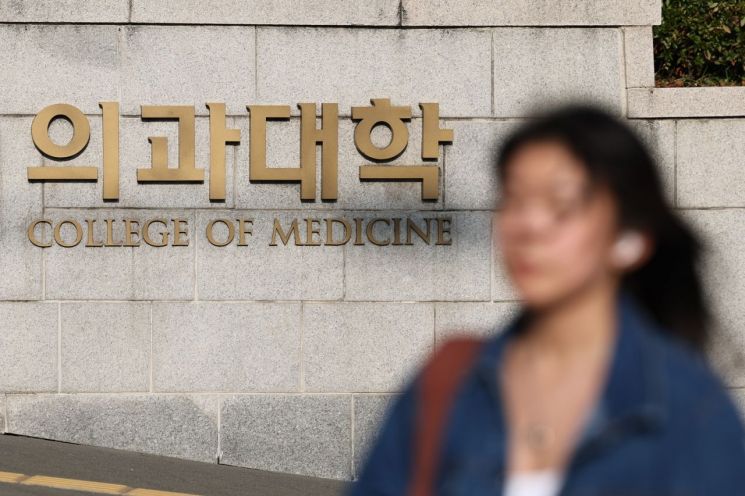
The medical community is sharply divided on the issue. The KMA, which has opposed the expansion of medical school quotas, argues that the problem of medical service gaps is not due to a shortage of doctors but rather due to institutional deficiencies.
On the 17th, Woo Bong-sik, director of the KMA Medical Policy Research Institute, stated in a CBS radio interview, "Based on the research conducted so far, it is actually impossible to determine whether the number of doctors is sufficient or insufficient."
Regarding the Korea Institute for Health and Social Affairs (KIHASA) report predicting a shortage of 27,232 doctors by 2035 if the current medical school quota is maintained, he said, "It is a report that does not address different systems, supply structures, or medical utilization cultures in each country at all," and added, "Deciding on the medical workforce based on a single flawed research report is a very dangerous decision."
Director Woo also said, "Currently, medical overconsumption is a problem, and increasing the number of doctors would pour fuel on the fire of overconsumption, eventually leading to the collapse of health insurance and healthcare itself," adding, "According to the 2023-2032 health insurance financial forecast released by the National Assembly Budget Office a week ago, the system is already expected to run a deficit next year and the accumulated reserves will be depleted by 2028."
On the other hand, those in favor of expanding the medical school quota argue that while institutional problems should be addressed, the number of doctors must also be increased. Kim Yoon, professor of Medical Management at Seoul National University College of Medicine, said, "Emergency patients have nowhere to be admitted and keep cycling through hospitals, the cause is a lack of doctors, and pediatric care crises and doctor shortages are appearing everywhere in society, including rural areas where even offering an annual salary of 400 million won cannot attract doctors, leading to emergency rooms operating on a day-of-the-week system," and countered, "The KMA says there is no shortage of doctors, but that is like covering the sky with the palm of your hand."
Regarding the argument that there is no need to increase the number of doctors because the population is declining, Professor Kim said, "The effect of an increasing elderly population and rising income levels, which increase medical demand, is five times greater than the effect of population decline," and emphasized, "For the same reason, most advanced OECD countries significantly expanded their medical schools and hospitals in the early to mid-2000s."
However, he added, "Increasing the number of doctors alone does not solve the problem; increasing the number of doctors is a necessary condition," and said, "To resolve the collapse of the medical system and medical crises, the healthcare system must also be reformed. The current education and training system, which is biased toward university hospitals, must also be changed."
Meanwhile, the KMA has warned of an all-out response, including strikes, if the government's expansion of medical school quotas is confirmed. The KMA General Assembly issued a statement saying, "Reports assuming the expansion of medical school quotas as a fait accompli have caused shock and confusion in the medical community," and added, "The KMA has agreed that it must respond with all available means in full force."
© The Asia Business Daily(www.asiae.co.kr). All rights reserved.

















