Rising Energy Prices Due to War... Concerns Over European Recession
Strong Growth Despite US High-Intensity Tightening... Dollar Strengthens
US and Europe Face Contrasting Economic Conditions, Euro Weakens
Euro Falls 6% After Peaking in July
JPMorgan "Parity Expected Within the Year"
There are forecasts that the rise in energy prices caused by the European economic recession and the Israel-Hamas war will lower the value of the euro. Accordingly, concerns are growing that the euro-dollar 'parity (parity·1-to-1 exchange)' realized for the first time last year, 20 years after the introduction of the euro, could be repeated within this year.
On the 16th (local time), JP Morgan announced that it has lowered its euro value forecast from the previous $1.05 to around $1. JP Morgan added that euro-dollar parity could be confirmed within this year. Citibank also stated, "The euro and the dollar will be exchanged at parity within the next six months," adding, "There are concerns about a recession in Europe more than in the United States." Earlier, Rabobank, Nomura, RBC Capital Markets, and others also recently downgraded their euro forecasts. These banks expected the euro to fall to around $1.02 by the end of this year or early next year.
Currently, 1 euro is trading at $1.0530. The euro's value against the dollar has fallen about 6% after peaking in mid-July. The market expects the euro's value to continue declining. Accordingly, there are even predictions that '1 euro = 1 dollar' will become visible again after about a year. Previously, the euro fell below $1 due to the Ukraine war, when Russia shut off gas pipelines, causing energy import prices to surge. This led to euro-dollar parity appearing 20 years after the introduction of the euro.
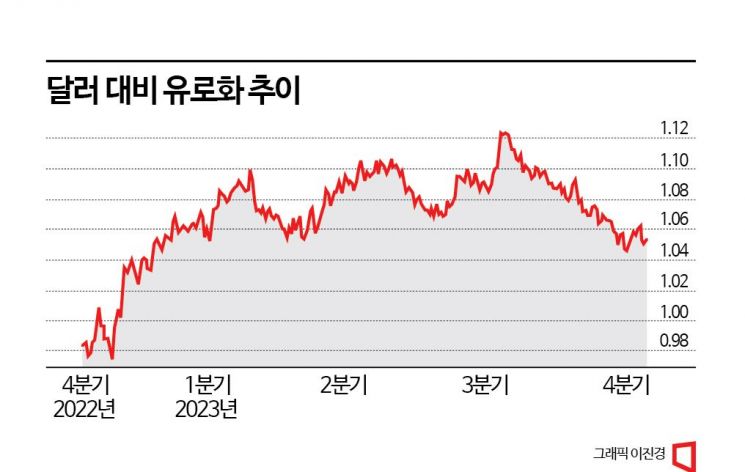
The contrasting economic situations between the U.S. and Europe are pulling down the euro's value. The U.S. economy has maintained strong employment and steady growth despite unprecedented high-intensity interest rate hikes since March last year, sustaining the dollar's strength. In contrast, Europe is experiencing an accelerating recession due to the impact of interest rate hikes, causing the euro's value to decline. In particular, Germany, the eurozone's largest growth engine, is expected to have an annual growth rate of only 0.4% this year.
Mira Chandan, head of JP Morgan's Global FX Strategy Research Team, diagnosed, "Despite the recent weakness, the euro still does not fully reflect the discount for the many uncertainties facing the currency," adding, "Growth is stagnating, financial conditions are tightening further, and potential geopolitical risks abound."
The armed conflict between Israel and the Palestinian militant group Hamas is also increasing downward pressure on the euro's value. Since Hamas's surprise attack on Israel on the 7th, there have been observations that Iran is behind Hamas, raising concerns that this war could spread throughout the Middle East. If Israel holds Iran, a major oil-producing country, responsible for backing Hamas and attacks Iran, escalating the situation across the Middle East, a rise in international oil prices will be inevitable. Reflecting these concerns, Europe's gas benchmark futures prices have surged by as much as 26% since the war began on the 7th.
Christine Lagarde, President of the European Central Bank (ECB), reportedly stated at the Eurozone Finance Ministers' meeting held in Luxembourg on the same day that she is closely monitoring the sharp rise in oil prices caused by the Israel-Hamas war. This is because if the situation leads to a surge in energy prices and inflation, additional interest rate hikes will be unavoidable. Further tightening by the ECB could accelerate Europe's recession. President Lagarde is known to have expressed concerns that soaring oil prices would harm both Europe and the United States.
Investor demand for the euro is also weakening. According to the U.S. Commodity Futures Trading Commission, net long positions in euro leveraged funds for the week ending on the 10th were about 75,000, a significant decrease compared to 170,000 in August.
Jane Foley, head of foreign exchange strategy at Rabobank, said, "Europe is facing obstacles on many fronts," adding, "We definitely see dollar-euro parity as possible. Discussions about parity will increase more and more within a few months."
© The Asia Business Daily(www.asiae.co.kr). All rights reserved.
![Clutching a Stolen Dior Bag, Saying "I Hate Being Poor but Real"... The Grotesque Con of a "Human Knockoff" [Slate]](https://cwcontent.asiae.co.kr/asiaresize/183/2026021902243444107_1771435474.jpg)
















