Personal Information, Accuracy, and High Costs as Obstacles
Reliability Crucial in Public Tasks... Ministries Cautious
Guideline Preparation Underway... Already Adopted Overseas
It has been 10 months since President Yoon Suk-yeol instructed government officials at a Ministry of the Interior and Safety briefing in January to explore ways to utilize ChatGPT in their work, saying, "I had ChatGPT write the New Year's address, and the result was excellent." However, there has been no news of generative AI being used in the public sector to dramatically improve the quality of services provided to the public. Why is the government and public institutions hesitant to adopt and utilize generative AI?
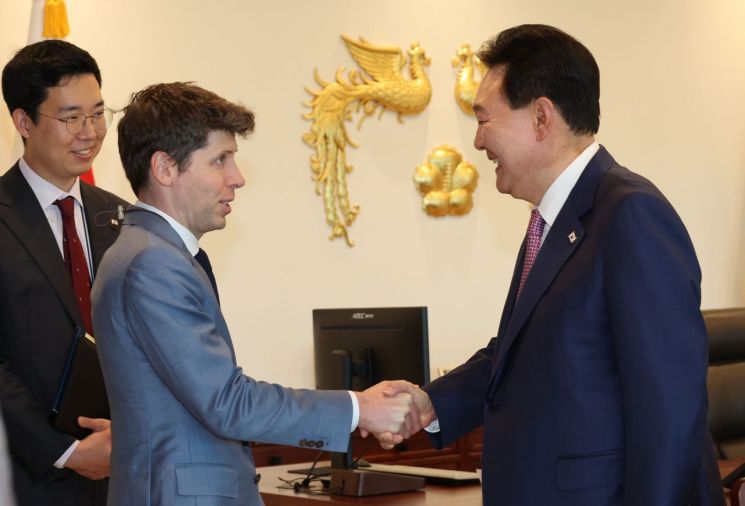 President Yoon Suk-yeol meeting with Sam Altman, CEO of OpenAI, the developer of the generative artificial intelligence (AI) ChatGPT, at the Presidential Office in Yongsan, Seoul, last June.
 [Image source=Yonhap News]
The National Information Society Agency (NIA) recently released a report titled "Utilization Plan for Generative AI in the Public Sector." The report noted the explosive interest in generative AI and the launch of large language models and related services by big tech companies, citing a Bloomberg Intelligence forecast that the generative AI market will grow 42% annually and reach $1.3 trillion by 2032. It is expected that generative AI will be applied across various fields such as healthcare, finance, education, and IT to automate tasks, increase productivity, enhance customer experience, and create new business opportunities.
The government has also announced plans to expand AI into citizens' daily lives and across public and industrial sectors, nurturing it as a national strategic industry. In April, it unveiled the "Plan to Strengthen Competitiveness of Super-large AI," and last month, the "National AI Normalization Execution Plan." However, aside from chatbot services like "ChatGyeongbuk," a policy support AI service developed by the Gyeongbuk Research Institute, there are few cases where generative AI has been directly applied to public tasks.
Most government and public institutions cite concerns such as personal information leakage, low response accuracy, and high costs when applying generative AI services to their work. Particularly, trustworthiness is the core of policy and administrative services in the public sector. Generative AI sometimes produces incorrect or meaningless answers, a phenomenon known as "hallucination," which can be a fatal weakness in public tasks. Incorrect information can be amplified and reproduced, undermining public trust. Introducing private models raises concerns about sensitive information leakage, and building proprietary language models in the public sector requires astronomical costs, leading to a cautious stance.
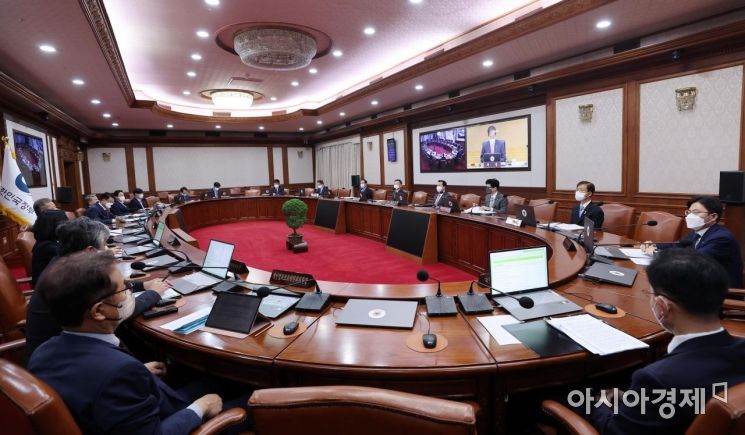
In June, the government, together with NIA, launched a project to establish criteria for suitable public sectors and implementation plans for adopting generative AI, with guidelines expected by the end of this year. However, some countries overseas have already introduced generative AI services in the public sector and are simultaneously working to resolve related issues. They acknowledge the limitations of generative AI but accept trial and error to improve public task efficiency.
The Japanese government signed a contract with Microsoft to use ChatGPT for ministry work, paying about 2.5 billion KRW annually. It plans to utilize it for drafting parliamentary responses, preparing meeting minutes, and supporting statistical analysis. Singapore operates a 24-hour AI service that answers citizens' questions. The Icelandic government is collaborating with OpenAI on GPT-4 development to ensure its citizens face no difficulties using generative AI.
Generative AI can be used to enhance public work efficiency and improve citizen convenience in various ways, including idea exploration, document drafting, task automation, and civil complaint processing and response services. NIA advised that it is necessary to identify the problems or inconveniences of organizations or customers and discover generative AI services considering the institution's specialized tasks. It also emphasized that collaboration between IT and operational departments is essential, along with continuous data building, expert personnel, and institutional foundations. It is preferable to apply generative AI first to tasks that significantly reduce time and cost and improve customer service compared to existing work methods. However, it stated that generative AI is inappropriate for Q&A tasks involving personal or sensitive information of complainants or tasks requiring quantitative rather than conversational answers.
Kim Tae-won, Senior Researcher at the AI and Future Strategy Center, said, "It is necessary to recognize the limitations of generative AI and make efforts such as hands-on training to strengthen generative AI utilization capabilities and recruit experts to maximize efficiency in the public sector."
© The Asia Business Daily(www.asiae.co.kr). All rights reserved.
![Clutching a Stolen Dior Bag, Saying "I Hate Being Poor but Real"... The Grotesque Con of a "Human Knockoff" [Slate]](https://cwcontent.asiae.co.kr/asiaresize/183/2026021902243444107_1771435474.jpg)












