As the possibility of Iran's direct involvement in the war between Israel and the Palestinian armed group Hamas is being raised, the sense of crisis in the global economy is intensifying. In a situation where the world is already suffering from record debt, high interest rates, and high inflation, there is a forecast that if the worst-case scenario of 'Iran involvement' materializes, the global economic growth rate (GDP) for next year could be 1.0 percentage point lower than expected.
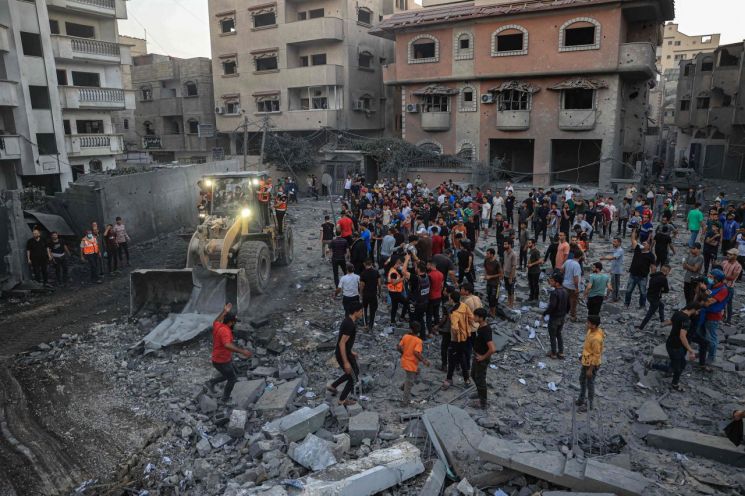
According to major foreign media including Bloomberg on the 15th (local time), officials from various countries attending the International Monetary Fund (IMF) and World Bank (WB) annual meetings in Morocco last week expressed concerns that if the armed conflict between Israel and Hamas expands into a Middle East war, it would have significant economic ripple effects.
Bruno Le Maire, France's Minister of Finance, diagnosed that "geopolitical risk is currently the greatest threat to the global economy" and that it is "growing day by day." He added, "The scope of risks (due to this situation) is very large, including oil price increases causing inflation." Ngozi Okonjo-Iweala, Director-General of the World Trade Organization (WTO), also said, "Global uncertainty is already high," and predicted, "(If the conflict spreads across the Middle East) it will have really significant repercussions." Earlier, the WTO had downgraded its global merchandise trade growth forecast (0.8%) to about half the previous level, citing high inflation, high interest rates, China's economic slowdown, and the Ukraine war.
In particular, officials expressed caution that geopolitical risks originating from the Middle East have emerged amid the increased vulnerability of the global economy due to massive debt, high interest rates, and high inflation. Gita Gopinath, IMF Deputy Managing Director, said, "The world is facing 'numerous shocks,' including the Middle East conflict and its potential impact on energy prices," adding, "Debt is at record levels, and at the same time, we are in a higher interest rate environment. There are many things that could go wrong." The IMF estimated that a 10% rise in oil prices would increase global inflation by 0.4%.
At the beginning of last week, when the annual meetings started, voices expressing concern about the economic impact of this war were relatively low. This was because the development and scale of the conflict were unclear, and the immediate reaction of global financial markets was not significant. Janet Yellen, U.S. Treasury Secretary, said on the 11th, "We are monitoring the potential economic impact of the crisis," but drew a line by saying, "I do not consider it a major driver of the global economic outlook."
However, anxiety began to rise significantly as the possibility of Iran's involvement was raised. Bloomberg reported, "As the annual meetings continued, daily reports of Israel's civilian evacuation notices and threats of new fronts in the north increased, and concerns about economic repercussions grew," adding, "The war adds risks to a world that is indebted, expensive, and divided."
Earlier, a report released by Bloomberg Economics on the 13th analyzed the impact of this war on the global economy by dividing it into three scenarios: a ground war in the Gaza Strip, a proxy war between Iran and Israel involving Lebanon and Syria, and Iran's direct participation.
Among these, the worst-case scenario of Iran's participation is estimated to push international oil prices beyond $150 per barrel and reduce next year's global growth rate by 1 percentage point compared to previous forecasts. It warned that major oil-producing Iran could pressure the global economy by controlling the Strait of Hormuz, potentially triggering an inflation crisis similar to the oil shock of the 1970s.
The resulting global GDP loss is expected to reach $1 trillion. Next year's inflation rate is also estimated to be 6.7%, 1.2 percentage points higher than previous forecasts. Volatility in financial markets is expected to increase, with the Volatility Index (VIX), known as the "fear index" of Wall Street, predicted to rise above 16 points. The report also forecast that oil prices would surge by $3-4 per barrel in the ground war scenario within the Gaza Strip and by more than $8 per barrel in the proxy war scenario, even without Iran's direct involvement.
Bloomberg pointed out, "Since the Israeli military is preparing for a ground war, these risks are real." On the same day, Jake Sullivan, U.S. National Security Advisor, stated in an interview with CBS that the possibility of Iran's direct involvement in the war between Israel and Hamas cannot be ruled out.
© The Asia Business Daily(www.asiae.co.kr). All rights reserved.

















