'Gwanghwamun' in Gold Letters on Black Background
Reviving Korea's Unique Cultural Heritage
Gwanghwamun, the symbolic landmark representing Seoul and the main gate of Gyeongbokgung Palace, has revealed a new appearance.
On the 15th, as people gathered at the plaza in front of Gwanghwamun in Seoul took out their mobile phones and turned on their lights, the area around Gwanghwamun brightly lit up. Including 500 pre-registered spectators and citizens out for an outing, cheers erupted as the Woldae was unveiled.
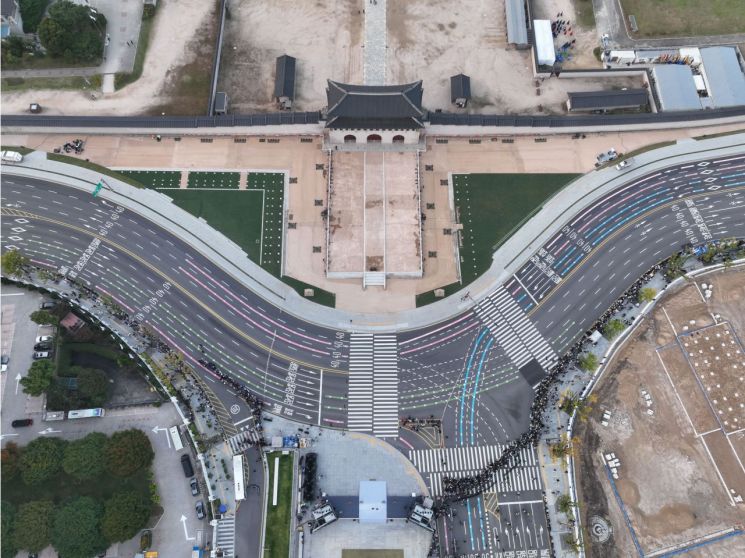
The Woldae (越臺, 月臺 - a wide platform installed in front of important buildings) and the new signboard in front of Gwanghwamun have completed a long restoration process. The Gwanghwamun Woldae is a unique cultural heritage of Korea, not found in China or Japan, and the signboard displaying ‘Gwanghwamun’ was replaced with gold lettering on a black background.
The Haechi statue, which was previously positioned close to Gwanghwamun, was moved forward onto the Woldae this time. Walking on the Woldae, which measures 48.7 meters in length and 29.7 meters in width, visitors could once again appreciate the grandeur of Gyeongbokgung Palace. The Seosusang (瑞獸像, mythical auspicious animal statues) donated by the family of the late Lee Kun-hee, former chairman of Samsung Group, and the unique balustrade stones found only on the Gwanghwamun Woldae, unlike those at Changdeokgung or Deoksugung Woldae, also attracted attention.
The Gwanghwamun Woldae was built in 1866 during King Gojong’s reconstruction of Gyeongbokgung Palace to communicate with the people. However, during the Japanese colonial period, it was destroyed and railroad tracks were laid to erase the spirit of the Korean people. The damaged Woldae has now regained its original form after 100 years. This marks the final journey and completion of the ‘Finding the Original Appearance of Gwanghwamun’ project that began in 2006.
On this day, the Cultural Heritage Administration held a commemorative event called ‘Gwanghwamun Woldae New Path Celebration’ at the plaza in front of Gwanghwamun in Seoul to mark the restoration of the Woldae and the signboard.
Director Choi Eung-cheon emphasized in his commemorative speech, "Although this appearance is quite different from the Gwanghwamun we have seen for a long time, this is the complete and original form of Gwanghwamun." He referred to Gwanghwamun as ‘the first face of Gyeongbokgung Palace’ and added, "I hope the symbolism, significance, and efforts of the Gwanghwamun restoration will be well conveyed to the public."
Minister Yoo In-chon of the Ministry of Culture, Sports and Tourism stated, "The Woldae is not only the ‘King’s path’ but also a space for communication with the people," emphasizing, "I hope it will play a role in opening up communication throughout the Republic of Korea."
Chief Restorer Lim Dong-jo, who led the Woldae restoration, said, "The new Gwanghwamun will become a plaza for meetings in the future," and urged, "Please remember the significance of restoring our precious cultural heritage and passing it on to future generations."
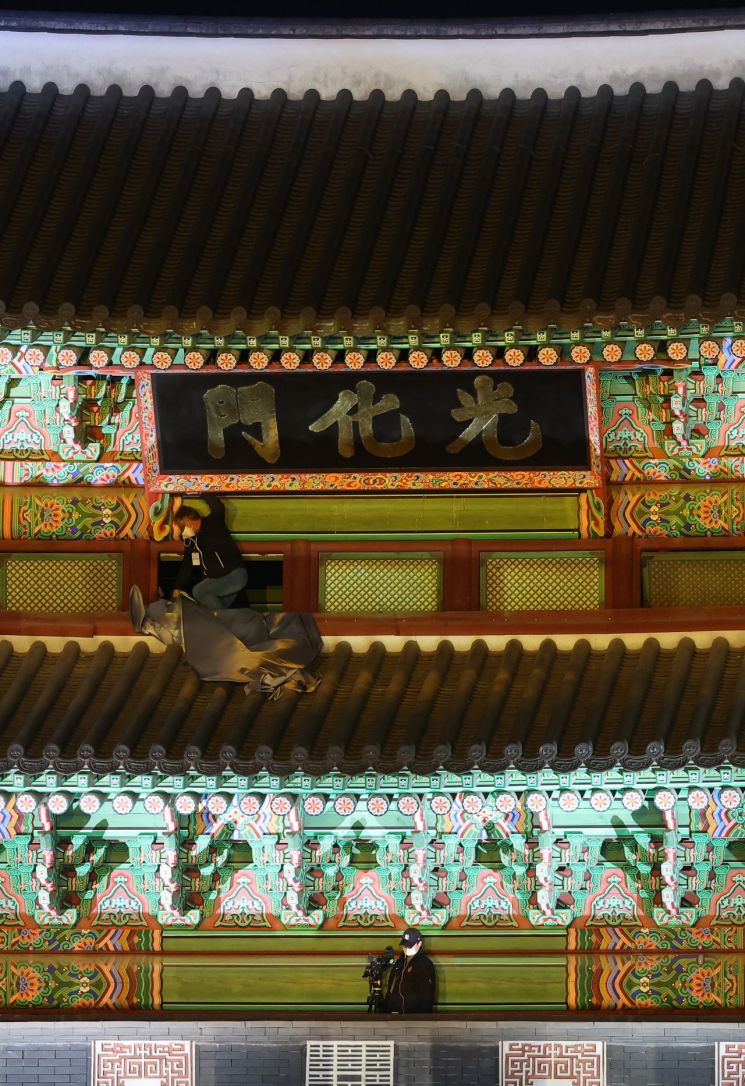
On this day, the new ‘nameplate’ of Gwanghwamun was also unveiled. While the previous signboard made in 2010 had black characters on a white background, the new signboard features the Chinese characters ‘光化門 (Gwanghwamun)’ engraved in gold-plated copper letters on a black background. The characters follow the style of Im Tae-young, who was the training commander and also in charge of the Younggeondo-gam during the reconstruction of Gyeongbokgung Palace.
In this regard, several Hangul-related organizations expressed opposition to the new Gwanghwamun signboard being made in Chinese characters for the first time in about 13 years since 2010. More than ten organizations, including the Korean Correct Language Research Institute, held a press conference at Gwanghwamun Plaza on the same day, stating, "Gwanghwamun is the history of the Republic of Korea and a symbol of Seoul," and asserted, "We oppose the Chinese character signboard."
© The Asia Business Daily(www.asiae.co.kr). All rights reserved.


















