Announcement of 'Hospitality and Cleanliness' Subprojects in the Comprehensive Tourism Infrastructure Plan
Seoul City will create 'symbolic street forests' at 10 gateways leading into Seoul, including Sangam, Yangjae, and Gaehwa. It will also focus on improving the pedestrian environment in five downtown areas popular with walking tourists, such as Seochon and Ikseon-dong, and will redesign public facilities.
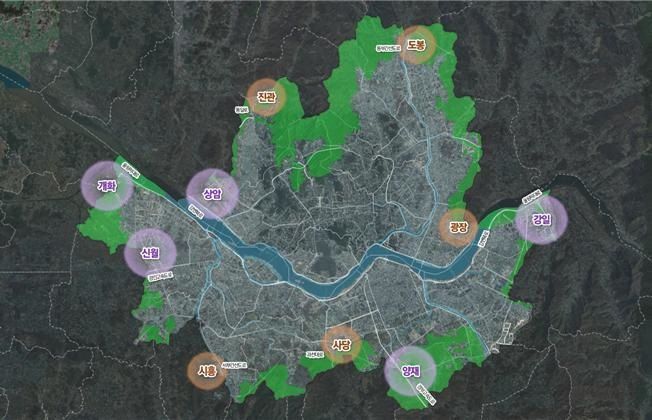
On the 15th, Seoul City announced that it will promote hospitality and cleanliness policies as part of the 'Seoul Tourism Infrastructure Comprehensive Plan.' The four core strategies are ▲Stay ▲Welcome ▲Clean ▲Fun. Previously, the city announced detailed projects in the accommodation sector on the 25th of last month.
First, the city will enhance symbolism by creating green spaces and sculptures along major gateway streets leading into Seoul from other cities, including Incheon and Gimpo where airports are located.
Specifically, these include the entrances of urban expressways (Olympic-daero, Gyeongbu Expressway, Gyeongin Expressway, Gangbyeonbuk-ro, Gwacheon-daero, Seobu Ganseon-ro, Dongbu Ganseon-ro, Tongil-ro), with five main entrances (Gangil, Yangjae, Sinwol, Gaehwa, Sangam) and five secondary entrances (Gwangjang, Sadang, Siheung, Jingwan, Dobong). Priorities will be set based on the inflow routes of domestic and foreign tourists.
The buffer green zones alongside major expressways such as Olympic-daero, Gyeongbu Expressway, and Gangbyeonbuk-ro, which serve as gateways, have so far focused only on blocking views and buffering noise from surrounding residential areas. Since the condition of these gateways, which visitors first encounter when entering Seoul, forms the city's first impression, the city plans to manage them from the perspective of urban image going forward. Additionally, the city will prepare integrated guidelines for systematic and sustainable maintenance and will work to eliminate management blind spots.
At key transportation hubs with high tourist inflow, a 'Travel Lounge' exclusively for travelers will be established. Beyond simply providing tourist information, it will offer various travel conveniences such as currency exchange, charging, and storage, and will serve as a space to support communication among travelers. The city is currently reviewing the creation of Travel Lounges at 13 existing Tourist Information Centers and idle city buildings, with plans to establish and operate them by 2026.
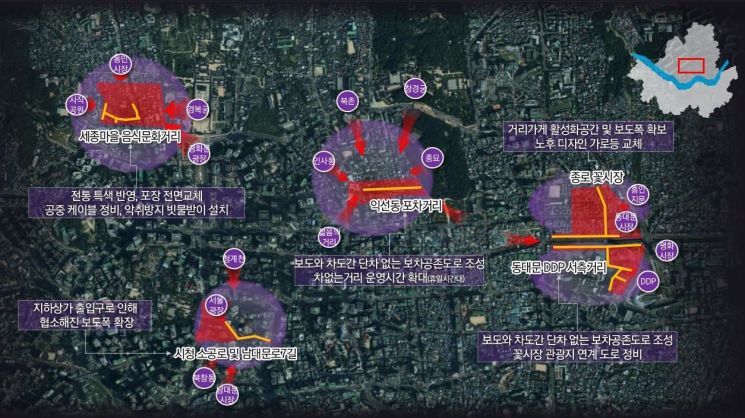 Areas targeted for the Pedestrian Environment Improvement Pilot Project. [Image provided by Seoul City]
In five major areas within the Four Great Gates where walking tourists concentrate?Seochon Sejong Village Food Culture Street, Ikseon-dong Pocha Street, Jongno Flower Market, the west side food street of Dongdaemun Design Plaza (DDP), and the area around Sogong-ro near City Hall?a 'Pedestrian Environment Improvement Pilot Project' will be launched starting next year.
This will include replacing old road facilities and eliminating level differences at crosswalks and subway entrances to create 'barrier-free streets.' Ventilation shafts, utility poles, and public phone booths that obstruct smooth walking will be relocated or buried underground to secure sufficient walking space. Photo zones matching local characteristics will be installed throughout pedestrian paths, and green spaces and rest areas utilizing public open spaces will be expanded.
Public facility designs that play a significant role in conveying the city's image?such as construction site barriers, street trash bins, public restrooms, and smoking booths?will be completely revamped. The city plans to produce and distribute guidelines by the end of the year for use by public and private entities when manufacturing these facilities.
A 'Seoul-style smoking booth' that harmonizes with the urban landscape while minimizing secondhand smoke exposure will be developed and pilot-installed, and a 'Seoul-style trash bin' design will be developed and expanded to all autonomous districts by 2025.
Fun designs will be applied to construction site barriers, and public restrooms will be developed and implemented with 'universal design' to ensure convenience for all users.
Furthermore, by next year, odor-blocking devices such as sewer pipes and rainwater inlets, as well as fine water spraying and deodorizing facilities for sewer pipes, will be installed in 75 major downtown areas with high foot traffic to maintain a clean urban environment.
An immediate response system will be established for sewer odor complaints, and to reduce odors from septic tanks?a major cause of odor problems?a remote monitoring system for odor reduction facilities will be set up at approximately 2,400 locations by 2028, with 556 odor reduction facilities for septic tanks installed.
A Seoul City official stated, "We plan to faithfully implement the 'Seoul Tourism Infrastructure Comprehensive Plan' to improve not only tourism facilities but also the quality of tourism services and content by utilizing Seoul's resources such as the natural environment of the Han River and Bukhansan Mountain, as well as nighttime scenery."
© The Asia Business Daily(www.asiae.co.kr). All rights reserved.


















