Stages Hosting Various Ceremonies and Events, Rice Distribution
Restored Based on 1890s Standards... Reusing Existing Materials
Greater Significance Given with New Gwanghwamun Signboard
Cultural Heritage Administration to Unveil at Commemorative Event on 15th at 5 PM
Outside Gwanghwamun during the Joseon Dynasty was a stage where various ceremonies and events took place. This is confirmed in numerous historical records. Volume 97 of the Annals of King Sejong (1442) states, "Outside Gwanghwamun at the jangjeon (a temporary seat arranged for the king), he personally oversaw the military examination." In the same book, Volume 127 (1450), it is written, "Outside Gwanghwamun, chaebung decorations were hung and various entertainments were held." Chaebung refers to decorations made of colored threads, colored paper, or cloth hung on gates, bridges, and roofs during royal processions or when welcoming Chinese envoys. Evidence also appears in Volume 12 of the Annals of King Munjong (1452), which notes, "When receiving the Chinese imperial envoy (...) chaebung was installed in front of Gwanghwamun and the crown prince (...)"
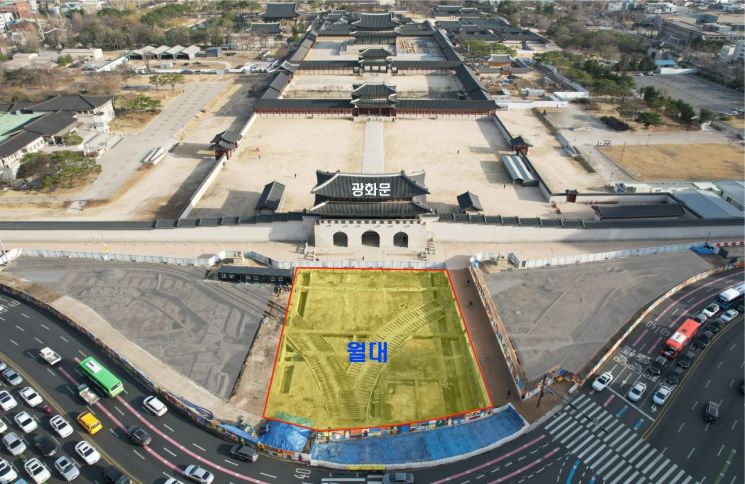
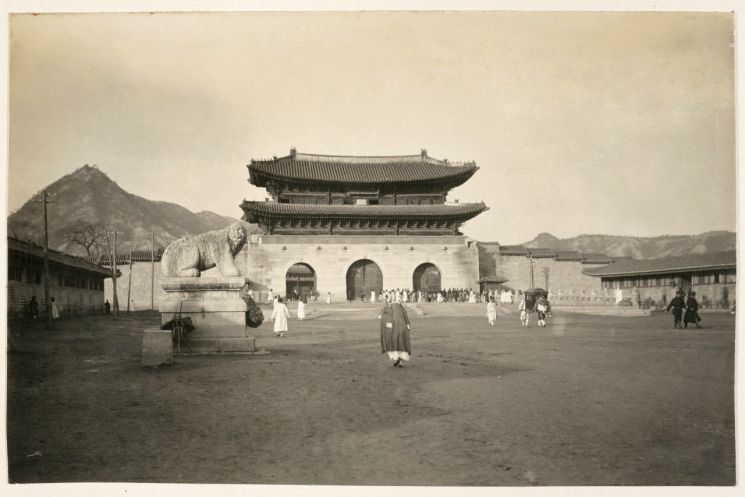
Outside Gwanghwamun was also a space where rice was distributed to the people and petitions and remonstrances were received. Volume 28 of the Annals of King Gojong (1891) records, "An event was held at Gwanghwamun where the crown prince bestowed rice upon (...)". The Seungjeongwon Ilgi (Diary of the Royal Secretariat) from the 20th year of King Yeongjo’s reign (1744) states, "An order was given to receive the people's remonstrances at Gwanghwamun." The connecting element was the woldae, a high and wide stone platform built to conduct ceremonies. The palace’s main gate was surrounded by a balustrade and the platform was constructed.
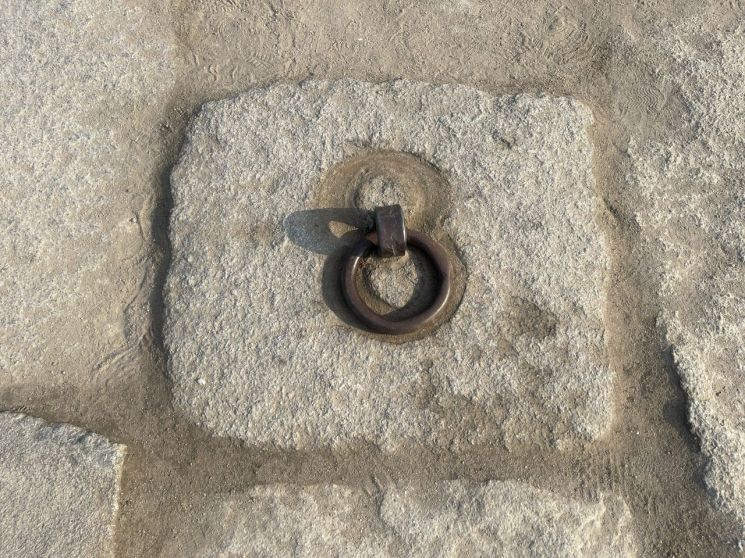
The woldae, which elevated the status of Gwanghwamun and facilitated communication between the palace and the people, has been restored to its original form. The Cultural Heritage Administration completed the restoration work it had been promoting since 2006. It will be unveiled at a commemorative event on the 15th at 5 p.m. The result was completed based on excavation surveys, data collection and analysis, and precise measurements. During the excavation conducted until May, the Cultural Heritage Administration confirmed the east-west width (29.7m), north-south length (48.7m), stair components, and early Joseon period remains. The restoration plan was designed based on conditions prior to the 1890s, and existing components (platform and stair stones) were reused as much as possible to proceed with the restoration.
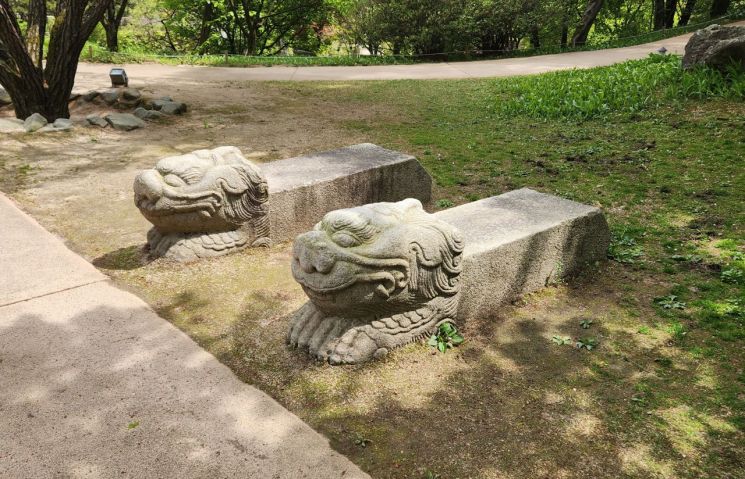
In August, the family of the late Lee Kun-hee, former chairman of Samsung Group, donated a Seosusang (瑞獸像), a sculpture of an auspicious animal. It is presumed to be an artifact placed on the woldae when King Gojong rebuilt Gyeongbokgung Palace in 1865. Its existence is confirmed in glass plate photographs of Gwanghwamun from the 1910s. Although its whereabouts had been unknown, it was exhibited in the outdoor garden of the Hoam Art Museum in Yongin, Gyeonggi Province. The Cultural Heritage Administration explained, "The processed parts to seat the upper components on the base stone, as well as the shape and size, are the same. The form and dimensions also match those of the past Gwanghwamun woldae confirmed through photographic materials."
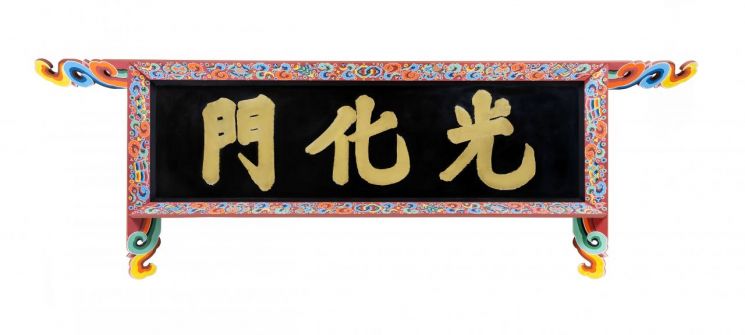
The restored woldae gains even greater significance with a new Gwanghwamun signboard. The Cultural Heritage Administration scientifically analyzed old photographs from the National Museum of Korea, the University of Tokyo, and the Smithsonian Institution, and incorporated expert advice to produce it. The most notable aspect is the color. Analysis of the Geunjeongjeon signboard and others revealed a black background with gold lettering. This unique composition is also confirmed in the "Gyeongbokgung Reconstruction Diary (1865)," which states, "The Gwanghwamun signboard was made by the training captain Im Tae-young. It has gold letters on a black background. The letters were made of copper plates and coated with the best quality gold worth four nyang. Silver craftsmen Kim Young-rok, Choi Tae-hyung, and Kim Woo-sam were the original donors."
The Cultural Heritage Administration engraved the letters in relief on metal plates. After cutting the letters out of copper plates, they applied the amalgam gilding technique. This technique involves applying an amalgam of gold dissolved in mercury onto the metal surface and then evaporating the mercury to leave a gold coating. The Cultural Heritage Administration explained, "Gyeongbok (景福), meaning 'great blessing,' symbolizes the idea that great fortune shines and spreads to the people, reflecting the philosophy of the people's welfare. The restoration was based on historical materials from the same period as the woldae, maintaining consistency with the overall restoration of Gyeongbokgung Palace."
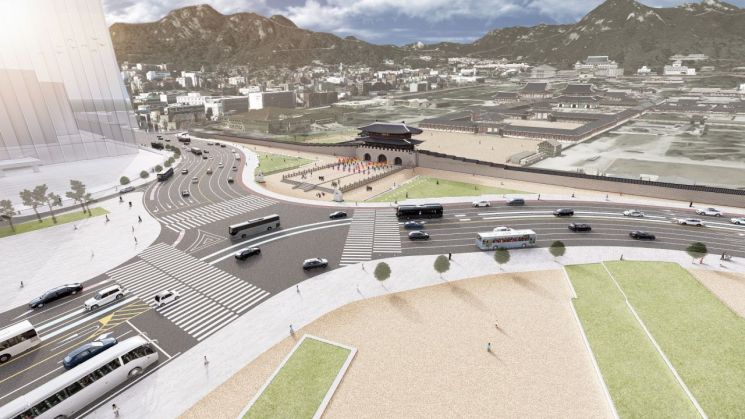
The commemorative ceremony will be a citizen-participation event. It will begin with a lighting ceremony unveiling the woldae and signboard, followed by a gate-opening ritual, a woldae procession, and the presentation of related videos, performances, and projection mapping (media show). The projection mapping, in particular, will be projected onto the approximately 130-meter-long Gwanghwamun and its surrounding walls, attracting significant early interest. The Cultural Heritage Administration stated, "With the complete restoration of Gwanghwamun, the public will be able to fully appreciate not only its architectural value but also its historical, social, and economic significance. We will continue to expand restoration and maintenance projects to restore historical authenticity and develop Gyeongbokgung Palace as a K-tourism landmark."
© The Asia Business Daily(www.asiae.co.kr). All rights reserved.
!["I'd Rather Live as a Glamorous Fake Than as a Poor Real Me"...A Grotesque Success Story Shaking the Korean Psyche [Slate]](https://cwcontent.asiae.co.kr/asiaresize/183/2026021902243444107_1771435474.jpg)


















