Likely to Worsen Ahead of General Election
12 Outdoor Advertising Law Bills Pending in National Assembly
Guidelines Exist but 'Ineffective'
Incheon, Busan, and Others Implement Independent Regulations
Since the end of last year, with the unlimited posting of party banners allowed, hate and slanderous phrases such as ‘pro-Japanese traitor,’ ‘fake news,’ ‘presidential election manipulation,’ and ‘Is this a country?’ have flooded the streets. The indiscriminate banners are damaging the cityscape and threatening citizens' safety, but discussions on related legislation in the National Assembly remain stagnant. With the general election approaching, banner pollution is expected to worsen until the end of the year.
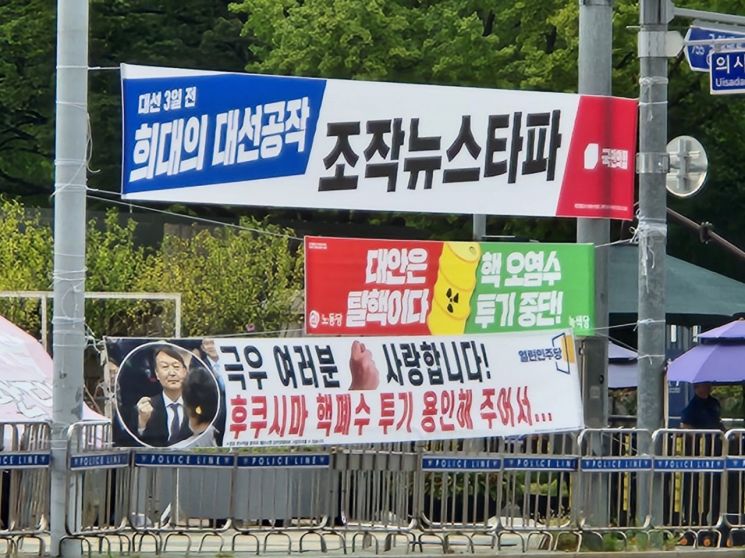 Political party banners are hung in front of the National Assembly building in Yeongdeungpo-gu, Seoul.
 [Photo by Im Chunhan]
◆Expansion of political hatred, threats to safety and environment= On the afternoon of the 13th, Kim (27), whom we met at Yeouido Station in Yeongdeungpo-gu, Seoul, said, “There are basically four to five or more banners in places with heavy foot traffic like subway stations or intersections. I almost tripped over a banner right next to me while trying to cross the crosswalk quickly,” and criticized, “It seems that parties use them more to slander each other than to inform about policies, and I’m also worried about environmental pollution.” Office worker Lee (27) said, “There are many banners hung around my neighborhood. Most of them were mocking in nature,” and added, “I wondered if it’s even allowed to hang such banners.” Kim Seong-gwon (32) said, “I don’t know what the law is like to allow this,” and “Regulations on banners seem absolutely necessary.”
Under current law, party policies or political issues can be displayed or installed as banners without separate reporting, permission, prohibition, or restriction. As long as the party name and the contact information of the installation company are indicated, banners can be posted anywhere for up to 15 days. With the proliferation of party banners, related complaints have surged. According to the Ministry of the Interior and Safety, complaints related to party banners numbered 6,415 from September to November 2022 before the Outdoor Advertising Act amendment took effect, but jumped to 14,197 from December 11 last year to March 31 this year after enforcement. In April this year, 4,195 complaints were received, and in May, 3,680, maintaining a higher level than before the law’s enforcement (average 2,115 complaints).
Banners also threaten pedestrian safety. From January to June this year, there were a total of eight banner-related accidents. In January, in Pohang, Gyeongbuk Province, four banners were installed between a traffic light and a street lamp, and a pedestrian was injured when a strong wind blew them down. In February, in Jung-gu, Busan, an elderly person fell after getting caught on a party banner, and in March, in Nowon-gu, Seoul, a pedestrian riding a bicycle was injured after getting caught on a banner string while crossing a crosswalk. The issue of disposing of discarded banners is also serious. According to Seoul City, discarded banners generated in 25 autonomous districts of Seoul last year totaled 236.3 tons. Except for some reuse as shopping bags or sandbags, recycling is almost nonexistent. Taxes spent on incineration and landfill for disposal and social costs to handle various pollutants released during the disposal process are also incurred.
Public opinion is negative toward party banners. According to a regular public opinion survey conducted jointly by Yonhap News Agency and Yonhap News TV through the polling company Metrics on August 5-6, targeting 1,000 adults aged 18 and over nationwide, 80.6% of respondents agreed with the proposal to limit the locations and number of party banners posted. The opinion to restrict party banners was high across all demographics regardless of age, region, or political inclination. The survey’s margin of error is ±3.1 percentage points at a 95% confidence level. It was conducted via telephone interviews using 100% mobile virtual numbers, with a response rate of 14.5%. For detailed information, refer to the Central Election Poll Deliberation Commission website.
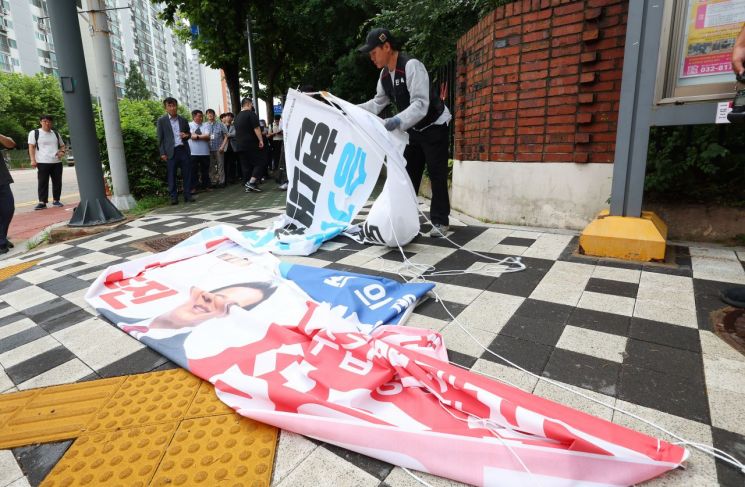
◆Stagnation in the National Assembly, fragmented efforts by local governments= There are a total of 12 bills pending in the National Assembly to regulate party banners under the Outdoor Advertising Act. Kang Byung-won of the Democratic Party proposed a bill limiting the number to two or fewer per eup, myeon, or dong (township-level administrative units), prohibiting banners that threaten pedestrian or traffic safety, and requiring prompt voluntary removal after the expiration period. Ryu Seong-geol of the People Power Party proposed a bill banning party banners within 200 meters of schools to protect students’ traffic safety and learning rights, and Park Seong-min of the People Power Party proposed allowing banners only in locations designated by city or provincial ordinances.
The Ministry of the Interior and Safety issued the ‘Party Banner Installation and Management Guidelines’ in May, but they are ineffective. According to the guidelines, party banners cannot be installed in child, elderly, or disabled protection zones, and the lowest part of the banner string must be at least 2 meters above the ground in places where pedestrians pass or drivers’ visibility may be obstructed. Banners must not block traffic signals or safety signs, and only up to two banners can be installed per street lamp. However, since these guidelines lack legal binding force, they are not properly observed. A Seoul city official said, “There are too many legal loopholes regarding party banners. Many parties exploit the fact that the guidelines have no legal binding force,” and added, “The city council is pushing for an ordinance, but we will have to see if it can pass before the general election.”
Ultimately, local governments have taken independent regulatory measures. Incheon City became the first in the country to enact an ordinance limiting the number of party banners and began removal efforts, followed by Busan, Gwangju, and Ulsan. The Ministry of the Interior and Safety filed a suspension of execution, arguing that the ordinances violate the higher-level Outdoor Advertising Act, but the Supreme Court dismissed the request. Other cities and provinces have also started enacting ordinances, but whether they will ultimately pass remains uncertain. Ahead of the general election, city and provincial council members have no choice but to consider the National Assembly members’ positions, and after the end of the year, regulations will naturally be enforced under election law. According to election law, political banner posting will be restricted from December 12, 120 days before the general election.
Experts unanimously agree on the need for regulation of party banners. Seo Jong-guk, professor of Urban Administration at Incheon National University, said, “Banner politics is a backward political propaganda method, and people are no longer deceived by it,” adding, “It obstructs citizens’ walking and traffic and causes safety issues. Unlike general banners, they should not enjoy special privileges.” Hong Seong-geol, professor of Public Administration at Kookmin University, said, “Freedom of expression is important, but party banners have a huge impact on people’s lives,” and suggested, “There needs to be an agreement, such as allowing only one banner per party.”
© The Asia Business Daily(www.asiae.co.kr). All rights reserved.


















