Research Team at University of Science and Technology of China Develops 'Jiuzhang 3.0'
Published in Top US Scientific Journal
A research team at a Chinese university has developed a quantum computer that is 10 quadrillion times faster than the world's fastest existing supercomputer, according to Chinese state media. Quantum computers, known as the "dream computers," are attracting focused investment from major advanced countries such as the United States, China, and Japan, as well as big tech companies like Google and IBM.
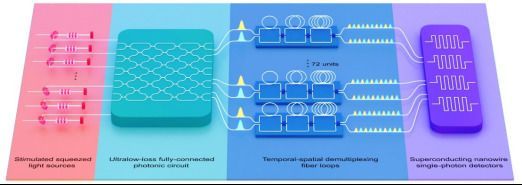 Conceptual Diagram of China's Quantum Computer Claim No. 3
[Photo by University of Science and Technology of China]
On the 12th, according to the Chinese state-run Global Times, a research team composed of quantum physicists Pan Jianwei and Lu Chaoyang from the University of Science and Technology of China collaborated with the Shanghai Microsystems under the Chinese Academy of Sciences to build a 255-photon-based prototype quantum computer named "Jiuzhang 3.0."
The research team explained that this quantum computer solves the Gaussian Boson Sampling (GBS) problem at a speed 10 quadrillion times faster than the world's fastest supercomputer. The related research results were published on the 11th (local time) in the international academic journal Physical Review Letters, published by the American Physical Society. Physical Review Letters is the most prestigious journal in the field of physics.
Jiuzhang is a quantum computer prototype first developed by Pan Jianwei's research team in China in 2019. At that time, it was the world's second quantum computer following Google's Sycamore, which was unveiled in 2019.
In 2021, the research team developed Jiuzhang 2.0 based on 133 photons, which can calculate the most complex samples in just 1 microsecond. According to the published optimal algorithm, the speed of Jiuzhang 3.0, which handles Gaussian Boson Sampling, is one million times faster than the previous model, Jiuzhang 2.0.
Lu Chaoyang stated, "The current prototype is used to calculate problems related to graph theory and will be used in the field of material design in the future," adding, "It has opened the path to universal quantum computers, which the academic community expects to achieve within 10 to 15 years."
China is evaluated to possess technological capabilities that threaten the United States even in quantum computers, which are considered future computing and defense technologies. According to consulting firm McKinsey, as of 2021, China's share of patent applications related to quantum computers was 52.3%, far ahead of the United States (10%) and Japan and the EU (both 13.8%). Although American companies such as Google and IBM still lead in manufacturing technology for commercial quantum computing products, China has significantly surpassed the United States in fundamental technologies.
Foreign media evaluated, "With Jiuzhang 3.0, China has continued its overwhelming competitiveness in the field of quantum computer research and development." Quantum computing is not only a focus for the United States and China but also for South Korea, which aims to become one of the four major quantum technology powers by the 2030s and is actively fostering the lacking core talent.
© The Asia Business Daily(www.asiae.co.kr). All rights reserved.
![Clutching a Stolen Dior Bag, Saying "I Hate Being Poor but Real"... The Grotesque Con of a "Human Knockoff" [Slate]](https://cwcontent.asiae.co.kr/asiaresize/183/2026021902243444107_1771435474.jpg)
















