The 15th Urban and Architectural Joint Committee Meeting Held
Strengthening Transit-Oriented Functions Around Ggachisan Station
Expanding Living SOC Around Nangok Station
On the 11th, the Seoul Metropolitan Government held the 15th Urban and Architectural Joint Committee meeting and announced on the 12th the redevelopment plans for the areas around Yeonsinnae Station, Kkachisan Station, and the Nangok living zone in Sillim-dong.
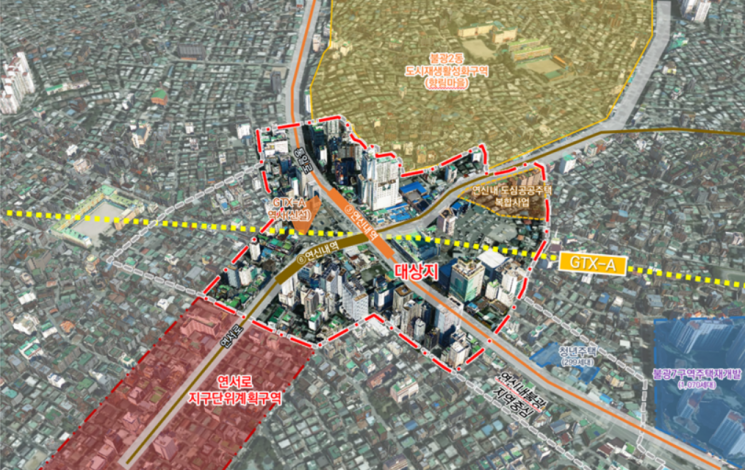
At the meeting, the committee approved a revised version of the “Yeonsinnae Station District Unit Plan Amendment.”
Yeonsinnae Station, where subway lines 3 and 6 pass through and the GTX-A line is scheduled to open in 2024, is designated as the Yeonsinnae-Bulgwang regional center in the city’s basic urban plan. The district unit plan is being reorganized to strengthen commercial and business functions.
This redevelopment plan encourages residents’ voluntary joint development to revitalize the regional center and significantly expands incentives for this purpose, while reducing the designated and recommended joint development requirements that acted as regulations.
To promote coexistence with the declining Yeonsinnae Rodeo Street, a clothing-specialized street, beauty sales facilities related to clothing sales were added to the recommended uses to foster a second wave of revitalization. Additionally, the land-use plan was changed to prohibit the installation of entertainment and lodging facilities, which are harmful to residential and educational environments.
For large-scale site developments, public facility plans prioritize the installation of resident convenience facilities such as sports facilities and parking lots. Reflecting the opinions of landowners, the boundaries of the special planning zone were adjusted to promote the activation of regional hub development.
On the same day, the committee also approved a revised version of the “Kkachisan Station District Center District Unit Plan Area and Plan Amendment.”
The area around Kkachisan Station, where subway lines 2 and 5 pass, and the Gangseo-ro roadside, including 897 Hwagok-dong, Gangseo-gu (221,180.5㎡), is a general commercial area and newly incorporated zones of second-class general residential (7 floors) and third-class general residential areas. It is a region with low district center functions that is transforming into a residential-commercial mixed area.
The main decisions include expanding the district unit plan area by 15,670.5㎡ centered on Kkachisan Station, specializing Gangseo-ro roadside as a business function zone to prevent excessive residential conversion of commercial areas and foster central functions, creating a food culture street along the covered road, and establishing land-use plans to introduce facilities such as libraries and sports facilities needed by local residents in the rear commercial areas.
Furthermore, to revitalize the low-rise street fronts along major commercial area arterials and overcome architectural limitations caused by Gimpo Airport height restrictions despite being a commercial area, plans include changes to some building coverage ratios and allowable floor area ratios.
In addition, to continuously maintain the market use for the community-based Kkachisan Market revitalization, allowable use plans were introduced, and plans to improve the pedestrian environment within the district through the establishment of building limit lines and front open spaces along major pedestrian activity axes were included.
Meanwhile, the committee also approved a revised version of the “Nangok Living Zone Center District Unit Plan Amendment for 706-22 Sillim-dong, Gwanak-gu.”
The Nangok Living Zone Center district unit plan area is located along Nangok-ro, where the Nangok Line light rail is currently under construction. With the light rail expected to open in the future, station area projects and large-scale developments are anticipated. The area requires management plans for the large market site, expansion of insufficient living SOC (social overhead capital), and improvement of narrow pedestrian paths.
The main district unit plan includes designating a special planning zone to induce complex development of the large market site, expanding cultural and leisure facilities through public contributions from development, and designating the Nangok Line station area as a special joint development zone to provide floor area ratio incentives and establish a new subway station building through public contributions.
Additionally, joint development designations are minimized to improve private development conditions, and road environments will be improved through adjustments to building limit lines.
© The Asia Business Daily(www.asiae.co.kr). All rights reserved.

















