The International Monetary Fund (IMF) has maintained South Korea's economic growth forecast for this year at 1.4%, the same as in July. However, it has revised down next year's growth rate by 0.2 percentage points to 2.2%.
According to the Ministry of Economy and Finance on the 10th, the IMF released the 'World Economic Outlook' containing this information. The IMF expects South Korea's economy to grow by 1.4% this year. The IMF's growth forecast is lower than that of the Korea Development Institute (KDI, 1.5%) but is on par with the government, the Bank of Korea, and the Organisation for Economic Co-operation and Development (OECD).
The report also maintained the global economic growth forecast for this year at 3%, while projecting next year's growth rate to decline by 0.1 percentage points to 2.9%. It forecasted South Korea's growth rate next year at 2.2%, higher than the United States at 1.5%, Japan at 1.0%, and the United Kingdom at 0.6%.
The IMF explained, "In the first half of this year, service consumption surged following the end of COVID-19, and financial instability originating from the United States and Switzerland was quickly resolved, resulting in stable growth. However, growth has gradually slowed due to a deepening economic downturn in China and continued weakness in the manufacturing sector."
Regarding global inflation, it noted that inflation has stabilized due to a high interest rate environment and falling international commodity prices, but it expects that achieving inflation targets will take considerable time due to persistently high core inflation.
The IMF forecasts that most countries will be able to achieve their inflation targets by 2025. It advised against premature monetary policy easing and recommended maintaining a tightening stance until the downward trend in inflation becomes clear. Regarding fiscal policy, it recommended securing fiscal soundness through expenditure reductions and revenue increases in coordination with monetary policy.
It also suggested that, in the medium to long term, it is necessary to improve overall economic productivity through structural reforms and deregulation.
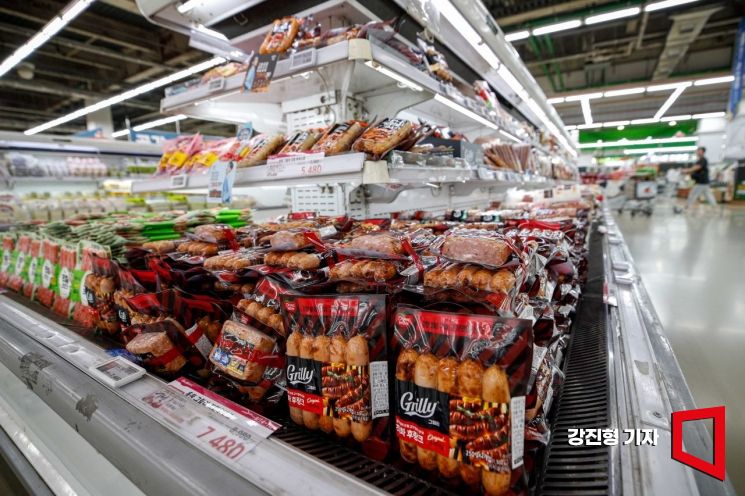 Sausages are displayed on the sales counter at Hanaro Mart Yangjae Branch in Seocho-gu, Seoul. Photo by Jinhyung Kang aymsdream@
© The Asia Business Daily(www.asiae.co.kr). All rights reserved.

















