Denmark Odense Robotics Head
Interview with CEO Søren Elmer Kristensen
Growth from Shipbuilding and Maritime Industry to Robot and Drone City
Startup Fund Created to Promote Cluster Growth
"If we make the industry's needs a common focus, it will greatly help us find a way forward together. I encourage all stakeholders to understand what is important to robot companies and to concentrate on that."
Søren Elmer Kristensen, CEO of Odense Robotics in Denmark, recently stated this in an interview with Asia Economy.
Odense Robotics is a national robotics industry cluster located in Odense, Denmark, a city with a population of 200,000. It operates based on industry-academia cooperation among local governments, companies, and universities. It took its first step 25 years ago when Lindø, a steel shipyard in Odense, began developing robotic applications in collaboration with the University of Southern Denmark. Five years later, the Maersk Mc-Kinney Moller Institute for Advanced Studies in Intelligent Autonomous Systems was established, and the Danish Technological Institute set up a robotics center in Odense, transforming it into a national-level regional cluster.
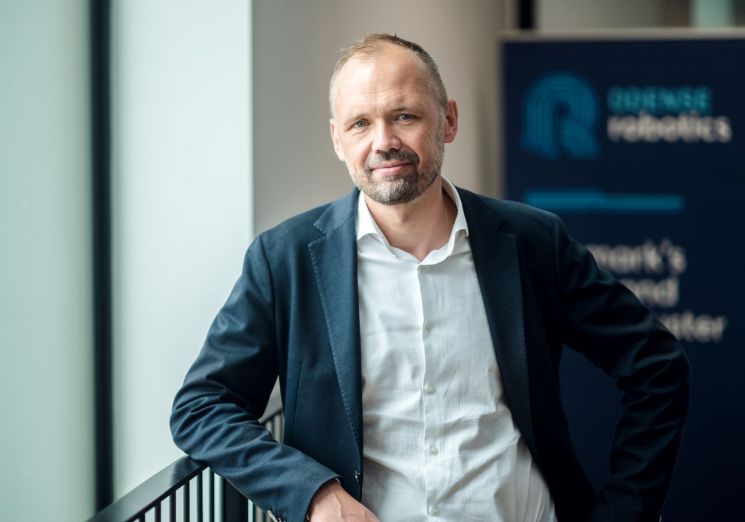 The CEO of Odense Robotics National Cluster in Odense, Denmark, Søren Elmer Kristensen. (Provided by Odense Robotics)
Kristensen, who took office as CEO in May, oversees all operations of Odense Robotics. Previously the project director of the Odense cluster, he also served as head of the Technology Innovation Department at the Faculty of Engineering at the University of Southern Denmark. He began his career in robotics while pursuing his master's degrees at the University of Copenhagen and the Royal Danish Veterinary and Agricultural University. Recently, he visited Korea as part of the official delegation led by the mayor of Odense.
CEO Kristensen said, "The Odense cluster has played a catalytic role in further promoting industry-academia cooperation," adding, "Our role is to connect various points within the ecosystem."
Odense is also famous as the hometown of the fairy tale writer Andersen. Its main industries are shipbuilding and maritime, and it is considered one of Denmark's three largest cities. However, in the 1990s, with the emergence of new shipbuilding powers such as Korea, Odense's shipbuilding industry began to decline, and the city chose robotics as its future growth engine.
Now, 30 years later, one-third of the headquarters of companies specializing in robots, drones, and related fields in Denmark are located on Fyn Island, where Odense is situated. In Denmark, the robotics and drone-related industries recorded sales of 4 billion euros (5.7024 trillion KRW) and exports of 2.1 billion euros (2.9937 trillion KRW) in 2022, a 21% increase compared to the previous year.
The Odense cluster particularly leads in the fields of collaborative robots (cobots) and mobile robots. Well-known robotics companies such as Universal Robots (UR) and MiR, which are also recognized domestically, have their headquarters in Odense. The small port city of Odense now proudly stands shoulder to shoulder with technology cities like Boston (population 650,000), Pittsburgh (300,000), and Munich (1.47 million).
CEO Kristensen emphasized, "We bring together various stakeholders in one place to create synergy and support the development of robotics companies based on that. Odense city and local governments have shown a strong commitment to supporting Denmark's robotics ecosystem."

Furthermore, CEO Kristensen is confident that the cluster can grow further through nurturing startups. For example, the 'Odense Robotics Startup Fund,' established last year, invests in early-stage robotics and drone startups based in Denmark and abroad, providing the latest know-how from leaders in the robotics industry and incubator facilities at the Danish Technological Institute in Odense. He stated, "This foundation was established through donations from the Danish robotics industry, several large corporations, and independent foundations," emphasizing, "The foundation's profits are reinvested into its nonprofit fund. This is a sustainable model that can continuously benefit startup founders, investors, and the entire Danish robotics industry."
© The Asia Business Daily(www.asiae.co.kr). All rights reserved.
![Clutching a Stolen Dior Bag, Saying "I Hate Being Poor but Real"... The Grotesque Con of a "Human Knockoff" [Slate]](https://cwcontent.asiae.co.kr/asiaresize/183/2026021902243444107_1771435474.jpg)












